Gaganyaan Moves Closer to Lift-Off as ISRO Clears Extreme-Condition Parachute Test: Jitendra Singh
New Delhi, December 4: India’s first human spaceflight mission advanced a major step this week after ISRO successfully carried out the Integrated Main Parachute Airdrop Test (IMAT), validating critical safety
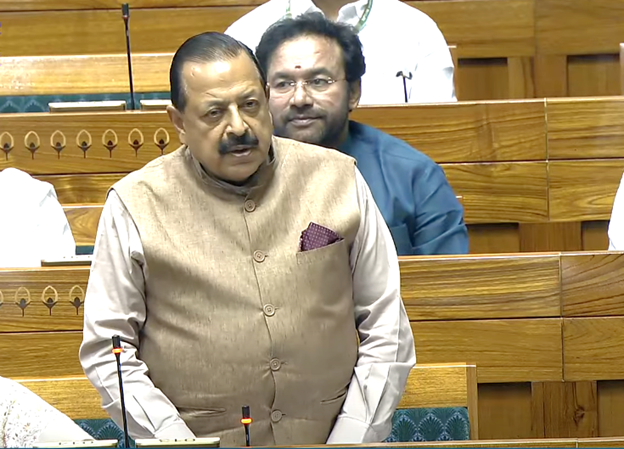
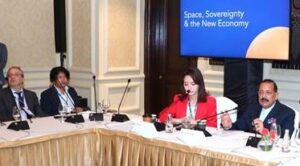
Union Minister of State (independent charge) for Atomic Energy and Space Dr Jitendra Singh

New Delhi, December 4: India’s first human spaceflight mission advanced a major step this week after ISRO successfully carried out the Integrated Main Parachute Airdrop Test (IMAT), validating critical safety mechanisms for the Gaganyaan crew module. Minister of State for Space and Science and Technology Dr Jitendra Singh informed the Lok Sabha that the accomplishment marks an essential milestone in the mission’s human-rating campaign and keeps the country on track for a crewed launch in the first quarter of 2027.
The test simulated one of the toughest descent conditions by deliberately delaying the disreefing sequence between the two main parachutes. According to the minister, the system demonstrated full structural integrity under asymmetric loads, confirming its readiness for future qualification phases. The parachute-based deceleration system is among the most crucial human-rated components of the spacecraft.
Responding to queries on oversight and third-party validation, the minister said ISRO’s systems undergo continuous scrutiny by expert bodies such as the Design Review Team, the Independent Assessment Committee and the National Advisory Panel for Human Rating and Certification. These institutional mechanisms, he said, ensure rigorous evaluation of every safety-critical element.
He added that ISRO has been “consistently disseminating major test outcomes” and will continue to share updates as the programme progresses. The agency has adopted an extensive risk-assessment and mitigation framework aligned with global standards, overseen by the Human Rating Certification Board and the National Advisory Panel.
On astronaut preparedness, the minister said crew safety remains the mission’s highest priority. The training regime includes emergency simulations, off-nominal landing survival procedures, operation of emergency kits and psychological conditioning, with all learnings from tests like IMAT fed back into improved training protocols.
The minister emphasised that every successful milestone enhances mission reliability and strengthens India’s readiness for its first human spaceflight. He said the recent IMAT achievement boosts confidence in meeting the government’s target timeline: “Each test not only validates critical systems but also contributes to the safe execution of Gaganyaan.”