NEET 2026 Crisis Deepens: Paper Leak, Exam Mafia and the Collapse of Trust in India’s Biggest Entrance Test
NTA announces June 21 re-exam after cancellation of NEET-UG 2026; CBI probe uncovers multi-state network involving coaching centres, digital circulation and alleged organised syndicates
What initially appeared to be another isolated allegation of exam irregularity has rapidly evolved into one of the largest education scandals in recent years — exposing what investigators increasingly describe as a sophisticated multi-state examination mafia operating through coaching centres, digital networks, intermediaries and organised cheating syndicates.

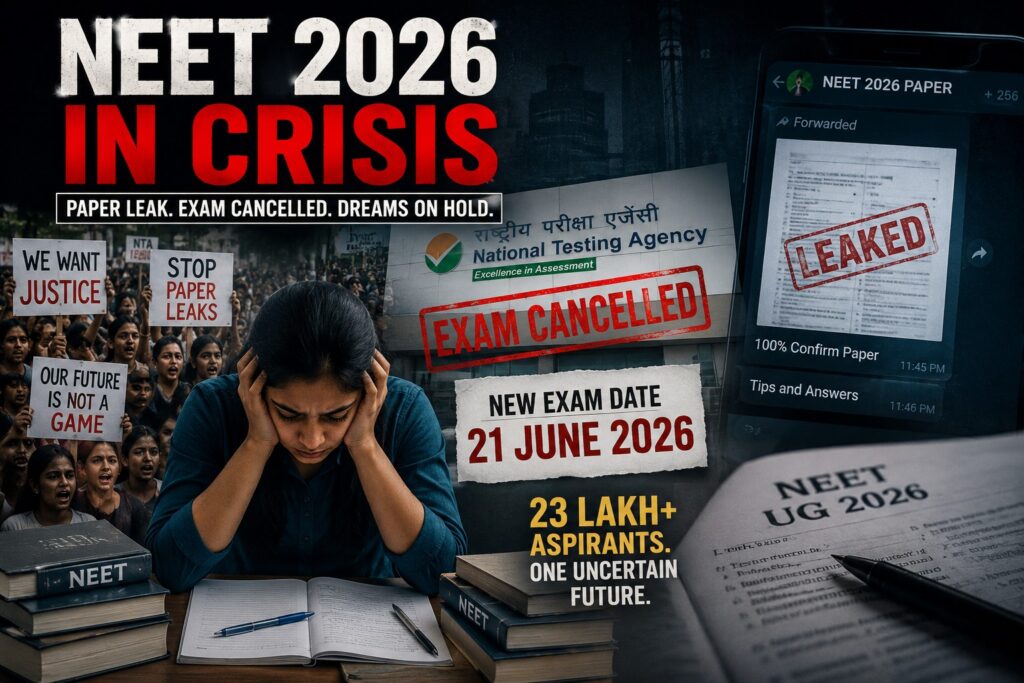
New Delhi: India’s largest and most consequential entrance examination has once again descended into crisis.
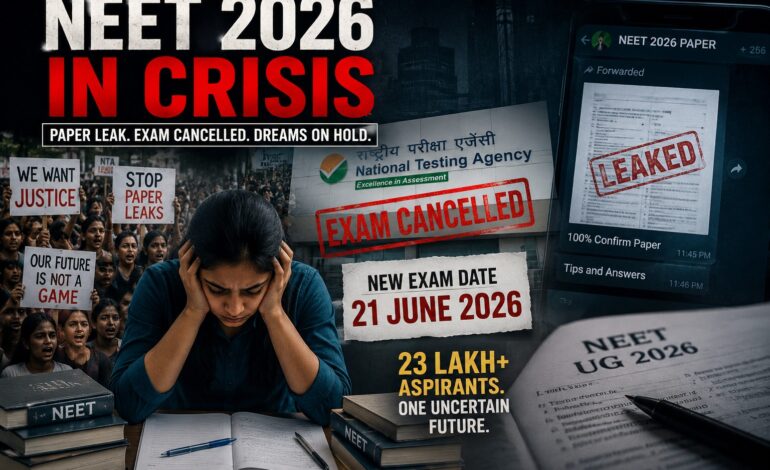
Nearly 23 lakh medical aspirants who appeared for the National Eligibility cum Entrance Test (NEET-UG) 2026 on May 3 now find themselves preparing once again after the National Testing Agency (NTA) officially cancelled the examination amid mounting evidence of a paper leak and announced June 21, 2026 as the fresh examination date.
What initially appeared to be another isolated allegation of exam irregularity has rapidly evolved into one of the largest education scandals in recent years — exposing what investigators increasingly describe as a sophisticated multi-state examination mafia operating through coaching centres, digital networks, intermediaries and organised cheating syndicates.
The controversy has reignited deep national questions about:
- the credibility of India’s high-stakes examination system
- the growing power of coaching ecosystems
- digital vulnerabilities in exam administration
- institutional accountability within NTA
- and the psychological cost imposed on millions of students trapped in hyper-competitive entrance systems.
The Cancellation That Shook India’s Examination System
The crisis escalated after investigators reportedly found that a large number of questions circulating in leaked PDFs and WhatsApp groups matched the actual NEET-UG 2026 paper.
Under mounting pressure from students, opposition parties and judicial scrutiny, the Centre cancelled the May 3 examination and handed over the probe to the Central Bureau of Investigation (CBI).
Today, the NTA formally announced that the NEET-UG 2026 re-examination will now be conducted on June 21 with approval from the Government of India.
The announcement may have ended uncertainty over the exam date, but it has done little to calm anger, anxiety and distrust among students and parents.
For lakhs of aspirants, the cancellation effectively means:
- repeating months of preparation
- extended psychological stress
- disrupted counselling timelines
- delayed admissions
- uncertainty over academic calendars
Many students described the development as “mental trauma,” with frustration amplified by the perception that paper leaks have become a recurring feature of competitive examinations in India.
Anatomy of an Alleged Exam Mafia
The emerging investigation suggests the leak may not have been the work of isolated individuals but part of a coordinated network spanning multiple states.
Investigators have reportedly uncovered links across:
- Rajasthan
- Maharashtra
- Haryana
- Bihar
- Uttarakhand
- Kerala
According to reports, the network involved:
- coaching centre intermediaries
- digital paper circulation
- WhatsApp groups
- Telegram channels
- student handlers
- exam insiders
- middlemen allegedly charging lakhs of rupees for access to leaked material
The CBI has already arrested multiple accused, including students, intermediaries and alleged coordinators.
One of the most disturbing revelations emerging from the probe involves claims that portions of the paper were handwritten, scanned, digitised and circulated through encrypted channels before the examination.
Investigators are reportedly examining:
- mobile phones
- laptops
- WhatsApp chats
- cloud storage systems
- scanner devices
- digital transmission trails
The allegations suggest the operation possessed significant organisational sophistication rather than being a random leak by a single individual.
Coaching Centres Under the Scanner
The scandal has once again drawn scrutiny toward India’s massive coaching industry, particularly in high-pressure examination ecosystems like NEET and JEE.
India’s medical entrance ecosystem has become deeply intertwined with:
- private coaching institutions
- rank-prediction systems
- unofficial test networks
- “guess papers”
- mentoring chains
- performance syndicates
Investigators reportedly suspect that certain coaching-linked networks may have functioned as distribution nodes in the leak ecosystem.
The broader concern is that India’s coaching economy — now worth thousands of crores — has evolved into a parallel education structure operating alongside formal schooling.
For many families:
- coaching determines educational destiny
- rank becomes social mobility
- failure carries devastating emotional and financial consequences
In such a hyper-competitive environment, even small leaks can generate enormous illegal markets.
NTA’s Credibility Crisis
The controversy has severely damaged the credibility of the National Testing Agency.
Originally created to professionalise and centralise India’s entrance examination ecosystem, NTA was expected to reduce irregularities through:
- standardisation
- digital systems
- biometric verification
- centralised testing frameworks
Instead, repeated controversies over recent years involving:
- paper leaks
- technical failures
- grace marks
- power outages
- biometric mismatches
- logistical irregularities
have steadily eroded public trust.
The NEET 2026 cancellation may now become a defining institutional crisis for the agency.
The fact that an examination affecting nearly 23 lakh students had to be entirely cancelled after completion raises serious questions about:
- exam paper security architecture
- transportation protocols
- digital surveillance systems
- insider vulnerabilities
- contractor oversight
- cybersecurity preparedness
The Human Cost Behind the Headlines
Lost amid the political outrage and investigative drama is the enormous human cost imposed on students.
For lakhs of aspirants, NEET preparation involves:
- years of study
- family financial sacrifice
- social pressure
- mental health strain
- isolation
- repeated attempts
Many students spend:
- 12–16 hours daily preparing
- multiple years in coaching programmes
- large family savings on preparation
The cancellation effectively punishes both:
- those allegedly involved in malpractice
and - genuinely hardworking candidates
This collective punishment dynamic has intensified student anger nationwide.
The re-exam announcement may restore procedural continuity, but it cannot easily restore emotional trust.
A Systemic Problem, Not an Isolated Leak
The deeper problem may not be NEET itself.
It may be the structure of India’s examination ecosystem.
High-stakes centralised exams involving millions of candidates create:
- enormous financial incentives for cheating networks
- black-market demand
- coaching-industrial dependencies
- corruption vulnerabilities
As long as a single examination determines the future of millions, organised leak syndicates are likely to remain incentivised.
Experts increasingly argue that India’s examination architecture itself may require structural reform, including:
- multi-stage assessments
- decentralised evaluation systems
- reduced overdependence on one-day testing
- stronger digital security infrastructure
- AI-based anomaly detection
- encrypted distribution systems
- stricter coaching regulation
The Political Fallout
The scandal has also triggered intense political confrontation.
Opposition parties have accused the government of failing to secure the examination system, while demands are growing for:
- NTA restructuring
- accountability fixation
- parliamentary scrutiny
- judicial monitoring
- examination reforms
Meanwhile, the government has attempted to project swift action through:
- cancellation of the examination
- CBI investigation
- arrests
- re-exam scheduling
But the larger credibility crisis may persist well beyond the June 21 re-examination.
Beyond NEET: The Future of India’s Meritocracy
At its core, the NEET controversy touches one of the most sensitive aspects of modern India:
faith in merit-based mobility.
For millions of middle-class and lower-income families, examinations represent the most legitimate path to:
- professional advancement
- social mobility
- economic security
When examination systems themselves appear compromised, the consequences extend far beyond academics.
They begin to erode trust in the fairness of the state itself.
That may ultimately become the most dangerous consequence of the NEET 2026 paper leak scandal:
not merely a leaked question paper — but a growing public perception that India’s competitive examination ecosystem is increasingly vulnerable to manipulation by money, networks and organised syndicates.