SMAM powers India’s farm mechanisation drive: Over 21.6 lakh machines distributed, drone farming gains momentum
Implemented under the Rashtriya Krishi Vikas Yojana (RKVY), SMAM aims to bridge the mechanisation gap by promoting affordable access to farm machinery through financial assistance, rental services and institutional infrastructure.
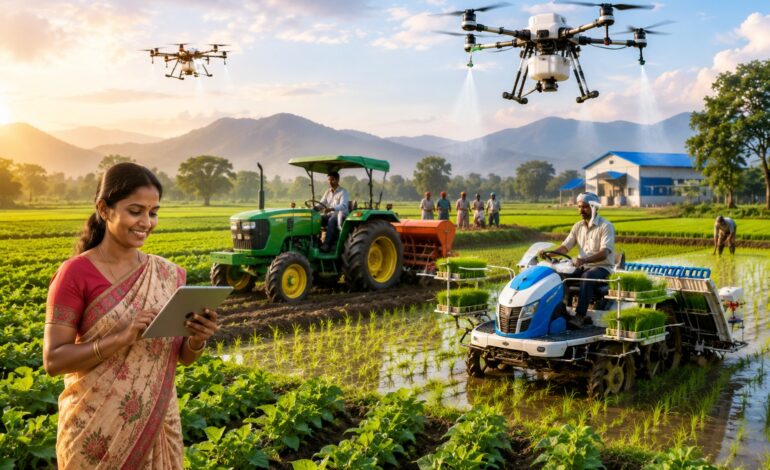
Farm mechanisation has emerged as a key pillar of India's strategy to improve agricultural productivity by reducing dependence on manual labour and enabling timely farm operations across the crop cycle—from land preparation and sowing to harvesting and post-harvest management.

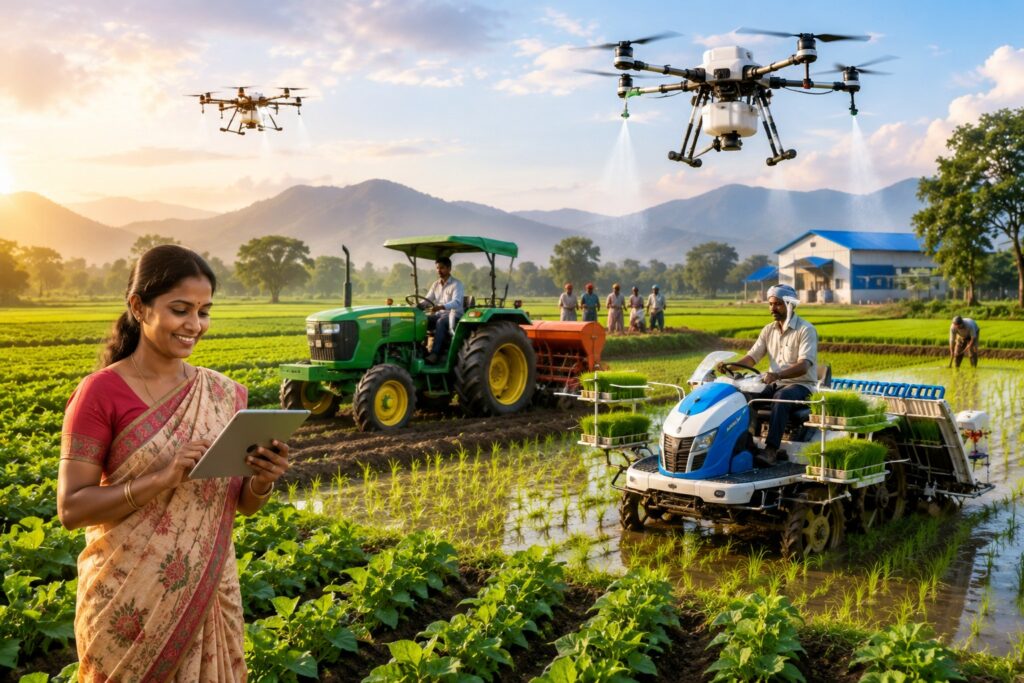
New Delhi: India’s agricultural mechanisation programme has achieved significant milestones under the Sub-Mission on Agricultural Mechanization (SMAM), with more than 21.61 lakh agricultural machines distributed to farmers and 40,928 drone demonstrations conducted across the country, strengthening productivity, precision farming and inclusive access to modern agricultural technologies.
According to a statement released by the Ministry of Agriculture and Farmers Welfare on Thursday, the Centrally Sponsored Scheme has received ₹9,404.47 crore in central assistance since its launch in 2014-15, making farm mechanisation more accessible to small and marginal farmers, women, Scheduled Castes (SCs), Scheduled Tribes (STs), Farmer Producer Organisations (FPOs) and rural entrepreneurs.
Mechanisation Driving Agricultural Productivity
Farm mechanisation has emerged as a key pillar of India’s strategy to improve agricultural productivity by reducing dependence on manual labour and enabling timely farm operations across the crop cycle—from land preparation and sowing to harvesting and post-harvest management.
Implemented under the Rashtriya Krishi Vikas Yojana (RKVY), SMAM aims to bridge the mechanisation gap by promoting affordable access to farm machinery through financial assistance, rental services and institutional infrastructure. Special emphasis has been placed on North-Eastern States and other underserved regions to reduce regional disparities in access to agricultural technology.
Expanding Access Through Custom Hiring Centres
Recognising that small landholdings often make individual ownership of expensive machinery uneconomical, the scheme has promoted shared mechanisation through Custom Hiring Centres (CHCs) and Farm Machinery Banks (FMBs).
Since inception, SMAM has supported the establishment of:
- 27,554 Custom Hiring Centres
- 25,608 Farm Machinery Banks
- 646 Hi-Tech Equipment Hubs
These facilities enable farmers to rent modern agricultural equipment at affordable rates while improving operational efficiency and reducing production costs.
Financial Support for Farmers
The scheme provides financial assistance through the Direct Benefit Transfer (DBT) system.
Eligible beneficiaries receive:
- 40% subsidy on machinery cost for general category farmers.
- 50% subsidy for SC/ST farmers, women farmers, small and marginal farmers, and beneficiaries in North-Eastern States.
- Small and marginal farmers can also receive ₹2,000 per hectare for mechanised services, including drone-based operations, through CHCs, SHGs and FPOs.
The Centre and States jointly fund the programme in a 60:40 ratio for most states, 90:10 for North-Eastern and Himalayan states, and 100% Central funding for Union Territories.
Drone-Based Precision Farming Gains Momentum
One of the fastest-growing components of SMAM is the adoption of agricultural drones.
With financial support of ₹52.5 crore, the Indian Council of Agricultural Research (ICAR) has conducted 40,928 Kisan Drone demonstrations covering 40,918 hectares during 2023-24 to 2025-26.
The demonstrations focused on precision application of fertilisers, nutrients and crop protection chemicals using drones, showcasing the potential of precision agriculture in improving efficiency and reducing input costs.
To accelerate adoption, the scheme provides:
- Up to ₹10 lakh per drone for ICAR institutes, Krishi Vigyan Kendras (KVKs) and State Agricultural Universities.
- Up to 75% grant support for Farmer Producer Organisations.
- Financial assistance for drone service providers through operational support.
Inclusive Growth at the Core
SMAM places strong emphasis on equitable access to mechanisation.
The scheme earmarks 30% of its total allocation for women farmers, while offering enhanced financial support for disadvantaged groups and region-specific interventions in North-Eastern India, including up to 100% subsidy for certain categories of agricultural machinery.
Sub-Mission on Agricultural Mechanization (SMAM): Key Highlights
- Launched in 2014-15 under the Rashtriya Krishi Vikas Yojana (RKVY).
- ₹9,404.47 crore central assistance released since inception.
- Over 21.61 lakh agricultural machines distributed to individual farmers.
- 27,554 Custom Hiring Centres, 25,608 Farm Machinery Banks and 646 Hi-Tech Equipment Hubs established.
- 40,928 drone demonstrations conducted across 40,918 hectares with ₹52.5 crore support.
- Subsidies of up to 50% for small and marginal farmers, women, SC/ST beneficiaries and North-Eastern States.
- 30% of scheme funds earmarked for women farmers.
- Promotes precision farming, shared mechanisation and affordable access to modern agricultural technology.
Modernising Indian Agriculture
The programme also supports training, equipment testing, certification, awareness campaigns and post-harvest mechanisation, while encouraging adoption of advanced technologies through Hi-Tech Equipment Hubs and institutional capacity building.
With increasing deployment of precision farming tools, drones and shared mechanisation infrastructure, SMAM is emerging as a key enabler of India’s transition towards technology-driven, sustainable and efficient agriculture.
The Sub-Mission on Agricultural Mechanization reflects India’s broader effort to digitise and modernise agriculture by combining mechanisation, precision farming and institutional innovation. While tractors and harvesters continue to improve productivity, the rapid integration of drones, shared equipment platforms and targeted subsidies is helping democratise access to advanced technologies for small and marginal farmers. As agriculture increasingly embraces automation and digital tools, SMAM is laying the foundation for a more productive, climate-resilient and technology-enabled rural economy.