NITI Aayog Releases ‘Trade Watch Quarterly’; Services Exports Anchor India’s Trade Resilience
The report estimates the global market size (excluding raw gold) at around $378 billion in 2024, with India accounting for exports worth $29.5 billion, representing a 7.8% global share. New
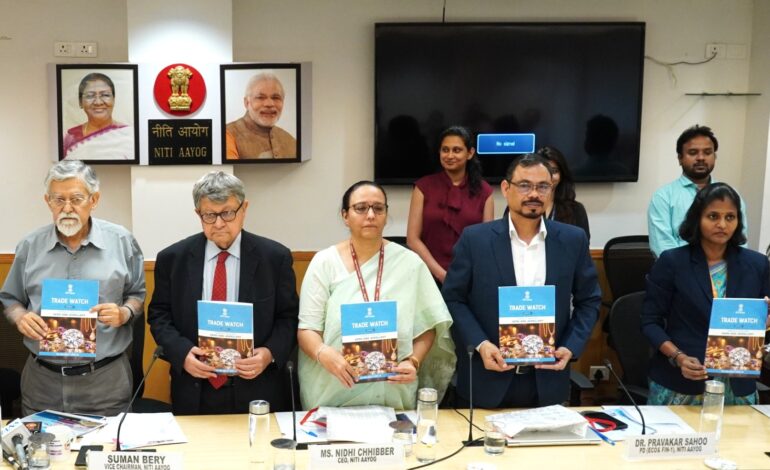
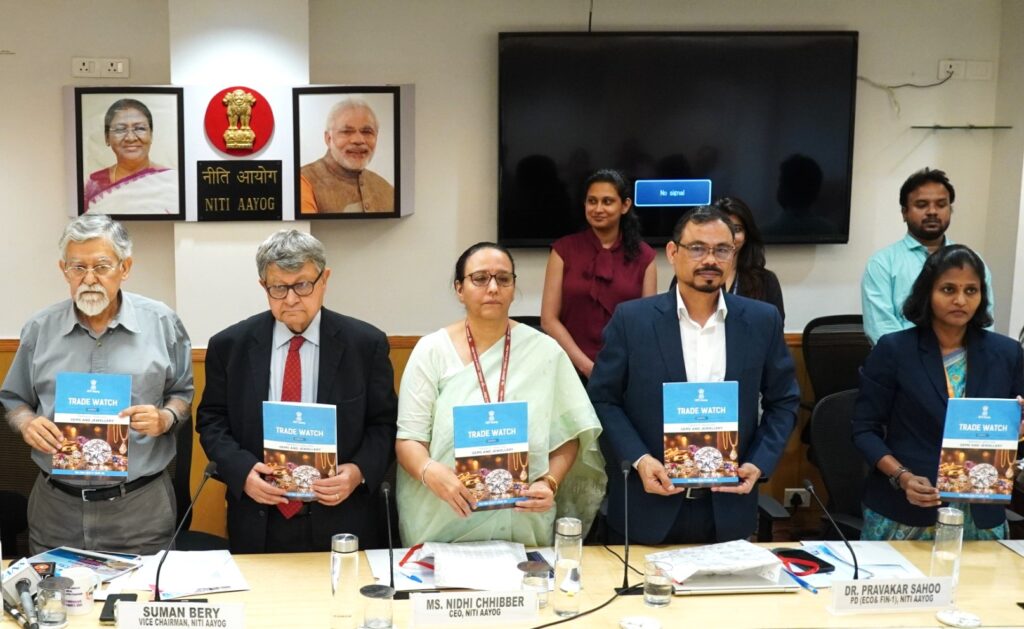
Suman Bery, Vice-Chairman, NITI Aayog, releases the latest edition of the Trade Watch Quarterly (Q3 FY26, October–December 2025) in New Delhi on April 20, 2026, in the presence of Arvind Virmani, Member, NITI Aayog, and senior officials in New Delhi on Monday.

The report estimates the global market size (excluding raw gold) at around $378 billion in 2024, with India accounting for exports worth $29.5 billion, representing a 7.8% global share.
New Delhi: NITI Aayog on Monday released the seventh edition of its flagship Trade Watch Quarterly, highlighting resilient global trade trends and India’s evolving export landscape despite macroeconomic and geopolitical uncertainties.
The report for Q3 FY26 (October–December 2025) was released by vice-chairman Suman Bery in the presence of member Arvind Virmani and senior officials.
The publication presents a mixed but stable picture of India’s trade performance during the quarter. Merchandise exports recorded a modest growth of 1.6%, while imports grew faster at 7.9%. In contrast, services exports expanded strongly by 7.8%, maintaining a surplus that continued to support the country’s overall external balance.
A key highlight of this edition is its thematic focus on India’s gems and jewellery sector, a major contributor to labour-intensive manufacturing and exports. The report estimates the global market size (excluding raw gold) at around $378 billion in 2024, with India accounting for exports worth $29.5 billion, representing a 7.8% global share.
India’s strength in the sector remains concentrated in diamonds and precious metal jewellery, which together account for over half of global demand. The country exported $26.7 billion in these segments, driven by value addition in imported raw materials. Surat continues to serve as the world’s largest hub for diamond cutting and polishing.
The report notes that India’s export structure is highly concentrated, with major markets including the United States, UAE and Hong Kong, while imports are dependent on a limited set of suppliers for raw materials.
Despite strong positioning, the sector faces several structural challenges such as limited value addition due to a fragmented MSME base, dependence on imported inputs, credit constraints, and skill and design gaps. The report calls for a strategic push towards diversification, improved access to finance, technology adoption, and stronger integration into global value chains.
Speaking at the release, Bery said that as global trade undergoes structural shifts, India must diversify its export base while strengthening domestic capabilities in key sectors to sustain growth and resilience.
Virmani emphasised the need for targeted sectoral interventions and deeper integration into global value chains to maintain export momentum and generate quality employment.
The report is expected to serve as a key reference for policymakers, industry stakeholders and researchers, offering data-driven insights and policy recommendations to enhance India’s trade competitiveness in a rapidly evolving global environment.