From Coastal Palms to Himalayan Orchards: The High-Value Crops Quietly Transforming India’s Farm Economy
370.74 MT Horticulture output 2024-25 37% Share of agri gross value output 30 million Livelihoods from coconut alone 150M Agarwood trees in India New Delhi: India’s agriculture sector has grown
India's agriculture sector has grown at 4.45 percent over the past decade — its fastest pace in modern history — and the driving force behind that number is not rice or wheat. It is horticulture.

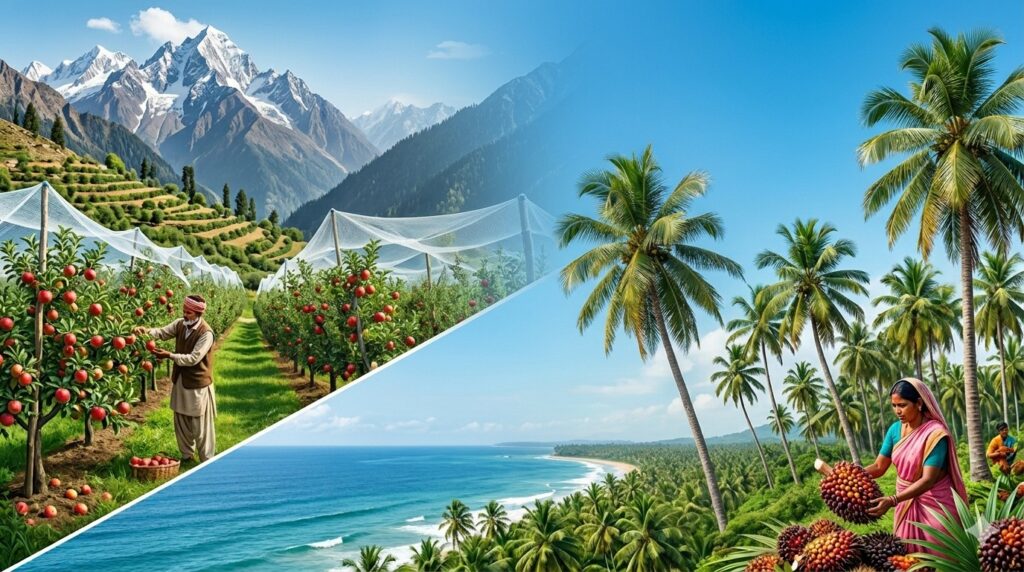
New Delhi: India’s agriculture sector has grown at 4.45 percent over the past decade – its fastest pace in modern history – and the driving force behind that number is not rice or wheat. It is horticulture. Fruits, vegetables, flowers, spices, and plantation crops now account for 37 percent of the gross value output of Indian agriculture, and the Union Budget 2026-27 has placed this sector at the centre of a sweeping, geographically differentiated strategy to raise farm incomes and build new export franchises for India.
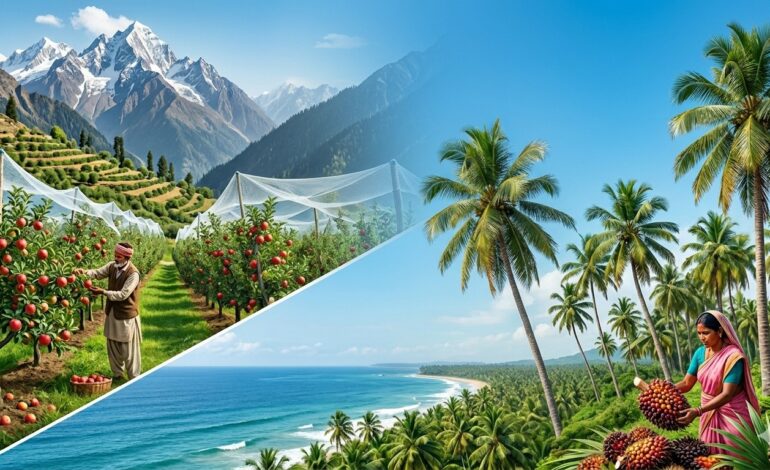
The strategy is deliberately regional. Rather than applying a uniform national policy, the budget proposes tailoring crop interventions to the agro-climatic realities of three distinct zones: coastal India gets coconut, cashew, cocoa, and sandalwood; the North-East gets agarwood; and the Himalayan hilly belt gets walnuts, almonds, and pine nuts. It is a recognition that India’s agricultural advantage is not homogeneous — and that unlocking it requires working with geography, not against it.
The coconut economy: from ₹25 crore to ₹4,349 crore in two decades
No crop better illustrates the transformation potential of India’s horticulture push than coconut. In 2001-02, India’s coconut and coconut-product exports stood at just ₹25.3 crore — a negligible figure for the world’s second-largest coconut producer. By 2024-25, that number had reached ₹4,349 crore (USD 513 million), a 25 percent jump over the previous year alone, driven by surging global appetite for virgin coconut oil, coconut water, and coconut milk.
The sector now supports the livelihoods of 30 million people, including nearly 10 million farmers, across 22 states and union territories. Kerala holds the largest cultivated area at 7.54 lakh hectares, Tamil Nadu leads in total production, and Andhra Pradesh achieves the highest productivity per hectare. The budget has proposed a new Coconut Promotion Scheme — focusing on replacing ageing, low-yielding trees with improved saplings — to sustain this momentum.
Horticulture is not peripheral to India’s agricultural growth story. It is pivotal, the Union Ministry of Agriculture & Farmers Welfare said in a statement on Sunday.
Cashew and cocoa: building premium global brands by 2030
India’s cashew cultivation spans 12.05 lakh hectares and produces over 8.02 lakh tonnes annually. In 2024-25, cashew exports totalled USD 369.17 million, with the UAE, Vietnam, Japan, the Netherlands, and Saudi Arabia as the leading destinations. Cocoa, grown primarily as an intercrop under coconut and arecanut canopies in Andhra Pradesh, Kerala, Karnataka, and Tamil Nadu, generated USD 295.58 million in exports during the same period.
The budget proposes a dedicated programme to make India self-reliant in raw cashew and cocoa production and processing — with the explicit ambition of positioning “Indian Cashew” and “Indian Cocoa” as premium global brands by 2030. The Directorate of Cashewnut and Cocoa Development, headquartered in Kochi, will continue to anchor this effort through replanting programmes, nursery modernisation, and training women beneficiaries in value addition.
Cashew — the “Gold Mine of Wasteland”: Introduced to India in the 16th century, cashew is drought-tolerant, thrives in poor soils, and actively reduces erosion — making it one of the few crops that can turn degraded and marginal land into economically productive terrain.
Agarwood: the North-East’s ₹2,000 crore opportunity
Of India’s estimated 150 million agarwood trees, 90 percent grow in the North-Eastern states — an extraordinary concentration of one of the world’s most valuable aromatic resources. Known internationally as oud, agarwood resin commands premium prices in luxury perfumery, traditional medicine, and religious practice. In Tripura alone, the annual turnover potential of the agarwood market is estimated at around ₹2,000 crore.
A strategic roadmap approved in 2024 focuses on sustainable cultivation, processing, and export. Annual export quotas under CITES have been set at 151,080 kg for agarwood chips and 7,050 kg for agarwood oil — and export applications have been integrated into the DGFT portal to streamline regulatory processes. The budget proposes expanding cultivation and strengthening processing capacity across Assam and Tripura, supported by geospatial mapping to identify optimal plantation zones.
Walnuts, almonds, and the Chilgoza pine of Kinnaur
In India’s Himalayan belt, the budget turns its attention to three nut crops with growing export profiles. Walnut production reached 3.22 lakh tonnes in 2024-25, with Jammu & Kashmir accounting for the dominant share. Exports of USD 7.80 million reached markets across the UAE, Turkey, Iraq, Singapore, and beyond. Almond production stood at 13.94 thousand metric tonnes, with J&K accounting for over 83 percent of national output.
The most culturally distinctive crop in this category is Chilgoza — the pine nut harvested from the inner arid valleys of the north-western Himalayas. Often called the “Champion of the Rocky Mountains,” Chilgoza is a primary livelihood source for tribal communities in Kinnaur district, Himachal Pradesh. The budget proposes a dedicated programme for high-density walnut, almond, and pine nut cultivation, paired with orchard rejuvenation schemes and value-addition opportunities for rural youth.
Sandalwood: Over 90 percent of India’s sandalwood resources are concentrated in Karnataka and Tamil Nadu. Globally prized for its premium essential oil used in perfumery and religious practice, Indian sandalwood commands higher prices than varieties from other countries. The budget has proposed promoting focused cultivation and strengthening post-harvest processing of this high-value cultural crop.
The bigger picture: horticulture as India’s agricultural future
Horticulture output has grown from 277.35 million tonnes in 2013-14 to 370.74 million tonnes in 2024-25 — a near-34 percent increase over a decade. India now ranks second globally in vegetable, fruit, and potato production, and is the world’s largest producer of onions and shallots, with a 22.42 percent share of global output. Fruits account for 9.18 percent and vegetables for 8.18 percent of global production.
The Union Budget 2026-27’s crop diversification strategy is, in essence, a bet that India’s next agricultural decade will be defined not by volume of staple output but by the value of what its farmers grow — and where they sell it. From coconut oil in Dutch supermarkets to oud in Gulf perfumeries to walnuts in Nigerian markets, the ambition is clear: India’s farms should reach every corner of the global value chain.