India Overhauls Wholesale Inflation Framework, Shifts Towards Global Producer Price Standards
WPI Base Year Updated After More Than a Decade; New Producer Price Indices to Debut on June 15
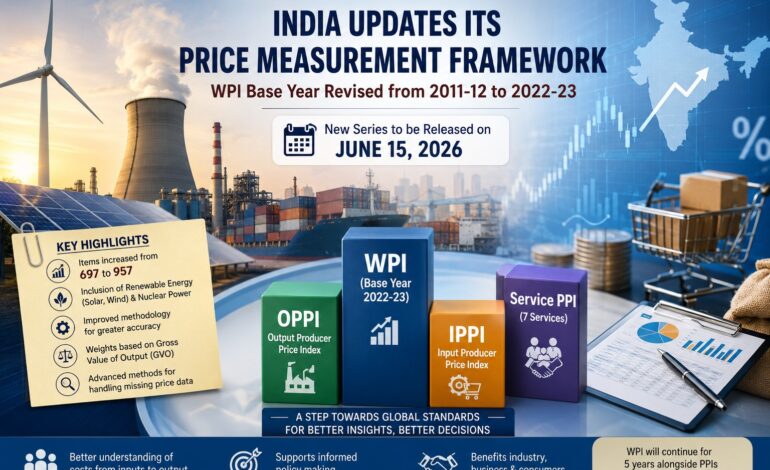
The revised WPI series and the new PPI framework will be released on June 15 by the Office of Economic Adviser under the Department for Promotion of Industry and Internal Trade (DPIIT), marking a major shift in how wholesale and producer-level inflation are measured in India.

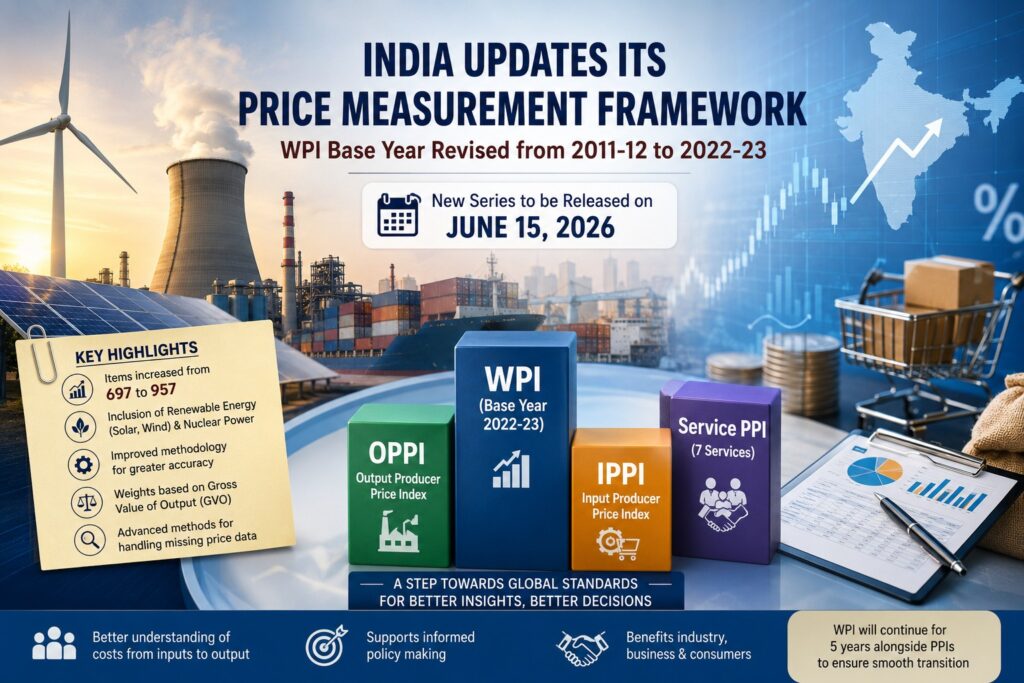
New Delhi: India is set to undertake one of the most significant reforms in its price measurement framework in over a decade, with the government approving the revision of the Wholesale Price Index (WPI) base year from 2011-12 to 2022-23 and introducing a new generation of Producer Price Indices (PPIs) aligned with global statistical practices.
The revised WPI series and the new PPI framework will be released on June 15 by the Office of Economic Adviser under the Department for Promotion of Industry and Internal Trade (DPIIT), marking a major shift in how wholesale and producer-level inflation are measured in India.
The move follows approval by the competent authority and recommendations from the Technical Advisory Committee on Statistics of Price and Cost of Living as well as the National Statistical Commission.
A Transition from Wholesale Prices to Producer Prices
The reform signals India’s gradual transition from the traditional Wholesale Price Index towards the internationally accepted Producer Price Index framework.
Beginning June 15, the government will publish:
- Revised WPI with base year 2022-23
- Output Producer Price Index (OPPI)
- Trial Input Producer Price Index (IPPI)
- Service Producer Price Index (Service PPI)
The service-sector index will initially cover seven major services — banking, securities transactions, insurance, pension fund management, railways, air passenger transport and telecom.
Officials said WPI will continue to be published alongside PPIs for five years to allow businesses, government agencies and contract holders sufficient time to migrate to the new framework. Thereafter, WPI is expected to be phased out.
Why the Change Matters
WPI has long served as India’s primary wholesale inflation indicator and is widely used in price-escalation clauses across infrastructure, construction and industrial contracts.
However, economists have increasingly argued that Producer Price Indices provide a more accurate picture of inflation faced by producers because they separately capture input costs and output prices.
The new framework will allow policymakers and businesses to better understand how increases in input costs are transmitted into finished goods and services.
The transition also aligns India with practices followed by advanced economies and recommendations from the International Monetary Fund (IMF).
Expanded Basket Reflects New Economy
One of the most notable features of the revised WPI is the significant expansion in coverage.
The number of commodities included in the index has increased from 697 to 957, providing broader representation of India’s evolving production landscape.
For the first time, renewable energy sources such as solar and wind power have been included under the electricity category. Nuclear electricity has also been added to the basket, reflecting the growing role of clean and diversified energy sources in the economy.
The government has also reorganized energy-related commodities by moving crude petroleum and natural gas from the “Primary Articles” category to the “Fuel and Power” group, creating a more coherent structure for tracking energy price movements.
Methodology Gets a Major Upgrade
The revised series introduces several methodological improvements.
Unlike the 2011-12 series, which used net traded value-based weights, the new WPI uses Gross Value of Output (GVO) to determine commodity weights. Officials say this better reflects the economic significance of domestic production from the producer’s perspective.
The government has also adopted:
- Chain-based short-term index formulation
- Targeted Mean Imputation for missing prices
- New linking factors to facilitate comparison between old and new series
These changes are expected to improve the accuracy, responsiveness and reliability of inflation measurement.
New Data Series to Offer Deeper Insights
The revised WPI and Output PPI will be released monthly, with historical data available from April 2023 onward.
The Trial Input PPI for manufacturing will initially be published on an experimental basis from March 2026 to allow stakeholders to assess data quality and provide feedback. Service PPIs will be released quarterly, beginning with data for the fourth quarter of FY26.
Implications for Industry and Policymakers
The new framework is expected to improve inflation tracking across sectors ranging from manufacturing and infrastructure to services and energy.
For policymakers, the indices will provide a more nuanced understanding of supply-chain pressures and producer costs. For businesses, they offer a better benchmark for contract pricing, cost escalation and investment decisions.
About the Reform
Most importantly, the inclusion of renewable energy, expanded commodity coverage and service-sector inflation indicators reflects the changing structure of the Indian economy, making the country’s inflation measurement system more relevant to current economic realities.
The revised WPI (base year 2022-23), Output PPI, Input PPI and Service PPI series will be officially launched on June 15, 2026, replacing India’s existing wholesale inflation framework that has been in use since 2011-12.