Odisha’s rise signals India’s new investment geography as NITI Aayog index redraws state rankings
While Gujarat, Maharashtra and Tamil Nadu retained their leadership, Odisha's entry into the country's top five marks one of the most significant shifts in India's investment landscape, suggesting that policy
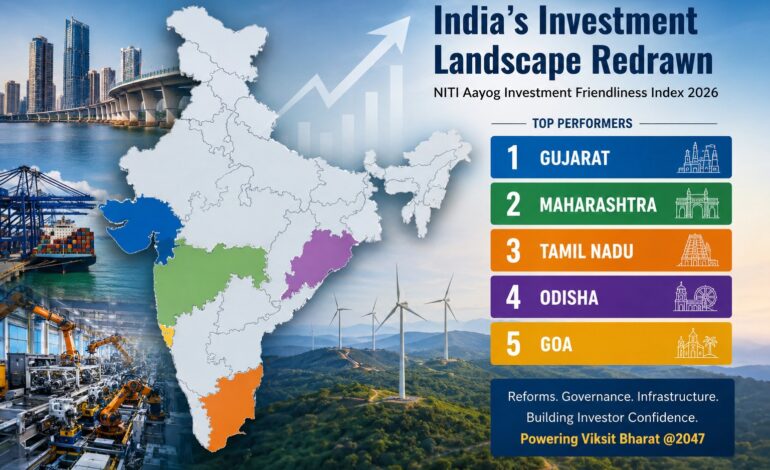
If Gujarat represents the benchmark and Maharashtra and Tamil Nadu demonstrate the value of long-term industrial ecosystems, Odisha's rise shows that perceptions can change faster than many expected.

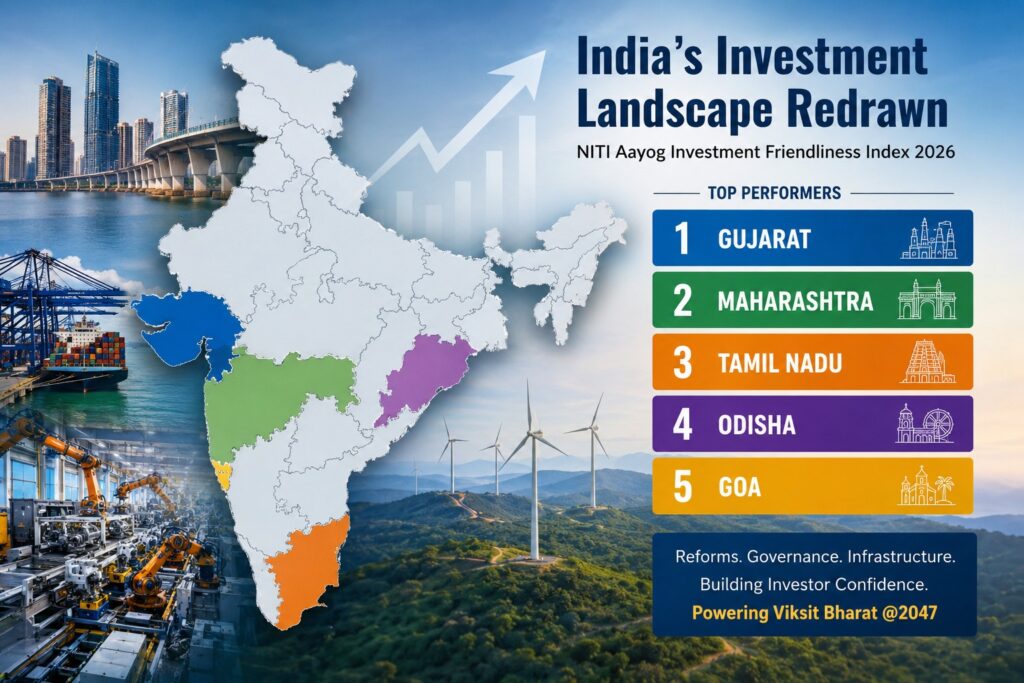
For decades, India’s investment map appeared almost settled. Gujarat symbolised industrial entrepreneurship, Maharashtra remained the country’s financial powerhouse, Tamil Nadu dominated manufacturing, Karnataka attracted technology investments, and states such as Odisha were largely viewed through the prism of mining and natural resources rather than as diversified investment destinations.
The first-ever Investment Friendliness Index released by NITI Aayog suggests that this map may be changing.
While Gujarat, Maharashtra and Tamil Nadu continue to dominate the rankings, the biggest story is arguably Odisha’s emergence among the country’s five most investment-friendly states—a development that reflects the growing importance of governance, infrastructure and policy execution over historical perceptions.
The Index is not a measure of investment received alone. Instead, it evaluates how prepared states are to attract future investments through 84 indicators covering infrastructure, business climate, regulatory ease, institutional quality, government policy, financial health, resources and environmental resilience.
That distinction makes the rankings more meaningful than traditional investment statistics.
Gujarat securing the top position comes as little surprise. Over two decades, the state has built an ecosystem where industrial parks, logistics infrastructure, ports, power availability and administrative efficiency reinforce one another. Rather than relying on incentives alone, Gujarat has institutionalised ease of doing business, making investment facilitation a permanent feature of governance.
Maharashtra’s second position reflects its unmatched economic scale. Mumbai continues to anchor India’s financial markets, while Pune, Nashik, Nagpur and other industrial corridors provide manufacturing depth. The state’s challenge has never been attracting investors but sustaining infrastructure capable of supporting rapid economic expansion.
Also Read: NITI Aayog launches India’s first Investment Friendliness Index; Gujarat tops, followed by Maharashtra and Tamil Nadu
Tamil Nadu, ranked third, demonstrates the strength of manufacturing-led development. The state has consistently positioned itself as India’s preferred destination for automobiles, electronics, aerospace and advanced manufacturing by combining industrial policy with skilled human resources and a mature supplier ecosystem.
The surprise begins with Odisha.
Historically, investors associated Odisha primarily with minerals, steel and heavy industries. Despite abundant natural resources, the state rarely featured among India’s preferred destinations for diversified private investment. Administrative bottlenecks, disaster vulnerability and infrastructure gaps often overshadowed its strengths.
The latest index suggests that perception is changing.
Odisha’s fourth-place ranking indicates that investors increasingly recognise improvements in governance, infrastructure and institutional responsiveness. The state has accelerated industrial corridor development, expanded port-linked infrastructure, strengthened single-window clearances and aggressively positioned itself for manufacturing and logistics investments. These reforms have coincided with the state’s political transition after the 2024 Assembly elections, when the BJP formed the government after nearly 24 years of Biju Janata Dal rule. While the Index does not attribute Odisha’s performance to any specific government, it suggests that recent reforms are being noticed by the investment community.
Goa’s presence among the top performers may appear unexpected until one considers the methodology. The Index measures institutional quality and investment readiness rather than economic size. For a compact state with efficient administration, high-quality infrastructure and relatively streamlined governance, securing a leading position is consistent with the framework adopted by NITI Aayog.
Beyond the top five, the broader picture is equally important.
Fifteen states have been classified as “Frontrunners,” indicating that the gap separating them from the leaders may be narrower than commonly assumed. These states possess strong foundations but need improvements in specific areas such as regulatory efficiency, financial management or institutional capacity to move into the top category.
The “Emerging Performers” represent perhaps the greatest opportunity. Many of these states have begun improving infrastructure and policy frameworks but continue to face structural constraints. If reforms continue, several could emerge as the next generation of investment destinations over the coming decade.
The “Aspiring States” category should not necessarily be viewed as a list of laggards. Rather, it highlights jurisdictions where deeper institutional reforms, better infrastructure, more predictable regulations and stronger governance mechanisms remain essential before they can compete effectively for large-scale investments.
Another noteworthy feature of the report is its peer-group methodology. Instead of comparing every state with vastly different geographies and economic realities, NITI Aayog evaluates Large States, Hilly and North-Eastern States, and Union Territories separately, making comparisons more meaningful and policy recommendations more practical.
Perhaps the most important contribution of the Investment Friendliness Index is that it shifts the national conversation away from simply measuring investment inflows towards evaluating investment readiness. Capital follows confidence, and confidence increasingly depends on governance quality rather than tax incentives alone.
For policymakers, the message is clear. Investors today evaluate the complete ecosystem – from land availability and infrastructure to institutional efficiency and policy stability. States that continuously improve these fundamentals are likely to attract investment irrespective of historical reputation.
If Gujarat represents the benchmark and Maharashtra and Tamil Nadu demonstrate the value of long-term industrial ecosystems, Odisha’s rise shows that perceptions can change faster than many expected. In India’s journey towards Viksit Bharat, the next generation of investment champions may well emerge from states that were once considered outsiders to the country’s industrial story.