Skyroot’s Vikram-1 enters orbit, opening a new chapter in India’s private space journey
India's first privately developed orbital rocket has successfully reached Low Earth Orbit, validating years of space-sector reforms and positioning Hyderabad-based Skyroot Aerospace among the world's pioneering private launch companies.
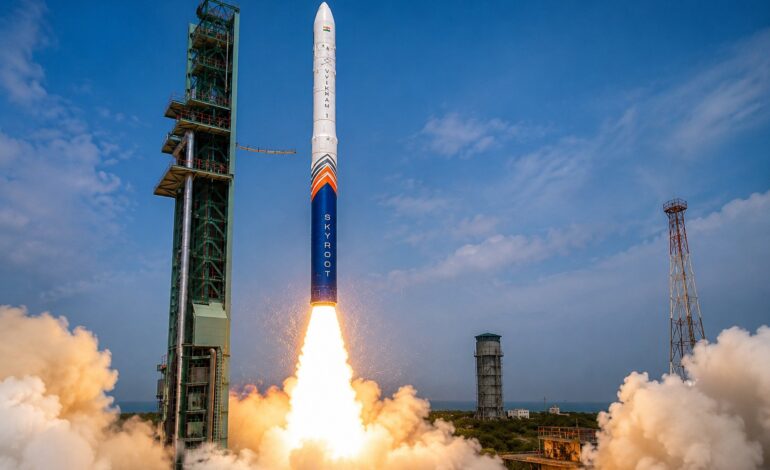
The maiden mission, christened Mission Aagaman, lifted off from the Satish Dhawan Space Centre at Sriharikota after a brief countdown hold and successfully deployed multiple customer payloads into a 450-km orbit, validating the rocket's propulsion, navigation, avionics and stage-separation systems during its first orbital flight.

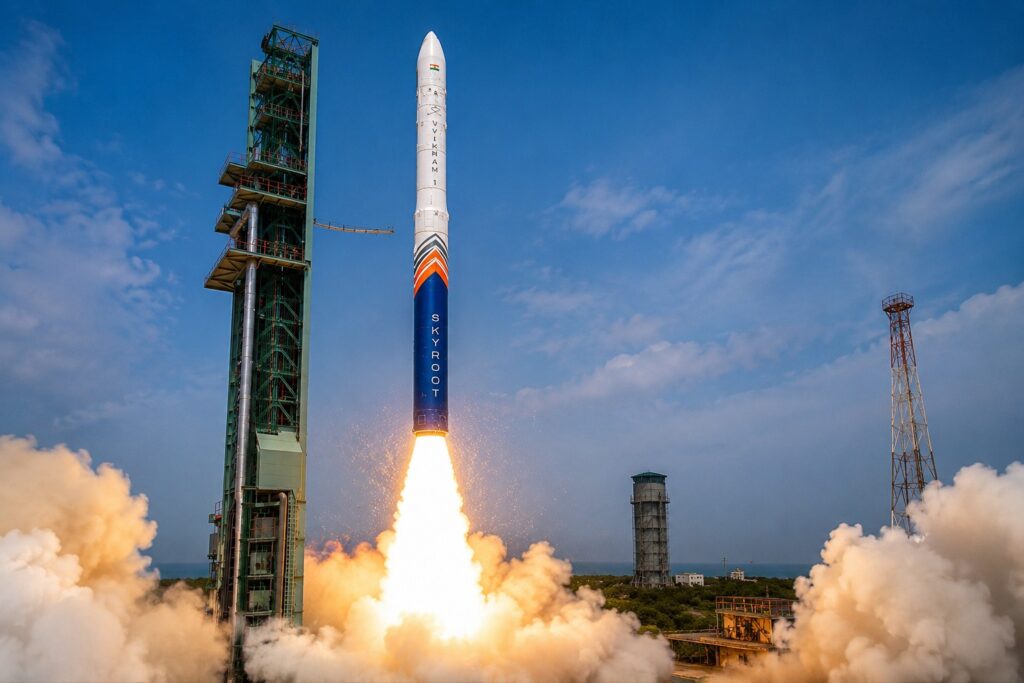
HYDERABAD/NEW DELHI: India scripted a historic milestone in its space journey on Saturday as Hyderabad-based Skyroot Aerospace successfully launched and placed its Vikram-1 orbital launch vehicle into Low Earth Orbit, becoming the country’s first private company to achieve an orbital launch.
The maiden mission, christened Mission Aagaman, lifted off from the Satish Dhawan Space Centre at Sriharikota after a brief countdown hold and successfully deployed multiple customer payloads into a 450-km orbit, validating the rocket’s propulsion, navigation, avionics and stage-separation systems during its first orbital flight.
The achievement represents far more than a successful rocket launch. It marks India’s transition from an ISRO-led space programme to a broader innovation ecosystem where private companies are designing, building and launching orbital-class rockets capable of serving commercial customers worldwide.
Vikram-1 is India’s first privately developed orbital launch vehicle. Built using an all-carbon composite structure, solid-fuel propulsion and an indigenously developed 3D-printed liquid engine, the vehicle is designed to carry payloads of up to 350 kilograms into Low Earth Orbit. The maiden mission carried multiple technology demonstration payloads, including Skyroot’s own SCOPE satellite, Grahaa Space’s SOLARAS S3 satellite, DCUBED’s technology payload and Cosmoserve Space’s EMBRACE robotic arm experiment, along with symbolic payloads celebrating India’s scientific legacy.
Prime Minister Narendra Modi congratulated the Skyroot team after the successful mission, describing it as a defining moment in India’s growing private space ecosystem. The achievement also received enthusiastic praise from Telangana Chief Minister A. Revanth Reddy, who termed it a historic milestone for India’s space sector and a moment of immense pride for Telangana.
Congratulating the Hyderabad-based startup, the Chief Minister said the success of Vikram-1’s Test Flight-1 demonstrates India’s growing technological capabilities and reflects Telangana’s emergence as a leading destination for aerospace innovation.
Recalling his visit to Skyroot Aerospace in April, when he flagged off the transportation of the Vikram-1 flight hardware to Sriharikota, Revanth Reddy said the successful launch marks a defining milestone in Telangana’s journey towards becoming a global aerospace and space technology hub. He added that such achievements reinforce the state’s position in advanced manufacturing and next-generation space technologies while inspiring a new generation of innovators and entrepreneurs.
Founded in Hyderabad in 2018, Skyroot Aerospace has rapidly emerged as India’s most prominent private launch company. Its earlier Vikram-S mission in 2022 became the first privately developed Indian rocket to reach space. Vikram-1 now extends that achievement by becoming the country’s first privately built orbital launch vehicle to successfully place payloads into orbit.
The mission also validates nearly six years of structural reforms introduced by the Government of India to open the space sector to private participation. The Indian Space Policy 2023, the creation of IN-SPACe as a single-window regulator, liberalised foreign investment norms, dedicated funding mechanisms, and technology transfer programmes have collectively enabled private companies to participate across the entire space value chain.
According to the Department of Space, India’s space startup ecosystem has expanded dramatically—from just one startup in 2014 to more than 400 in 2026. The country’s space economy, currently valued at around USD 8.4 billion, is projected to grow to USD 40-45 billion by 2030 and reach USD 100 billion by 2040, with private enterprises expected to play an increasingly significant role.
Internationally, the successful orbital mission strengthens India’s position in the fast-growing global small satellite launch market, where demand is increasing for cost-effective and responsive launch services. Analysts believe commercial launch capability by private companies will complement ISRO’s scientific and strategic missions while expanding India’s share of the global space economy.
For Hyderabad, the mission is equally significant. Already home to major defence, aerospace and satellite manufacturing facilities, the city has emerged as one of India’s leading centres for space technology startups. Skyroot’s success is expected to further strengthen Telangana’s ambitions to become a global hub for aerospace innovation, attracting investments across launch systems, propulsion technologies, satellite manufacturing and downstream space applications.
With Mission Aagaman successfully completed, India has crossed another historic threshold in its space journey. What began decades ago as a government-led programme has now evolved into a collaborative ecosystem where public policy, private innovation and entrepreneurial ambition are together shaping the country’s future in space.
The successful mission also drew praise from India’s top space leadership, who described Vikram-1 as a defining milestone for the country’s rapidly expanding private space ecosystem.
ISRO Chairman Dr V. Narayanan congratulated the Skyroot Aerospace team, saying the successful completion of the Vikram-1 mission reflected years of innovation, perseverance and engineering excellence. He said the achievement demonstrated the growing maturity of India’s private space sector, with Indian industry translating technological capability into launch capability that complements the national space programme.
“The successful accomplishment of the Vikram-1 mission is the outcome of years of innovation, perseverance and engineering excellence,” Dr Narayanan said, adding that ISRO, along with IN-SPACe, remains committed to working closely with industry partners to build a vibrant and globally competitive space ecosystem that advances India’s long-term space ambitions.
IN-SPACe Chairman Dr Pawan Goenka described the launch as a landmark achievement not only for Skyroot Aerospace but for the nation as a whole.
“This is a proud day, not just for Skyroot but for the whole country. Only a handful of nations can reach space on their own, and today a private Indian company joined that exclusive club,” Dr Goenka said.
Calling the mission the culmination of years of effort involving more than a thousand professionals and nearly 400 suppliers, he said Vikram-1 represented far more than a successful rocket launch.
“What lifted off today is the culmination of years of work, a team of over a thousand people, and the efforts of close to four hundred suppliers. Congratulations to Team Skyroot. You have given us an India moment,” he added.
The remarks from the heads of ISRO and IN-SPACe underscore the growing collaboration between India’s public space institutions and the private sector—a partnership that has gathered momentum since the opening up of the space sector through the Indian Space Policy 2023. Together, ISRO’s technological leadership, IN-SPACe’s regulatory support and the emergence of companies such as Skyroot are reshaping India’s ambitions in the global commercial space economy.