Digital India Gets a Permanent Academic Memory: NAD Emerges as India’s Trusted Digital Vault for Educational Credentials
India's education ecosystem is among the world's largest, comprising nearly 14.71 lakh schools, 1,420 universities, 53,583 colleges, 16,795 standalone institutions and 280 research and development institutes.
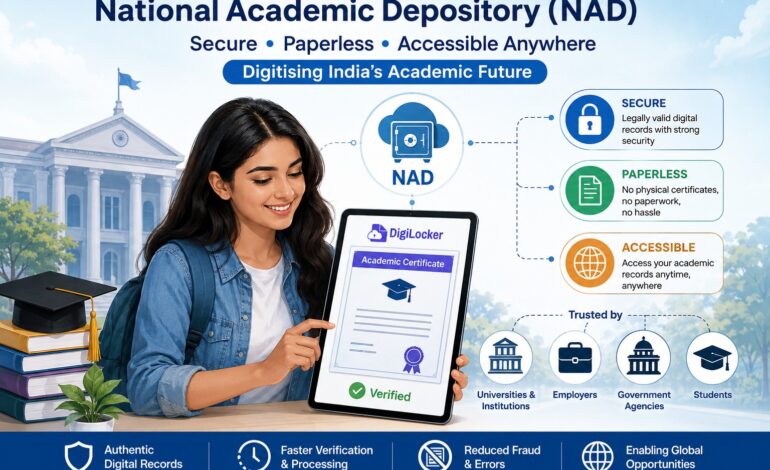
Designed as a cornerstone of India's digital governance architecture for education, NAD enables students to access their degrees, diplomas, mark sheets and certificates anytime, anywhere, while allowing employers, universities and government agencies to verify credentials instantly and securely.

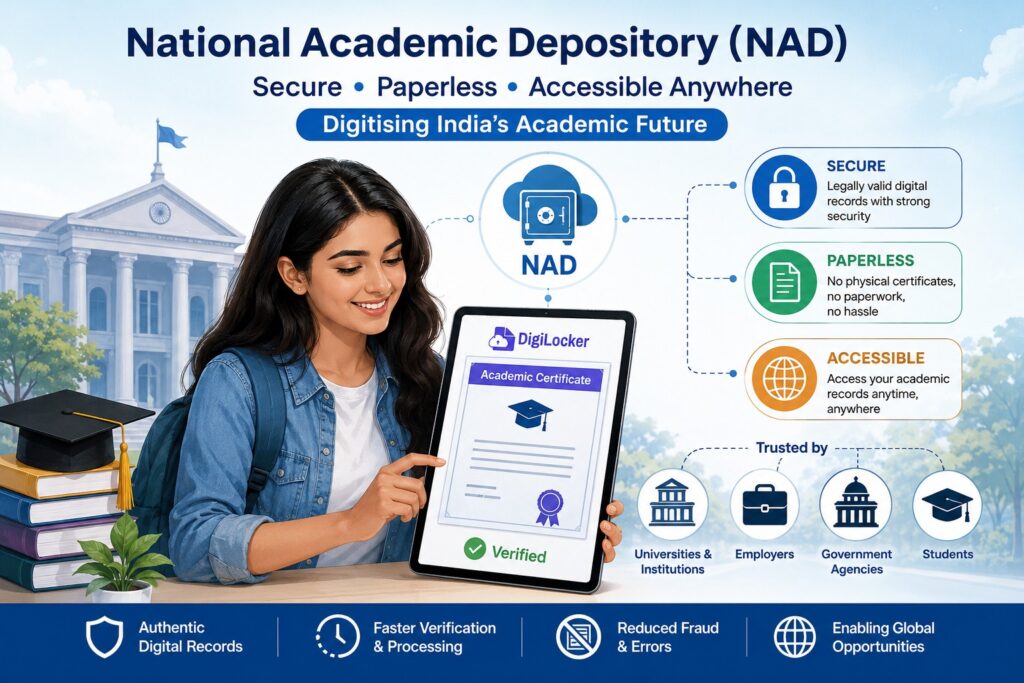
New Delhi: India’s journey towards a fully digital education ecosystem has taken another significant step with the continued expansion of the National Academic Depository (NAD), a nationwide framework that securely stores, verifies and authenticates academic credentials in digital form through the DigiLocker platform. The initiative is transforming the way educational records are issued, accessed and verified, eliminating dependence on paper certificates while supporting the vision of the National Education Policy (NEP) 2020.
Designed as a cornerstone of India’s digital governance architecture for education, NAD enables students to access their degrees, diplomas, mark sheets and certificates anytime, anywhere, while allowing employers, universities and government agencies to verify credentials instantly and securely.
Building a Digital Foundation for India’s Education System
India’s education ecosystem is among the world’s largest, comprising nearly 14.71 lakh schools, 1,420 universities, 53,583 colleges, 16,795 standalone institutions and 280 research and development institutes. Every year, these institutions generate millions of academic records, making paper-based management increasingly inefficient and vulnerable to loss, damage and forgery.
To address these challenges, the Government introduced the National Academic Depository as a secure digital repository that permanently stores verified academic credentials and enables seamless online verification.
Integrated with DigiLocker and APAAR
Since 2020, NAD has been implemented through DigiLocker, the Government’s flagship digital document platform launched under the Digital India programme.
The ecosystem works in conjunction with:
- APAAR (Automated Permanent Academic Account Registry)
- Academic Bank of Credits (ABC)
Together, these platforms create an integrated digital education infrastructure that supports flexible learning pathways, academic mobility and lifelong access to educational achievements envisioned under NEP 2020.
Over 110 Crore Academic Records Digitised
According to the latest data, the NAD ecosystem has onboarded:
- 3,420 awarding institutions and organisations
- More than 110 crore digital academic records
The repository includes records issued by Central and State universities, private universities, Institutions of National Importance, CBSE and other school boards, along with higher education institutions across the country.
How NAD Works
The digital workflow begins when an educational institution issues a verified academic credential after successful completion of a course or examination.
The credential is securely uploaded to the National Academic Depository through DigiLocker, where it is automatically linked to the student’s account.
Students can then:
- Access their credentials anytime
- Share them digitally with employers or universities
- Provide explicit consent before any verification
- Eliminate the need for physical certificates
Authorised organisations verify credentials directly through the platform, ensuring that documents are authentic and tamper-proof.
Strong Legal Backing
The system operates under a comprehensive legal framework comprising:
- Information Technology Act, 2000
- Digital Locker Rules, 2016
- National e-Authentication Framework (NeAF)
Digital academic credentials issued through NAD enjoy the same legal validity as physical certificates, enabling paperless verification for admissions, recruitment and other official purposes.
Benefits Across the Education Ecosystem
For students, the platform offers lifelong access to academic records while eliminating the risks associated with physical documents.
Educational institutions benefit from secure issuance, efficient administration and simplified record management.
Employers, banks, government departments and licensing authorities can instantly verify academic qualifications, significantly reducing verification time, administrative burden and document fraud.
National Academic Depository (NAD): Key Highlights
- National framework for secure digital storage and verification of academic credentials.
- Operates through the DigiLocker platform under the Digital India programme.
- Supports NEP 2020, Multiple Entry-Multiple Exit (MEME) and Academic Bank of Credits (ABC).
- 3,420 awarding institutions onboarded.
- More than 110 crore academic records digitised.
- Students can access, retrieve and securely share certificates anytime, anywhere.
- Consent-based digital verification for employers, universities and government agencies.
- Integrated with APAAR, ABC and e-Sanad.
- Digital certificates have the same legal validity as physical documents.
- Reduces paperwork, verification time and academic document fraud.
The system is also integrated with the Government’s e-Sanad platform, facilitating electronic verification, attestation and apostille services for Indians pursuing higher education or employment overseas.
The National Academic Depository represents more than a digital archive—it is becoming the digital trust infrastructure for India’s education ecosystem. As education becomes increasingly flexible through initiatives such as Multiple Entry-Multiple Exit (MEME) and the Academic Bank of Credits, secure digital credentials are essential for enabling seamless movement across institutions and lifelong learning.
By integrating DigiLocker, APAAR and ABC into a unified framework, the Government is creating a future where academic qualifications can be issued, stored, shared and verified entirely online. This not only reduces paperwork and fraud but also strengthens India’s position as a global leader in digital public infrastructure for education.