India’s Academic Bank of Credits Crosses New Milestone as 26.35 Crore APAAR IDs Power Lifelong Learning Ecosystem
One Nation, One Student ID initiative accelerates digital transformation of education with seamless credit mobility, secure academic records and flexible learning pathways
The initiative, spearheaded by the Ministry of Education and regulated by the University Grants Commission (UGC), is designed to transform the way students earn, store, transfer and redeem academic credits.

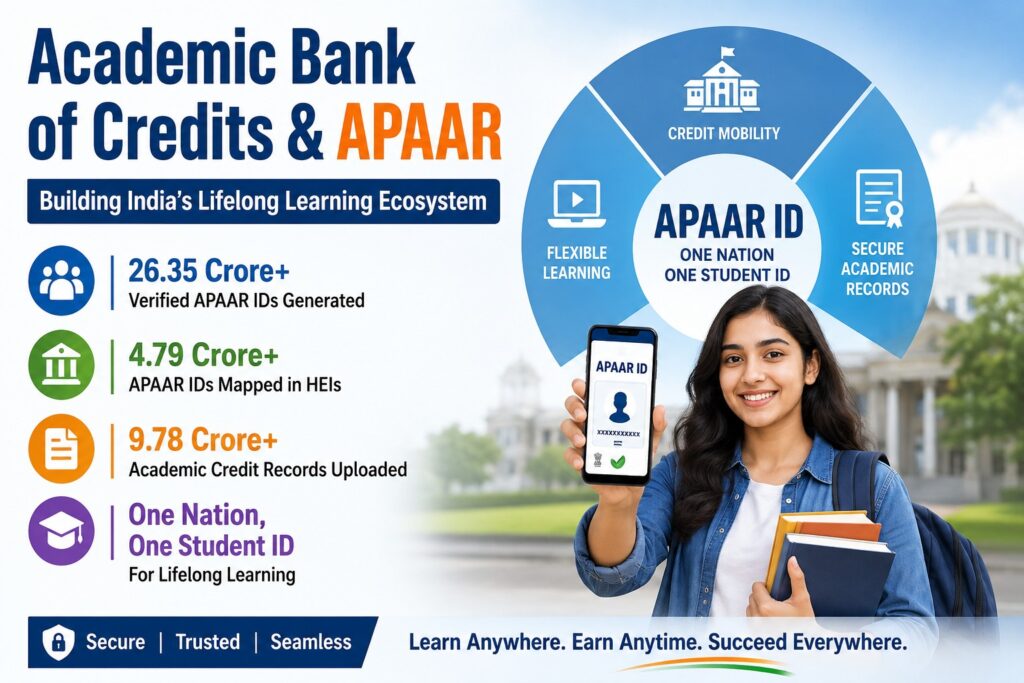
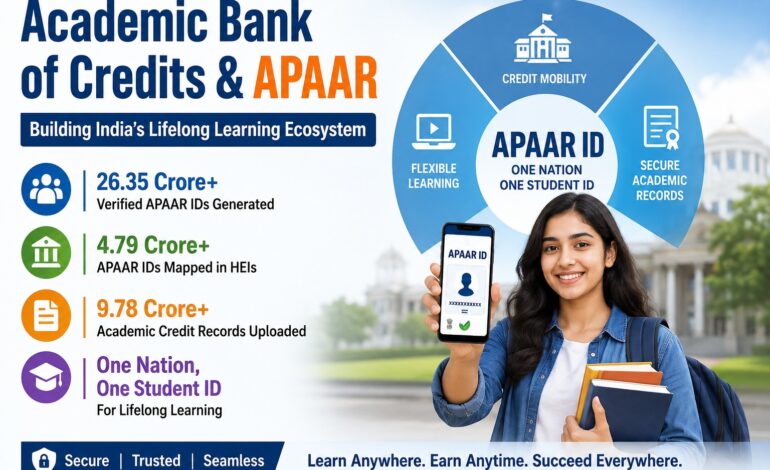
New Delhi: India has taken another significant step towards building a digitally integrated education ecosystem, with the Academic Bank of Credits (ABC) and APAAR (Automated Permanent Academic Account Registry) emerging as the backbone of the country’s lifelong learning framework. According to a Backgrounder released by the Press Information Bureau (PIB), more than 26.35 crore verified APAAR IDs have been generated across the country as of July 2, 2026, creating one of the world’s largest digital academic identity systems.
The initiative, spearheaded by the Ministry of Education and regulated by the University Grants Commission (UGC), is designed to transform the way students earn, store, transfer and redeem academic credits. Together, the ABC platform and APAAR ID seek to make education more flexible, portable and learner-centric, in line with the vision of the National Education Policy (NEP) 2020.
A Digital Academic Identity for Every Learner
APAAR serves as a unique 12-digit student identification number under the “One Nation, One Student ID” initiative. Linked to DigiLocker and the Academic Bank of Credits, it consolidates a learner’s educational journey—including school education, higher education, vocational training and professional learning programmes—into a single, verified digital identity. Students in remote and underserved regions can also obtain APAAR IDs through Common Service Centres (CSCs), extending the initiative’s reach across rural India.
The Academic Bank of Credits functions as a secure digital repository where credits earned from recognised institutions are stored, allowing students to continue their education without losing academic progress even if they temporarily discontinue their studies.
Supporting Flexible Learning Under NEP 2020
The ABC framework is central to implementing key reforms proposed under NEP 2020 and the National Credit Framework (NCrF). It enables students to move between institutions, transfer credits and benefit from Multiple Entry-Multiple Exit (MEME) provisions.
Under this framework, learners can earn:
- A Certificate after one year of study,
- A Diploma after two years, and
- A Degree after three or four years.
The accumulated credits remain valid for up to seven years or for the duration specified by the relevant academic discipline, giving students greater flexibility in completing their education.
How the System Works
Students register on the Academic Bank of Credits portal and receive an APAAR ID linked to their Aadhaar and DigiLocker accounts. Participating Higher Education Institutions (HEIs) and Skill Awarding Bodies upload verified academic credits directly to the National Academic Depository (NAD), which acts as the secure backbone for storing academic records.
Students can subsequently accumulate, transfer and redeem these credits across recognised institutions without repeating completed coursework. Once redeemed towards a qualification, however, credits cannot be reused.
Massive Nationwide Adoption
The initiative has witnessed rapid adoption across India’s higher education landscape.
As of July 2, 2026:
- 2,899 Higher Education Institutions have registered on the ABC platform.
- 4.79 crore APAAR IDs have been mapped to higher education institutions.
- Nearly 9.78 crore academic credit records have been uploaded.
- 98 Skill Awarding Bodies have joined the ecosystem.
- 16.62 crore APAAR IDs have already been generated in school education.
- Another 3.39 crore APAAR IDs remain unmapped and are expected to be integrated progressively.
The UGC had also mandated all higher education institutions to upload credit data relating to examinations held in 2025 to the NAD-ABC portal by June 30, 2026, significantly accelerating institutional participation.
Driving Academic Mobility and Student Convenience
Beyond credit storage, the ABC ecosystem offers several practical benefits.
Students can securely access their academic records and digital certificates from anywhere through DigiLocker integration. Consent-based document exchange simplifies verification processes, reducing paperwork and processing time for admissions, employment and academic transfers.
The platform also supports integration with the SWAYAM online learning ecosystem, allowing students to earn up to 40% of their academic credits through recognised online courses. Around 450 universities have adopted these provisions, expanding opportunities for flexible and blended learning.
In another student-centric feature, authenticated APAAR ID holders aged between 13 and 30 years can access exclusive travel benefits, including discounts on base airfares and additional baggage allowance.
Strengthening India’s Digital Public Infrastructure
The Academic Bank of Credits has become an important component of India’s Digital Public Infrastructure (DPI) for education.
The platform integrates with DigiLocker, the National Academic Depository, SAMARTH ERP and institutional APIs, enabling seamless authentication, digital credential issuance and academic verification. Common Service Centres have also been integrated into the system to facilitate registration in remote villages, helping bridge the digital divide.
Towards Blockchain-Based Academic Credentials
Looking ahead, the government is exploring the integration of Bharat Praman Chain, the sovereign blockchain platform developed by the Digital India Corporation, to make academic credentials tamper-proof and verifiable at scale.
The proposed integration aims to ensure that academic records remain securely stored within India’s sovereign digital infrastructure while complying with the Digital Personal Data Protection Act. The blockchain-enabled framework is expected to further enhance trust, transparency and authenticity in digital academic records.
Building a Lifelong Learning Nation
The government said the continued expansion of the Academic Bank of Credits and APAAR reflects India’s broader vision of creating a learner-centric education system where academic achievements remain portable across institutions and throughout an individual’s lifetime.
By combining digital identity, secure academic record management, credit portability and flexible learning pathways, the initiative is laying the technological foundation for a future-ready education ecosystem aligned with the goals of Digital India and the National Education Policy 2020.