Rajnath Singh inaugurates advanced weapon system complex at DRDL in Hyderabad
Raksha Mantri says indigenous missile systems proved their capabilities during Operation Sindoor; outlines vision for multi-layered missile shield under Mission Sudarshan Chakra
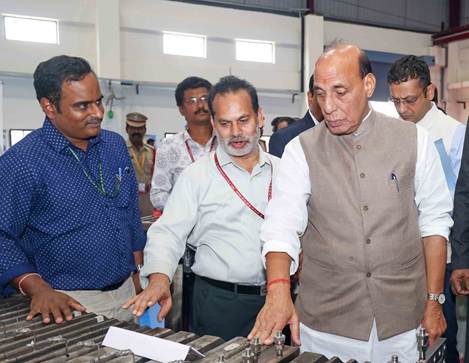
Defence minister Rajnath Singh inaugurates the Advanced Weapon System Complex at DRDO's Defence Research & Development Laboratory (DRDL), Dr APJ Abdul Kalam Missile Complex, in Hyderabad on Friday.

Hyderabad: Defence minister Rajnath Singh on Friday inaugurated an Advanced Weapon System Complex at the Defence Research and Development Organisation’s (DRDO) Defence Research & Development Laboratory (DRDL), part of the Dr APJ Abdul Kalam Missile Complex in Hyderabad.
Addressing scientists and defence personnel, Singh hailed the Missile Systems and Strategic Systems Cluster of DRDO for its contribution to India’s technological advancement, strategic autonomy and national security. He said the outstanding performance of indigenous missile systems during Operation Sindoor demonstrated the growing strength of India’s defence research and development ecosystem.
“The systems developed by DRDO, such as Akash and BrahMos, have proved that India possesses the capability to compete in the global defence technology ecosystem. Strength is essential for peace, and self-reliance is the most reliable foundation for that strength,” he said.
Referring to the role of air defence systems during Operation Sindoor, the Raksha Mantri said India’s air defence network successfully neutralised aerial threats and prevented enemy attempts to breach the country’s security. He noted that recent conflicts across the world have reinforced the importance of advanced missile defence capabilities.
Singh highlighted the government’s plans to develop a comprehensive multi-layer missile defence architecture under Mission Sudarshan Chakra, announced by Prime Minister Narendra Modi during his Independence Day address in 2025.
Describing the initiative as a future protective shield for the nation, he said the system would safeguard military assets, critical infrastructure and civilian establishments through a three-layered defence architecture. According to him, the system will also possess offensive capabilities to deliver a decisive response whenever required.
He stressed that resilience and deterrence have become critical pillars of national security in an era marked by rapid technological change and evolving warfare. Technologies such as precision-strike systems, integrated air defence networks, hypersonic weapons, autonomous platforms, artificial intelligence, electronic warfare and advanced sensors are redefining military operations, he said.
“The international order is undergoing a period of tension and transformation. In such an environment, nations need resilience to absorb shocks and recover quickly, and deterrence to ensure that any adversary understands the consequences of hostile action,” Singh said.
The Raksha Mantri credited DRDO with strengthening both these capabilities and instilling confidence that India will remain prepared to face emerging security challenges.
He also urged DRDO to continue balancing immediate operational requirements with investments in futuristic technologies that can provide India with a long-term strategic advantage. Noting the organisation’s achievements in indigenous missile development, he said recent advances in strategic and tactical weapon systems reflect India’s growing self-reliance, confidence and defence capability.
Calling for closer collaboration among DRDO, the armed forces and industry, Singh stressed the need to rapidly convert technological innovations into large-scale production. He said future military preparedness would depend not only on technological superiority but also on the ability to manufacture advanced systems in sufficient quantities and within required timelines.
The minister urged DRDO to integrate production considerations into the development process itself, reduce the time between research and deployment, simplify manufacturing and increase indigenous content in defence systems.
Singh said the government’s efforts over the last decade have focused on strengthening research and development and promoting self-reliance under the Make in India and Aatmanirbhar Bharat initiatives. He noted that stronger collaboration among DRDO laboratories, defence public sector undertakings, private industry, startups, MSMEs and academic institutions has transformed the country’s defence innovation ecosystem.
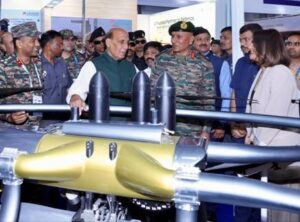
Earlier, the Raksha Mantri visited a technical exhibition showcasing advanced indigenous missile platforms, weapon systems and emerging defence technologies developed by DRDO.
Director General (Missile & Strategic Systems) U. Raja Babu, DRDL Director Ankathi Raju and other senior DRDO officials were present during the inauguration.