
Quality Beyond Price: What a Public Health Expert’s Study Reveals About Generic Medicines
Carried out by the Mission for Ethics and Science in Healthcare (MESH) under the leadership of noted hepatologist Dr. Cyriac Abby Philips, the research was published in the peer-reviewed journal
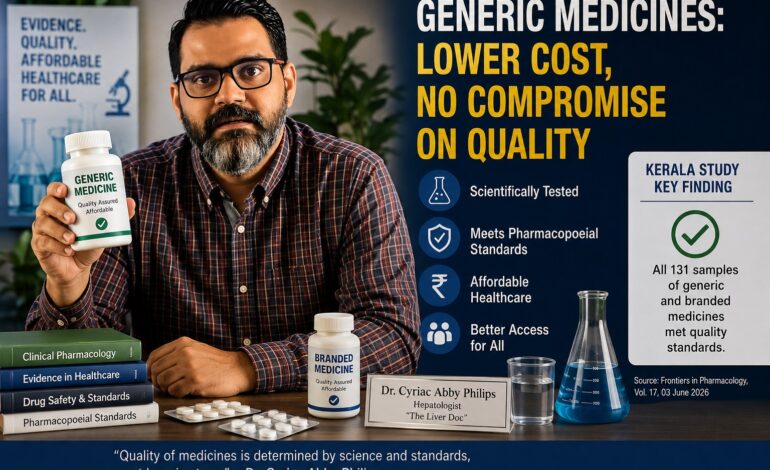
Dr. Cyriac Abby Philips is widely respected for his work in liver diseases, drug safety and public health awareness.

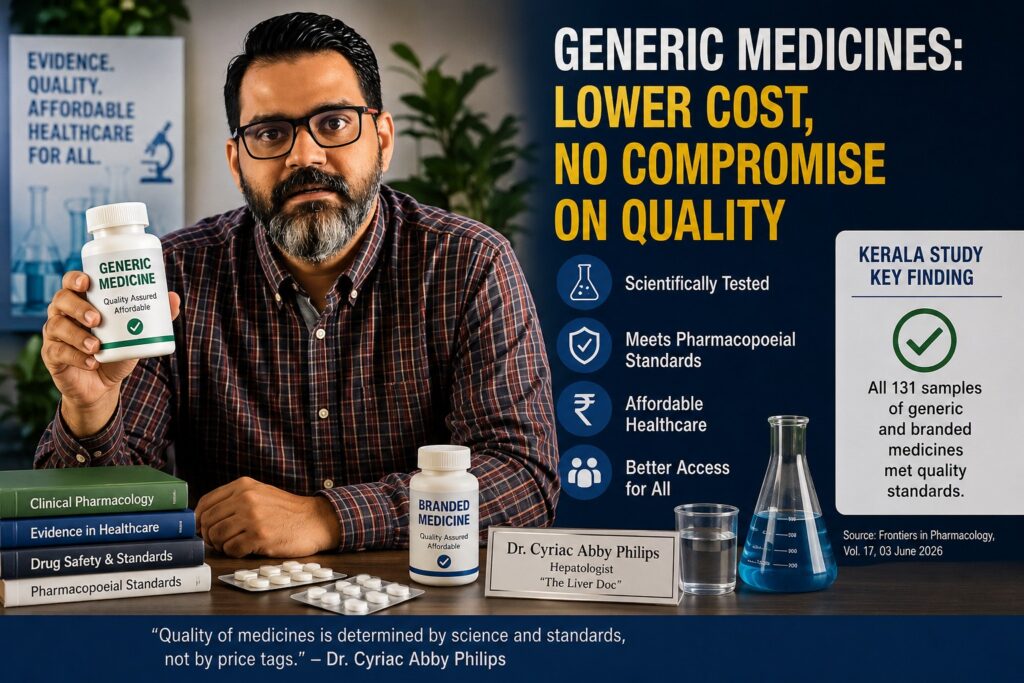
The debate over generic medicines has persisted for years. Many people continue to believe that expensive branded medicines are inherently superior, while lower-priced generic medicines are often viewed with caution. For patients living with chronic conditions such as diabetes, hypertension, cardiovascular diseases and thyroid disorders, this perception carries significant financial consequences. Since medicines account for a substantial share of household healthcare expenditure, the question of whether affordable medicines can match the quality of branded products has become increasingly important.
Against this backdrop, a recent study conducted in Kerala has attracted considerable attention. Carried out by the Mission for Ethics and Science in Healthcare (MESH) under the leadership of noted hepatologist Dr Cyriac Abby Philips, the research was published in the peer-reviewed journal Frontiers in Pharmacology on June 3, 2026. The study provides scientific evidence to a debate that has long been shaped more by perception than by data.
Dr Cyriac Abby Philips is widely respected for his work in liver diseases, drug safety and public health awareness. Popularly known as “The Liver Doc,” he has earned national and international recognition for promoting scientific thinking and evidence-based medical information.
One of the most noteworthy aspects of the study is its independence. The researchers stated that pharmaceutical companies, generic manufacturers, government supply agencies and the Jan Aushadhi network had no role in the study design, sample selection, laboratory testing or data analysis. The project was funded entirely through voluntary public contributions rather than industry sponsorship, strengthening confidence in the findings and reducing concerns about commercial influence.
The study focused on pharmaceutical quality rather than clinical treatment outcomes. Researchers assessed whether medicines contained the correct amount of active ingredient, maintained dosage uniformity, dissolved appropriately and complied with prescribed pharmacopoeial standards. To ensure objectivity, laboratory analysts were not informed whether samples originated from generic or branded sources. All products were coded and tested blindly, with identities disclosed only after completion of the analysis.
The central finding was striking. All 131 medicine samples examined met the relevant pharmacopoeial standards. In other words, every tested medicine satisfied prescribed quality requirements irrespective of whether it was sold as a generic, branded generic or branded product. The laboratory evidence did not support the assumption that higher-priced medicines automatically offer superior pharmaceutical quality.
The study also revealed substantial price differences. Some medicines showed price variations of up to fourteen-fold between generic and branded versions. Yet these differences in cost were not accompanied by comparable differences in laboratory performance. The findings challenge the common tendency to equate price with quality.
The results are particularly relevant in the context of the Pradhan Mantri Bhartiya Janaushadhi Pariyojana. In many of the medicine categories examined, Jan Aushadhi outlets offered the lowest-priced products among those studied. At the same time, the tested samples met all required quality standards. While the research was not designed as an evaluation of government policy, its findings inevitably contribute to the broader discussion on affordable access to medicines.
The study’s conclusions also resonate with an important public policy objective: reducing the financial burden of healthcare on ordinary families. Rising expenditure on medicines remains a major concern for lower-income and middle-class households, particularly for patients managing chronic diseases that require lifelong treatment. Initiatives such as the Pradhan Mantri Bhartiya Janaushadhi Pariyojana seek to improve access to affordable medicines without compromising quality. Studies such as the MESH analysis provide valuable evidence in assessing whether such efforts are achieving their intended goals.
These findings are consistent with the quality assurance framework followed by the Pharmaceuticals and Medical Devices Bureau of India (PMBI). Medicines supplied through the Jan Aushadhi network are sourced from manufacturers complying with World Health Organization Good Manufacturing Practices (WHO-GMP). In addition, every batch undergoes testing in NABL-accredited laboratories before distribution. The MESH findings and the existing quality assurance mechanisms point to the same conclusion: pharmaceutical quality depends on scientific standards, manufacturing practices and regulatory oversight rather than on price alone.
At the same time, the study should be interpreted within its limitations. The analysis was confined to legally manufactured and regulated products obtained through formal supply channels in Kerala. It does not draw conclusions about counterfeit medicines, unregulated products or illegal distribution networks. Patients should therefore continue to purchase medicines from authorised pharmacies and follow professional medical advice.
India is one of the world’s largest producers of generic medicines and supplies affordable pharmaceuticals to numerous countries. Yet doubts about generics continue to persist in the domestic market. The significance of the MESH study lies in its effort to move the discussion beyond assumptions and toward evidence.
For millions of patients who depend on long-term medication, affordability is not merely an economic issue; it is a determinant of treatment adherence and health outcomes. Ultimately, patients seek three things from any medicine: safety, effectiveness and affordability. The findings of this study suggest that these objectives need not be mutually exclusive.
As healthcare systems around the world search for ways to reduce treatment costs without compromising standards, the Kerala study offers an important reminder: quality should be judged by rigorous scientific testing, manufacturing standards and regulatory compliance – not by price alone.