Road Safety Network Calls for Evidence-Based Speed Limits to Cut India’s Road Fatalities
New Delhi: Speed management is the fastest and most effective intervention to reduce road deaths in India, experts said at a national seminar organised by the Road Safety Network in
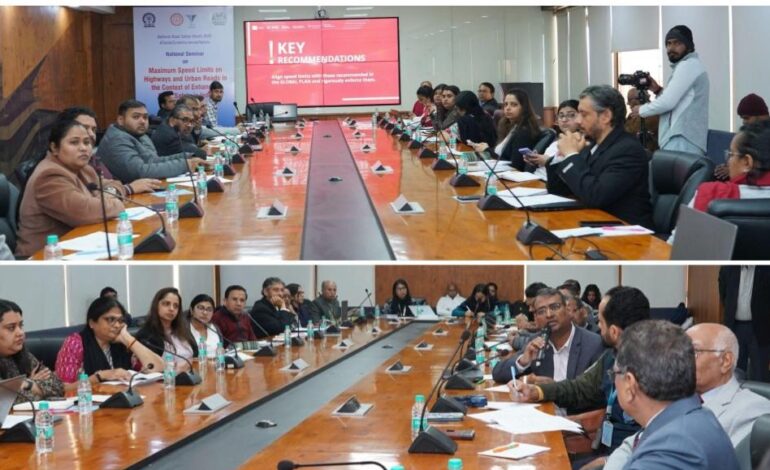
The seminar brought together road safety researchers, policymakers, enforcement officials, urban planners, and civil society groups to deliberate on rational speed limits for national highways and urban roads, with speakers unanimously stressing the need for evidence-based limits aligned with road design and enforcement.

New Delhi: Speed management is the fastest and most effective intervention to reduce road deaths in India, experts said at a national seminar organised by the Road Safety Network in collaboration with IIT Delhi and IIT Kharagpur during National Road Safety Month 2026.
The seminar brought together road safety researchers, policymakers, enforcement officials, urban planners, and civil society groups to deliberate on rational speed limits for national highways and urban roads, with speakers unanimously stressing the need for evidence-based limits aligned with road design and enforcement.
India records over 1.7 lakh road fatalities every year, with speeding cited as the leading cause in more than 70% of deaths. Experts noted that while road infrastructure has expanded rapidly, speed regulations have not kept pace with mixed traffic conditions, human injury tolerance, and the safety needs of vulnerable road users.
Bhargab Maitra, professor of civil engineering at IIT Kharagpur and member of the Road Safety Network, said national highways account for just about 2% of India’s road network but nearly 36% of road fatalities. He said lowering maximum speed limits, along with stronger enforcement and better emergency response, is critical to saving lives.
Highways and expressways
The first session focused on national highways, where high operating speeds, heterogeneous traffic, frequent access points, and roadside activity significantly increase crash severity. Speakers cautioned against treating highways solely as high-speed corridors, particularly when they pass through or near populated areas.
David Cliff, chief executive officer of the Global Road Safety Partnership, said global evidence shows that even modest reductions in speed can sharply reduce fatalities. He recommended maximum speeds of 100 km/h on expressways, under 80 km/h on rural roads, and much lower limits in urban settings, supported by strict enforcement.
Urban road safety
The second session examined speeding in urban areas, where experts said most fatal crashes occur not on narrow streets but on wide arterial roads, flyovers, and signal-free corridors, often during low-traffic hours.
According to the 2023 data of the Ministry of Road Transport and Highways, more than 17,000 people were killed and over 73,000 injured in cities with populations exceeding five million. Current speed limits—up to 70 km/h on urban roads—were flagged as unsafe in densely populated environments.
Geetam Tiwari of IIT Delhi’s TRIP Centre said global evidence clearly indicates that 50 km/h is the absolute maximum safe speed in urban areas, particularly given the high proportion of pedestrians, cyclists, and two-wheeler riders involved in crashes.
Participants recommended a maximum speed limit of 50 km/h on urban roads, with lower limits in residential areas, school zones, and pedestrian-dense streets. They noted that lower speeds improve public health, liveability, and environmental outcomes, without significantly increasing travel time due to existing congestion.
Enforcement and road design
Speakers emphasised that enforcement alone cannot ensure safe speeds. Road design measures such as traffic calming, lane narrowing, and self-explaining streets were highlighted as essential for sustained compliance.
Kayitha Ravinder, chief scientist at CSIR-CRRI, said fines without redesigning streets have limited impact, particularly in cities where police presence cannot be universal.
PK Sikdar, advisor to the International Road Federation (India Chapter), said under-reporting of speeding-related crashes and high motorcycle fatalities continue to mask the true scale of the problem. He noted that nearly 60% of serious crashes occur at intersections, making context-sensitive speed management essential.
The Road Safety Network said the seminar’s recommendations will be compiled into a formal policy submission to the ministry of road transport and highways, urging the adoption of evidence-based speed limits as a core pillar of India’s road safety strategy.
About Road Safety Network
The Road Safety Network is a national coalition of civil society organisations working to reduce road crash fatalities in India through data-driven advocacy, stronger governance, and accountability, guided by the Safe Systems approach.