SBI Research: India’s Labour Market Undergoing Structural Shift as Informal Employment Remains Dominant
PLFS 2025 unit-level analysis highlights declining agriculture dependence, lower youth unemployment and persistent informality challenges
In a detailed report titled “How India Works Today: Insights into Wages, Skills, and Informal Employment through the Lens of PLFS 2025”, SBI Research analysed unit-level data from the Periodic Labour Force Survey (PLFS) 2025 for the first time.

Mumbai: State Bank of India Research has said India’s labour market is undergoing a structural transformation, with gradual movement away from agriculture, improved employment quality for women and declining youth unemployment, even as informal employment continues to dominate the workforce.
In a detailed report titled “How India Works Today: Insights into Wages, Skills, and Informal Employment through the Lens of PLFS 2025”, SBI Research analysed unit-level data from the Periodic Labour Force Survey (PLFS) 2025 for the first time.
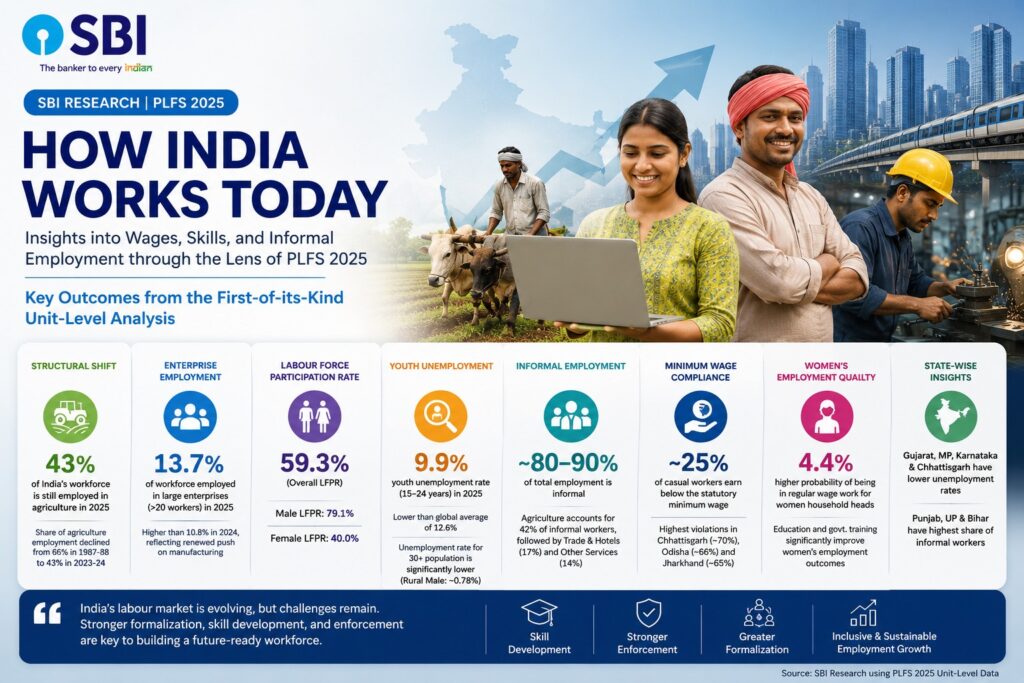
The report noted that the share of agriculture in India’s workforce has declined from 66% in 1987-88 to 43% in 2023-24, indicating a long-term structural shift in employment patterns. However, agriculture still remains the single largest source of employment in the country.
How India Works Today
SBI Research Analysis of PLFS 2025 reveals major structural shifts in India’s labour market, wages, skills and informal employment ecosystem.
Agriculture Workforce Share
Agriculture still employs 43% of India’s workforce despite long-term structural decline from 66% in 1987-88.
Large Enterprise Employment
Workforce employed in enterprises with 20+ workers increased sharply from 10.8% in 2024.
Youth Unemployment
India’s youth unemployment is below the global average of 12.6%, according to SBI Research analysis.
Informal Workforce
Informal employment continues to dominate India’s labour market across sectors and geographies.
Key Labour Market Findings
Female-headed households show better employment quality and higher access to regular wage jobs.
Higher education significantly improves women’s transition from casual labour to salaried employment.
Manufacturing push and large enterprise growth are improving labour formalisation trends.
Training reduces probability of informal employment by 4.8%.
States with Highest Informality
Estimated to be earning below statutory minimum wages.
Agriculture remains India’s largest source of informal employment.
For women heading households compared to non-head women.
The Big Picture
India’s labour market is steadily transitioning from agriculture-led employment towards more diversified and formal economic structures. However, informality, wage inequality, gender disparities and social protection gaps remain critical policy challenges.
According to the analysis, large enterprises employing more than 20 workers now account for 13.7% of the workforce, up from 10.8% in 2024, reflecting the government’s increased focus on manufacturing and formal sector expansion.
The Labour Force Participation Rate (LFPR) for people aged 15 years and above stood at 59.3% in 2025, with male LFPR at 79.1% and female LFPR at 40%. Rural participation remained significantly higher than urban participation.
SBI Research highlighted substantial regional disparities in labour market conditions. States such as Gujarat, Madhya Pradesh, Karnataka and Chhattisgarh recorded relatively lower unemployment rates, while Goa, Nagaland, Arunachal Pradesh, Punjab and Telangana reported higher unemployment levels.
The report estimated India’s youth unemployment rate at 9.9% in 2025, lower than the global average of 12.6% for the 15–24 age group. However, the study argued that conventional youth unemployment metrics may overstate employment stress because many individuals in the 15–29 age bracket remain engaged in formal education.
Using a revised methodology focused on the 30-plus population, SBI Research estimated substantially lower unemployment rates across rural and urban categories.
The report also highlighted improvements in women’s employment quality. Women heading households were found to have a 4.4% higher probability of being in regular wage employment and lower likelihood of remaining in casual labour.
Education was identified as a major factor influencing women’s employment quality, with higher educational attainment significantly increasing access to regular salaried jobs while reducing casual labour participation.
On wage compliance, the study estimated that nearly 25% of casual workers in India earn below statutory minimum wages. Chhattisgarh, Odisha and Jharkhand recorded the highest incidence of minimum wage violations among casual workers.
The report further revealed that informal employment continues to dominate India’s labour market, accounting for nearly 80–90% of total employment. Punjab recorded the highest share of informal workers at 82%, followed by Uttar Pradesh and Bihar at 81% each.
Agriculture accounted for nearly 42% of informal employment, followed by trade and hotels at 17% and other services at 14%. Women workers were found to be approximately 4.8% more likely to be engaged in informal employment compared to men.
The study also found that participation in training programmes reduces the probability of informal employment by 4.8%, with government-funded training significantly improving self-employment outcomes for women.
SBI Research said the findings highlight the need for stronger workforce formalisation, improved enforcement of minimum wages, greater social security coverage and sustained investment in skill development to support India’s evolving labour market structure.