Mahakumbh of Theatre Brings People, Languages and Regions Together at 25th Bharat Rang Mahotsav
NEW DELHI: Mahakumbh of theatre brings the people, languages and regions together as the National School of Drama prepares to stage the 25th Bharat Rang Mahotsav in its largest-ever format,
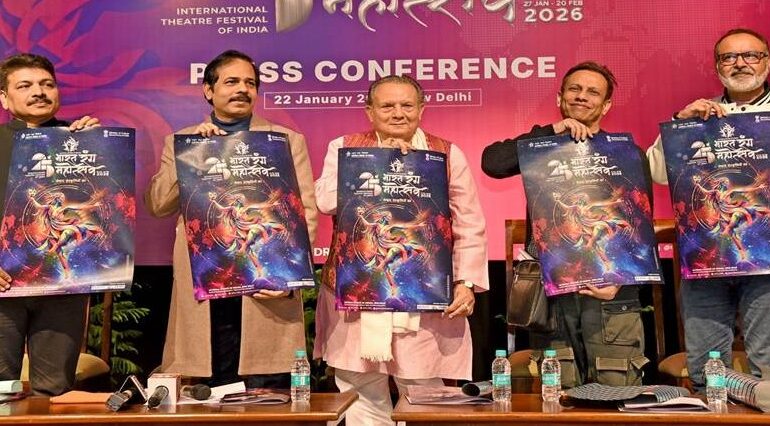
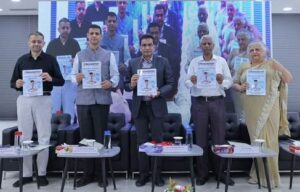
Officials of the National School of Drama unveil the poster of the 25th Bharat Rang Mahotsav 2026 during a press conference in New Delhi on Thursday.

NEW DELHI: Mahakumbh of theatre brings the people, languages and regions together as the National School of Drama prepares to stage the 25th Bharat Rang Mahotsav in its largest-ever format, spanning 40 locations across India and at least one country in each of the seven continents.
The world’s largest international theatre festival will be held from January 27 to February 20, 2026, marking a major milestone for Bharat Rang Mahotsav with unprecedented geographical, linguistic and cultural reach.
The festival will present 277 Indian productions, including selected and invited plays, along with 12 international productions. Performances will be staged in 228 Indian and foreign languages and dialects, underlining the festival’s position as the most linguistically diverse theatre event in the world.
The selected productions emerged from a rigorous screening of 817 national and 34 international applications. The programme also includes 19 university productions and 14 local productions at various centres.
Bharat Gupt, Vice Chairman, NSD, said the festival reflects the democratisation and universalisation of theatre through its scale and intent, bringing together diverse languages, genres and theatrical expressions from different communities and age groups into a shared creative continuum.
This edition significantly widens its cultural canvas with performances in Maithili, Bhojpuri, Tulu, Urdu, Sanskrit, Tai Khamti and Nyishi, alongside almost all major Indian languages and several tribal and endangered tongues.
New centres have been added for the first time, including Ladakh, Andaman and Nicobar Islands, Lakshadweep, Daman and Diu, Aizawl in Mizoram, Tura in Meghalaya, Nagaon in Assam, Mandi in Himachal Pradesh and Rohtak in Haryana.
Chittaranjan Tripathy, Director, NSD, said the 25th edition represents an inclusive and non-elitist international theatre festival that brings together languages, regions, aesthetics and ideologies through diverse theatrical forms. He added that the festival’s expansion to remote regions offers access to theatre where such opportunities are limited and provides a platform for underrepresented languages with rich oral and written traditions.
BRM 2026 will host a wide range of curated and allied festivals, including Adirang Mahotsav focusing on tribal theatre, dance and crafts; Jashne Bachpan for children’s theatre; Bal Sangam showcasing folk dance and drama by children; Poorvottar Natya Samaroh highlighting North-Eastern theatre; as well as puppet theatre, dance drama, classical Sanskrit drama and micro drama festivals.
For the first time, productions by transgender communities, sex workers, senior citizens and other underrepresented groups will be featured.
The festival will also commemorate figures such as Bhagwan Birsa Munda, Lok Mata Ahilya Bai and Shyama Prasad Mukherjee, while paying tribute to theatre stalwarts Ratan Thiyam, Daya Prakash Sinha, Bansi Kaul and Alok Chatterjee. A special seminar honouring Ebrahim Alkazi will be held at the NSD campus in Delhi. A unique theatrical performance written and performed by a cancer survivor and NSD alumnus will also be staged.
Folk art performances, street theatre, seminars, master classes and workshops will be integral to the programme. The Advitiya segment, led by the NSD Students’ Union, will organise interactive sessions and Nukkad Natak performances on the NSD campus.
Theatre Bazaar will promote newly written plays, with selected works to be awarded and published. Under the Shruti initiative, 17 books will be launched. The festival will also showcase 33 productions directed by women and feature special performances honouring freedom fighters, social reformers and eminent theatre exponents.
Special counters highlighting India’s culinary traditions and traditional handicrafts will add to the festival’s cultural experience.
The expanded edition is supported by collaborations with national and international cultural and academic institutions, including the Maithili–Bhojpuri Academy, Hindi Academy, Garhwali–Kumaoni–Jaunsari Academy and Urdu Academy of the Government of NCT of Delhi. International collaborators include theatre institutions from Warsaw, Madrid and Moscow, along with support from several Indian states and cultural bodies.