From Antyodaya to Viksit Bharat: How 12 Years of Policy Transformation Are Reshaping India
Over the past 12 years, India has witnessed a far-reaching transformation driven by welfare reforms, digital innovation, infrastructure expansion and financial inclusion.
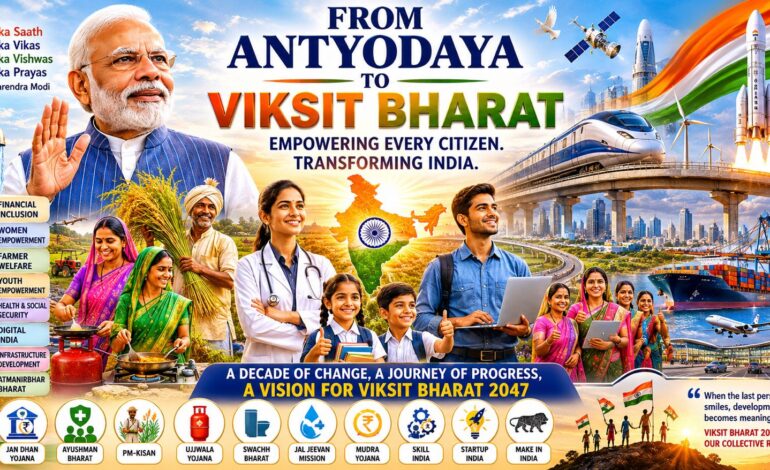
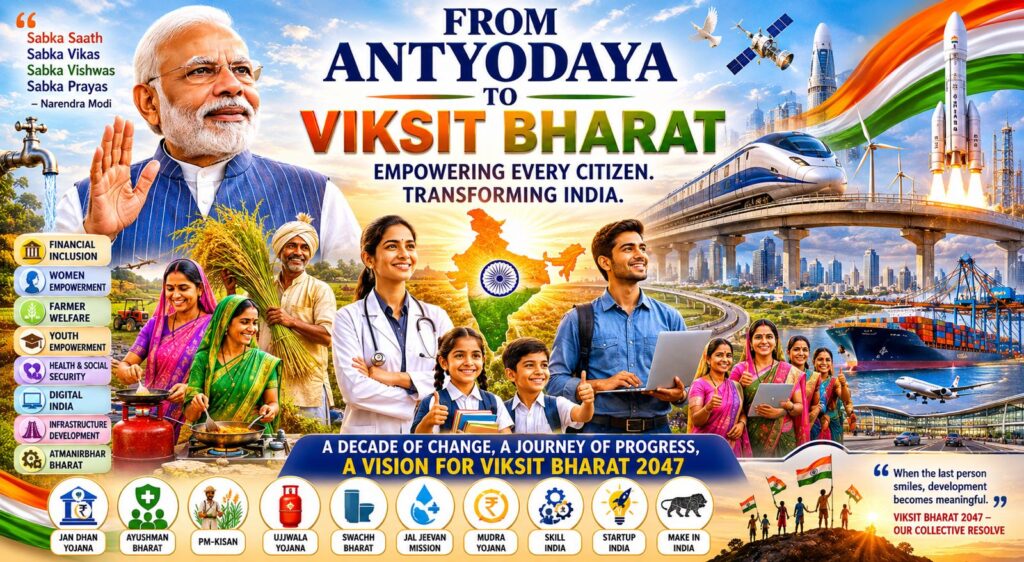
From Jan Dhan and Ujjwala to Digital India, PM-KISAN and Atmanirbhar Bharat, a series of interconnected policy initiatives have sought to expand opportunity, strengthen institutions and lay the foundation for Viksit Bharat 2047.

In any democracy, changes in government are a natural outcome of evolving public aspirations and socio-economic realities. However, securing public support across three consecutive national elections remains a rare achievement, particularly in an era marked by intense political competition, constant public scrutiny and the pervasive influence of digital media.
Against this backdrop, the twelve-year period under Prime Minister Narendra Modi merits examination not merely through the lens of electoral success, but through the impact of public policy on the everyday lives of citizens. Welfare programmes, governance reforms, digital transformation, infrastructure expansion, financial inclusion, women’s empowerment, agricultural support and youth-oriented initiatives have together shaped a broader narrative of socio-economic change.
While political success may be measured by electoral victories, the true test of governance lies in its ability to improve the quality of life of ordinary citizens. Viewed through this lens, the past decade has witnessed significant shifts across multiple sectors of Indian society.
The transformation is visible not only in policy announcements or budgetary allocations, but in the lived experiences of millions. Families once excluded from the formal banking system are now financially connected. Welfare benefits increasingly reach citizens directly. Access to sanitation, electricity, housing and drinking water has expanded significantly. Young Indians are increasingly emerging not merely as seekers of opportunity, but as creators of opportunity.
At the philosophical level, many of these initiatives draw inspiration from the idea of Antyodaya – the upliftment of the last person in society. Propounded by Pandit Deendayal Upadhyaya through the philosophy of Integral Humanism, Antyodaya holds that national development remains incomplete unless its benefits reach the most disadvantaged sections of society. The vision of Viksit Bharat 2047 can be viewed as a contemporary extension of this principle.
Pradhan Mantri Jan Dhan Yojana
The Pradhan Mantri Jan Dhan Yojana marked a significant turning point in India’s financial inclusion journey. A bank account is more than a financial instrument; it is a gateway to participation in the formal economy. Combined with Aadhaar-linked identification, mobile connectivity and Direct Benefit Transfer mechanisms, Jan Dhan has contributed to a new framework of welfare delivery characterised by transparency and reduced leakages.
Pradhan Mantri Ujjwala Yojana
Women’s empowerment has emerged as another defining theme. Programmes such as the Pradhan Mantri Ujjwala Yojana have promoted cleaner cooking fuel access, while the Swachh Bharat Mission has improved sanitation infrastructure and dignity, particularly for women. The Jal Jeevan Mission has eased the burden of water collection in many rural households. Initiatives supporting self-help groups, entrepreneurship and skill development have expanded economic participation among women. The constitutional initiative to enhance women’s representation in legislatures has added a political dimension to this process of empowerment.
PM-KISAN/ Kisan Credit Card/ Fasal Bima Yojana
Agriculture and rural development continue to occupy a central place in India’s socio-economic landscape. The PM-KISAN scheme introduced direct income support to farmers, while the Pradhan Mantri Fasal Bima Yojana sought to mitigate risks arising from climatic uncertainties. The Kisan Credit Card programme expanded institutional credit access, and the National Agriculture Market (e-NAM) attempted to connect farmers to wider markets through digital platforms.
PM Matsya Sampada Yojana/ PM-KUSUM scheme
The government has also focused on allied sectors. The Pradhan Mantri Matsya Sampada Yojana aims to strengthen fisheries through investment in production, processing, storage and exports. Similarly, the PM-KUSUM scheme seeks to integrate agriculture with renewable energy by promoting solar-powered irrigation and decentralised energy generation, creating additional income opportunities for farmers.
VB-G RAM G
Rural livelihoods have received renewed attention through programmes aimed at employment generation, skill development and economic self-reliance. Efforts such as VB-G RAM G reflect a broader policy shift towards transforming rural India into a centre of economic opportunity rather than merely a recipient of welfare support.
India’s demographic profile presents both an opportunity and a challenge. Harnessing the productive potential of its youth remains central to long-term development. The Mudra Yojana has expanded access to credit for small entrepreneurs, while Start-up India has encouraged innovation and enterprise creation. Increasingly, young Indians are participating in emerging sectors ranging from technology and manufacturing to services and creative industries.
Stand-Up India
The Stand-Up India initiative has sought to widen entrepreneurial participation among Scheduled Castes, Scheduled Tribes and women. Skill India, PM Internship initiatives and PM Vishwakarma represent efforts to bridge the gap between education, traditional skills and contemporary economic requirements. Together, these programmes reflect a broader attempt to convert demographic potential into productive economic capacity.
Healthcare and social security
Healthcare and social security have also witnessed notable changes. Ayushman Bharat has expanded access to healthcare protection for economically vulnerable families. Jan Aushadhi centres have improved the availability of affordable medicines. Mission Indradhanush has strengthened immunisation coverage, while Poshan Abhiyaan has focused on nutritional outcomes among women and children.
Social security initiatives such as e-Shram, Atal Pension Yojana and PM Shram Yogi Maandhan have attempted to extend institutional protection to workers in the informal economy.
Digital India programme
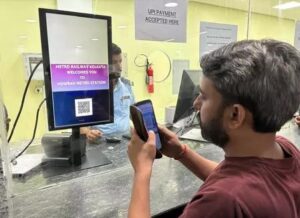
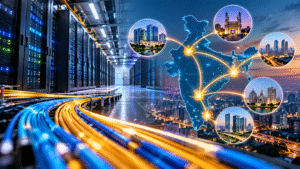
Among the most consequential developments has been India’s digital transformation. The Digital India programme has fundamentally altered the interaction between citizens and the state. Unified Payments Interface (UPI) has emerged as one of the world’s most significant digital payment platforms. Common Service Centres and BharatNet have expanded access to government services and digital connectivity in rural regions.
These interventions have improved accessibility, efficiency and transparency in governance.
Infrastructure development has likewise assumed strategic importance. Programmes such as PM Gati Shakti, Bharatmala, Sagarmala and UDAN seek to improve connectivity across sectors and regions. Railway modernisation, station redevelopment, electrification, high-speed corridors and the expansion of airport infrastructure are aimed at enhancing economic productivity and reducing logistical barriers.
The vision of Atmanirbhar Bharat represents another important dimension of India’s development trajectory. While global integration remains essential, strengthening domestic productive capacity has become a policy priority. The Make in India initiative, coupled with production-linked incentive schemes, has sought to attract investment, expand manufacturing and create employment opportunities across sectors such as electronics, automobiles, pharmaceuticals, defence and semiconductors.
The emergence of India as a major mobile-phone manufacturing hub illustrates this shift. Beyond import substitution, Atmanirbhar Bharat seeks to build confidence in domestic innovation, entrepreneurship and industrial capability. Developments in defence production, semiconductor manufacturing, drone technology, renewable energy and the space sector reflect this broader ambition.
The period has also witnessed efforts to combine cultural heritage with contemporary development. Projects associated with Ayodhya, Kashi Vishwanath, Mahakal Lok and Kedarnath have sought to preserve and revitalise cultural and spiritual centres while generating tourism and local economic activity.
Global Achievements
On the global stage, India’s profile has expanded considerably. The G-20 Presidency showcased India’s ability to shape international conversations. The country has played an increasingly prominent role in articulating the concerns of the Global South. The International Solar Alliance, Chandrayaan missions, Aditya-L1 and the forthcoming Gaganyaan programme reflect growing technological and diplomatic confidence.
Taken together, these developments suggest that the past twelve years cannot be understood merely as a collection of individual schemes. Rather, they represent an interconnected framework aimed at expanding inclusion, improving service delivery, strengthening infrastructure, promoting entrepreneurship and enhancing national capacity.
Jan Dhan laid the foundation for financial inclusion. Direct Benefit Transfers strengthened transparency. Ujjwala, Swachh Bharat and Jal Jeevan Mission improved living standards. PM Awas Yojana expanded housing security. Ayushman Bharat enhanced healthcare access. PM-KISAN supported farmers. Mudra promoted entrepreneurship. Digital India increased accessibility, while Gati Shakti improved connectivity. Atmanirbhar Bharat sought to strengthen productive capacity, and India’s growing global role reinforced national confidence.
Ultimately, Viksit Bharat 2047 is more than a governmental aspiration. It is a national project that requires collective participation. Governments can create opportunities, provide resources and build institutions. The success of development, however, is ultimately reflected in the lives of citizens—in the confidence of women, the aspirations of youth, the resilience of farmers, the progress of villages and the opportunities available to future generations.
The journey from Antyodaya to Viksit Bharat is therefore not merely about economic growth. It is about expanding dignity, opportunity, security and participation across society. If development reaches the last person, the promise of a developed India will acquire genuine meaning. In that sense, the smile of the most vulnerable citizen remains the most meaningful measure of national progress.