Indian scientists develop ultra-sensitive wearable ammonia sensor that works without batteries
Portable, self-powered device can detect toxic ammonia leaks at extremely low concentrations, opening new possibilities for industrial safety and wearable health monitoring
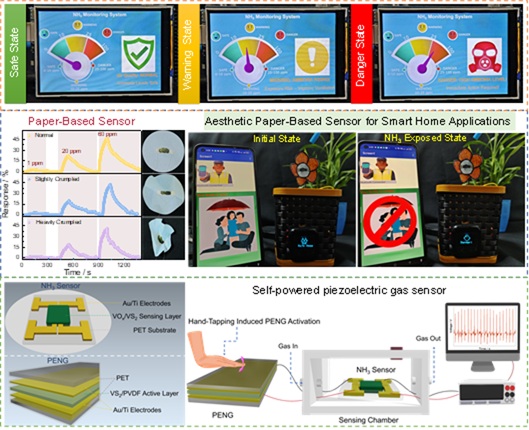
Portable, wearable, and self-powered ammonia sensing prototypes

NEW DELHI: Scientists at the Centre for Nano and Soft Matter Sciences (CeNS), Bengaluru, an autonomous institute under the Department of Science and Technology (DST), have developed an ultra-sensitive ammonia sensor capable of detecting toxic gas at extremely low concentrations while operating entirely at room temperature.
The breakthrough technology could pave the way for portable, self-powered, and wearable gas detection devices, significantly enhancing workplace safety, environmental monitoring, and personal health protection in industries where ammonia exposure poses serious risks.
Addressing a Critical Industrial Safety Challenge
Ammonia is extensively used across industries including fertilizer manufacturing, refrigeration, chemical processing, and agriculture. Although indispensable in industrial operations, accidental ammonia leaks can cause severe irritation to the eyes, skin, and respiratory system, while prolonged exposure may lead to chronic health complications.
The newly developed sensing platform enables continuous monitoring of ammonia without the high energy requirements associated with conventional gas sensors.
Nanotechnology at the Core
The research team engineered a highly sensitive sensing material using a hybrid vanadium oxide–vanadium sulfide (VOx/VS₂) heterostructure.
Through a carefully controlled surface transformation process, the scientists created abundant active sites that efficiently capture ammonia molecules while simultaneously improving electrical charge transport across the sensing layer.
This dual advantage enables the sensor to deliver rapid, highly selective, and reliable detection of ammonia under normal ambient conditions.
Detects Ammonia Below Occupational Safety Limits
Laboratory tests demonstrated remarkable performance.
The sensor successfully detected ammonia concentrations as low as 319 parts per billion (ppb)—well below occupational safety thresholds recommended for industrial workplaces.
Researchers also reported several key performance advantages:
- Detection down to 319 ppb
- High selectivity against interference from other gases
- Stable performance over repeated sensing cycles
- Reliability exceeding 10 weeks
- Effective operation across a wide concentration range
- Room-temperature operation without external heating
Unlike many existing gas sensors that require elevated temperatures or additional activation mechanisms, the new device operates efficiently at room temperature, reducing energy consumption while simplifying deployment.
From Laboratory Innovation to Real-World Devices
Beyond developing the sensing material, the research team translated the technology into practical devices for industrial and consumer applications.
Led by Prof. Angappane Subramanian, along with Dr Vishnu G. Nath, Ankur Verma, Abhijit Paul, and Dr. Subash Cherumannil Karumuthil, the team developed a portable threshold-based monitoring system capable of automatically categorising ammonia concentrations into:
- Safe
- Warning
- Danger
The system provides instant alerts whenever ammonia levels exceed predefined safety limits, allowing users to respond quickly without requiring technical expertise.
Such devices can be deployed in:
- Chemical industries
- Fertilizer plants
- Cold storage and refrigeration facilities
- Research laboratories
- Agricultural environments
- Industrial storage units
Self-Powered Sensor Harvests Energy from Human Movement
One of the most innovative aspects of the research is the development of a battery-free, self-powered ammonia detector.
Scientists integrated the sensor with a flexible piezoelectric nanogenerator, allowing it to convert simple human movements into electrical energy required for gas detection.
The self-powered design eliminates dependence on external power sources, making the technology particularly suitable for remote industrial sites, disaster zones, and continuous environmental monitoring applications.
Wearable Smart Safety Devices
Researchers also fabricated flexible versions of the sensor on polymer films, paper, and textile substrates.
The devices continued to perform reliably even when bent, twisted, or folded, demonstrating their suitability for wearable electronics.
Prototype applications showcased by the team include:
- Smart safety bands
- Electronic textiles
- Smart-home ammonia warning systems
- Wearable environmental monitoring devices
The study has been published in the international journal ACS Sensors.
Towards Smarter Industrial Safety
The development demonstrates how advanced nanomaterials, flexible electronics, and energy-harvesting technologies can be integrated into practical solutions for protecting human health and the environment.
The successful demonstration of portable, wearable, and self-powered sensing platforms marks an important step toward next-generation gas monitoring systems that are more energy-efficient, user-friendly, and suitable for real-world deployment.