Below-Normal Monsoon Likely in 2026; IMD Projects 92% of Long Period Average
Weak La Niña transitioning to ENSO-neutral; El Niño conditions may emerge during season New Delhi: India’s southwest monsoon for 2026 is likely to be below normal, with seasonal rainfall projected
The forecast places rainfall in the “below normal” category (90–95% of LPA), with a model error margin of ±5%. The LPA for the June–September monsoon, based on 1971–2020 data, stands at 87 cm.

Weak La Niña transitioning to ENSO-neutral; El Niño conditions may emerge during season
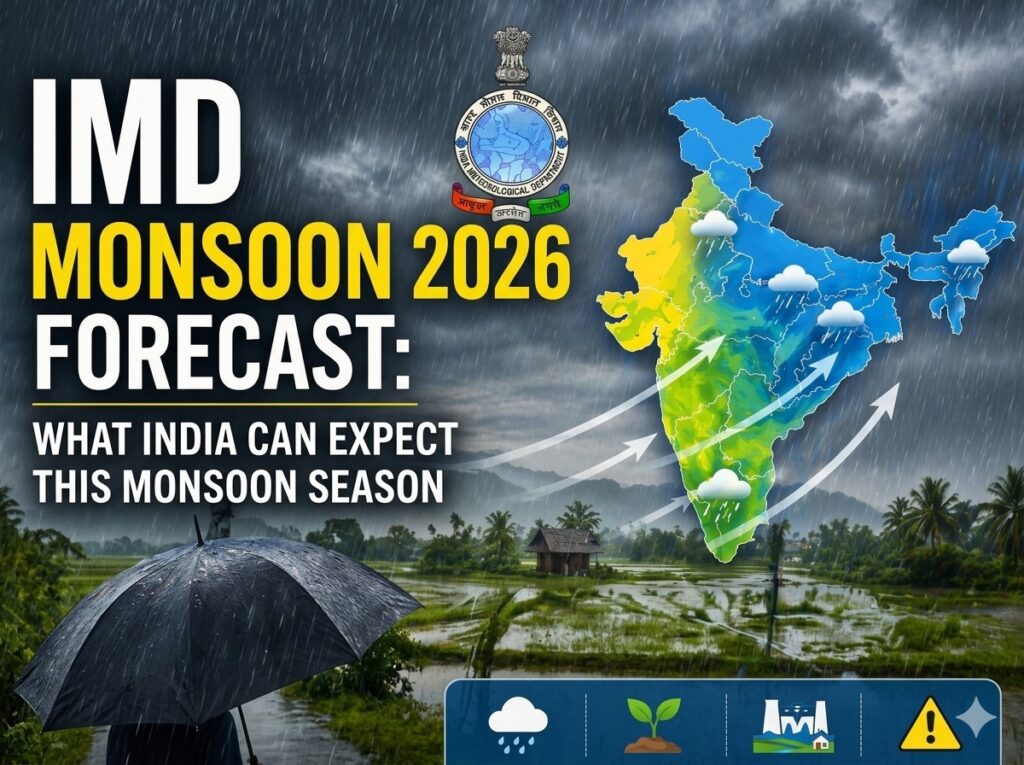
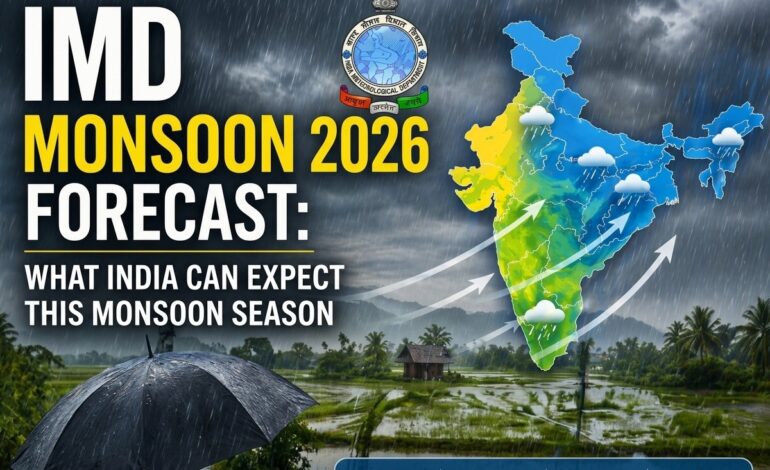
New Delhi: India’s southwest monsoon for 2026 is likely to be below normal, with seasonal rainfall projected at 92% of the Long Period Average (LPA), according to the long-range forecast released by the India Meteorological Department under the Ministry of Earth Sciences.
The forecast places rainfall in the “below normal” category (90–95% of LPA), with a model error margin of ±5%. The LPA for the June–September monsoon, based on 1971–2020 data, stands at 87 cm.
Probability Signals Tilt Toward Deficient Rainfall
Forecast modelling indicates a higher likelihood of weaker rainfall outcomes compared to climatological averages:
- Deficient rainfall (<90% of LPA): 35% probability
- Below normal (90–95%): 31%
- Normal (96–104%): 27%
- Above normal (105–110%): 6%
- Excess (>110%): 1%
The data signals a clear skew toward below-normal and deficient rainfall categories, reducing the probability of above-normal monsoon performance this year.
ENSO Shift and Ocean Conditions to Shape Monsoon
Climate indicators suggest evolving ocean-atmospheric dynamics that could influence the monsoon trajectory:
- Weak La Niña conditions are transitioning toward ENSO-neutral phase
- Models indicate potential development of El Niño conditions during the monsoon
- Neutral Indian Ocean Dipole (IOD) conditions currently prevail, with a positive IOD likely toward the latter half of the season
Sea surface temperature patterns across the Pacific and Indian Oceans are being closely monitored, given their strong influence on monsoon behaviour.
Regional Variations Likely
While most parts of the country are expected to experience below-normal rainfall, some regions – including parts of northeast, northwest, and south peninsular India – may receive normal to above-normal rainfall.
Snow Cover and Climate Linkages
Winter and spring snow cover across the northern hemisphere and Eurasia – observed to be slightly below normal – has an inverse relationship with monsoon rainfall over India, adding another variable to seasonal projections.
Forecasting Framework and Next Update
The IMD’s forecast is based on a Multi-Model Ensemble (MME) approach combining global climate models and its Monsoon Mission Climate Forecast System. The long-range forecast is issued in two stages, with an updated outlook scheduled for the last week of May 2026.