Union Budget 2026–27: Industry Welcomes Manufacturing, Infrastructure and AI Push, Sees Circular Economy as Growth Pillar
New Delhi: Industry leaders across infrastructure, technology, sustainability, manufacturing, healthcare and real estate have broadly welcomed the Union Budget 2026–27, describing it as a decisive step towards strengthening India’s manufacturing
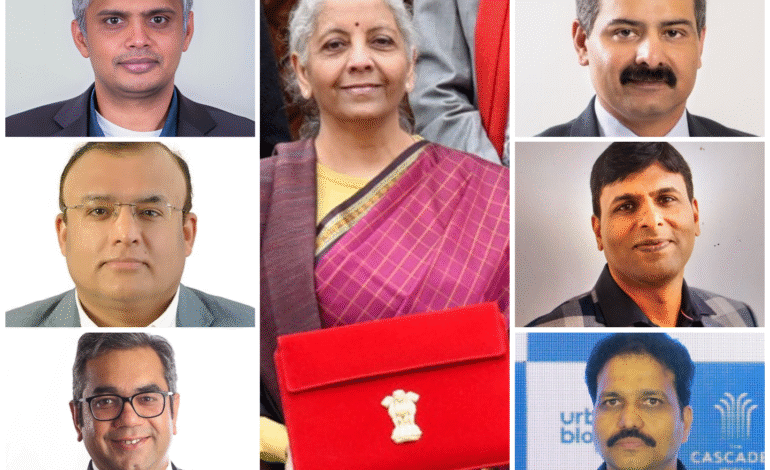
Industry leaders across infrastructure, technology, sustainability, manufacturing, healthcare and real estate have broadly welcomed the Union Budget 2026–27, describing it as a decisive step towards strengthening India’s manufacturing base, accelerating infrastructure development, deepening technology adoption and embedding sustainability into economic growth.

New Delhi: Industry leaders across infrastructure, technology, sustainability, manufacturing, healthcare and real estate have broadly welcomed the Union Budget 2026–27, describing it as a decisive step towards strengthening India’s manufacturing base, accelerating infrastructure development, deepening technology adoption and embedding sustainability into economic growth.
The Budget’s emphasis on scaling up manufacturing in strategic and frontier sectors, expanding public capital expenditure to ₹12.2 lakh crore, advancing AI and semiconductor ecosystems, and supporting circular economy infrastructure drew strong reactions from corporate leaders, who said the measures provide long-term policy clarity and investment confidence.
Circular economy and resource security gain policy depth
Masood Mallick, Chairman of the CII National Committee on Waste to Worth Technologies and Managing Director and Group CEO of Re Sustainability Limited, said the Budget marks a structural shift in how India views sustainability and resource security.
“The Union Budget 2026–27 marks a decisive shift in how India approaches resource security and decarbonisation—treating them as strategic economic priorities rather than regulatory afterthoughts,” Mallick said.
He highlighted the ₹20,000 crore allocation for Carbon Capture, Utilisation and Storage (CCUS) as a critical signal for hard-to-abate sectors such as steel and cement, especially in the context of global trade mechanisms like the EU’s Carbon Border Adjustment Mechanism.
Mallick also pointed to duty exemptions for critical mineral processing, support for rare-earth corridors and incentives for battery energy storage and biogas-blended CNG as measures that recognise secondary resources as strategic assets.
“By placing execution, scale, and infrastructure at the centre of its approach, this Budget positions circularity as foundational to India’s manufacturing resilience and its Viksit Bharat ambitions,” he said.
Technology, AI and digital infrastructure seen as growth multipliers
Abhay Deshpande, founder and CEO of Recykal, said the Budget reinforces technology as the backbone of India’s industrial and sustainability transition.
“Union Budget 2026 has put a strong emphasis on AI adoption, semiconductor manufacturing, and digital infrastructure. India’s investment in AI and technology will significantly enhance our national tech stack,” Deshpande said.
He noted that with ₹40,000 crore for semiconductor expansion, rare earth corridors, chemical parks and the revival of legacy industrial clusters, the Budget clearly recognises that digital traceability and technology-enabled platforms will be essential to scaling India’s circular economy.
Sree Balaji, co-founder and group CEO of iLink Digital, echoed similar views, saying the Budget positions AI as central to enterprise competitiveness.
“Initiatives such as the India AI Mission and the recognition of AI as a force multiplier for governance and enterprise operations create a positive outlook for AI-led modernisation across manufacturing and services,” Balaji said.
Infrastructure, risk mitigation and asset monetisation welcomed
Sunil Nair, CEO of Ramky Infrastructure Ltd, described the Budget as a reaffirmation of confidence in India’s infrastructure growth story.
“The proposal to establish an Infrastructure Risk Guarantee Fund is a particularly forward-looking intervention. It directly addresses risk perception during early-stage project development and construction,” Nair said.
He also welcomed the move to accelerate asset monetisation through REITs for CPSE-owned real estate, calling it a catalyst for unlocking capital and driving investment across logistics, housing and industrial infrastructure.
“With capital expenditure of ₹12.2 lakh crore, the Budget reaffirms infrastructure as the backbone of India’s economic momentum,” he added.
Human capital, services and IT reforms draw support
Sandeep Kumar Jain, Managing Director of CDK Global, said the creation of a High-Powered Education-to-Employment and Enterprises Standing Committee signals a meaningful shift in India’s human capital strategy.
“By directly linking education, skilling, employment and entrepreneurship, the government is building the connective tissue needed for sustainable growth in the services sector,” Jain said.
He also welcomed the unified IT services framework, noting that it simplifies compliance, reduces arbitrage and strengthens India’s position as a global digital services hub.
Healthcare expansion welcomed, insurance gap flagged
Ravi Vishwanath, board member and director at Narayana Health Insurance, said the Budget continues the momentum of healthcare infrastructure expansion but cautioned that financial protection remains a critical gap.
“As healthcare capacity expands, the next phase of reform must focus on making insurance simpler, more affordable, and better aligned with care delivery,” Vishwanath said, pointing to India’s low insurance penetration and high out-of-pocket expenditure.
Real estate, housing and green construction gain policy clarity
Lakshmi Narayana G, designated partner at Laxmi Infra (GHR Lakshmi Urbanblocks Infra LLP), said the Budget positions real estate as a key growth engine by reducing risk and attracting institutional capital.
“The push for Green Credits and incentives for sustainable construction technologies signals a clear policy shift toward environmentally responsible development,” he said.
He also highlighted simplified NRI transaction norms and the Construction and Infrastructure Equipment scheme as positive for premium housing markets such as Hyderabad.
Hardware, deep tech and innovation ecosystem encouraged
Kulpreet Sahni, founder and CEO of Chiltier, said the focus on semiconductors, rare earth corridors and industry-driven R&D is a strong signal for India’s hardware and deep-tech ecosystem.
“The ability to tap into domestic components, power electronics and materials is essential to building robust, affordable solutions at scale,” Sahni said, adding that the emphasis on skills and research will help India move from assembly to full-stack innovation.
A confidence-building Budget for long-term growth
Across sectors, industry leaders agreed that Union Budget 2026–27 provides policy continuity, execution focus and long-term visibility, creating conditions for sustained private investment. By aligning manufacturing depth, infrastructure scale, digital capability and sustainability goals, the Budget is being seen as a foundational step towards building a resilient, competitive and inclusive Indian economy.
Harsha Solanki, VP GM Asia, Infobip, said, “We welcome the Union Budget 2026, which reinforces India’s shift towards a competitive, AI-driven digital economy. By prioritizing new technologies and promoting innovation through initiatives such as the AI Mission, the National Quantum Mission, and the Research and Development and Innovation Fund, the government is laying a solid foundation, enabling businesses to adopt smarter, more intelligent solutions across their operations.
The long-term tax holiday for global cloud service providers and investments in data centers will help free up costs, allowing companies to invest more in AI innovation, ensure performance and reliability, and expand their infrastructure. Complementing this, expanding the safe harbor threshold for IT and tech services will ensure regulatory clarity and reduce compliance burdens, making it easier for technology providers to scale their operations.
For SMEs, these initiatives are transformative. The combination of AI technologies, simplified compliance, and accessible digital infrastructure opens new paths for growth. It empowers them to improve efficiency, engage customers better, expand their presence, and participate more in India’s next phase of digital growth. At Infobip, we sit at the intersection of intelligent automation and cloud communications, and these measures will enable tech platforms like us to innovate more responsibly and deepen localization while empowering businesses to create a more connected, safer, and outcome-driven experience for their customers.”
Srinath Setty, CEO & Co-Founder, Hosachiguru: “The Union Budget 2026 strengthens the case for farmland to be viewed as a long-term sustainability asset, built on soil health, water security, and climate resilience. The higher allocation and the integrated development of 500 reservoirs are practical signals that water and land stewardship are moving up the national priority list.
For managed farmland, these measures matter because they support outcomes that investors and landowners increasingly look for: stable productivity without soil depletion, crop diversity that reduces risk, and resilience against weather shocks. The continued push for natural farming aligns with regenerative practices that improve soil structure over time, while faster settlements under the crop insurance framework help protect the downside in extreme seasons. Put together, this policy direction supports a more responsible, future-ready approach to owning and managing farmland.”
Aparna Reddy, Executive Director, Aparna Enterprises Ltd: “We welcome the Union Budget 2026–27, which reinforces infrastructure as a key pillar of India’s growth journey. The enhanced capital expenditure allocation of ₹12.2 lakh crore signals continued support for large-scale construction and connectivity projects, helping sustain momentum across the infrastructure ecosystem. The proposed Infrastructure Risk Guarantee Fund addresses an important challenge in project execution by helping mitigate risks during the construction and early development phases. By improving financing confidence for developers and lenders, this measure can contribute to stronger project viability and more predictable execution timelines.
The Budget’s emphasis on planned urban development through City Economic Regions, along with continued infrastructure expansion in Tier II and Tier III cities, reflects an approach that supports more balanced urban growth beyond traditional metropolitan centres. As these emerging cities continue to grow, improved connectivity and infrastructure are expected to drive demand for housing, commercial real estate, and supporting urban amenities. This expansion will translate into sustained construction activity and steady demand for high-quality building materials such as cement and concrete. The scale and spread of infrastructure initiatives outlined in the Budget create a conducive environment for long-term capacity building in the construction sector, supporting the development of resilient cities and addressing the evolving needs of a rapidly urbanising population.”
Vishak Raman, Vice President of Sales, India, SAARC, SEA & ANZ, Fortinet: “Budget 2026 reflects India’s intent to strengthen its position as a trusted hub for digital services, cloud, and advanced technologies. Steps to simplify the IT services framework, encourage data center investments, and push wider AI adoption are aimed at building long-term competitiveness. At the same time, as digital infrastructure scales, complexity, and cyber risk increase.
Cyber risk today is continuous, not episodic, and organizations need to plan for resilience as a core business requirement. Embedding security into digital foundations will be critical to protecting data, ensuring continuity, and maintaining trust as India’s digital economy continues to expand.”
Sunil Jose, President – Workday India: “This year’s Budget places people, skills, and AI at the centre of India’s long-term growth agenda. By encouraging large-scale AI investments and inviting global organisations to build and innovate in India through tax incentives extending up to 2047, the government is reinforcing India’s ambition to become a global hub for talent and technology. The focus on education-to-employment pathways, continuous skilling, and AI-enabled workforce transformation reflects a clear understanding of how work is evolving. For organisations, sustained investments in skills, workforce agility, and human-centric technology will be critical to driving productivity and inclusive growth.”