National Conference on Rare Diseases Focuses on Early Diagnosis, Innovation and Collaboration
The conference will feature technical sessions on genomic technologies, collaborative research, affordable treatment strategies and patient-centric care models, with a focus on improving access and outcomes.
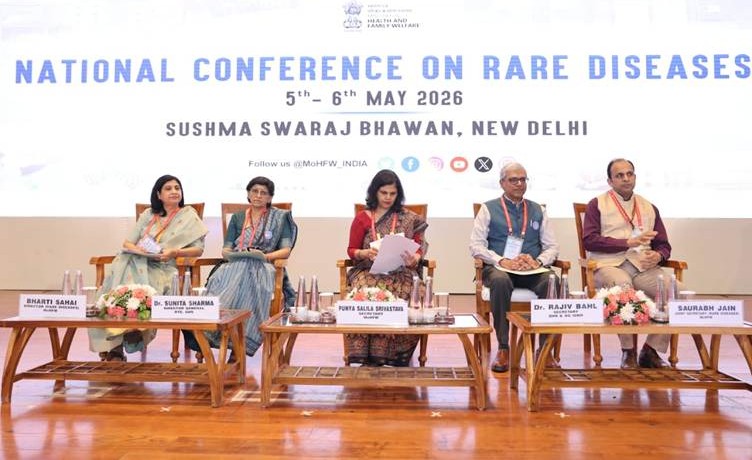
The conference, being held on May 5–6, aims to address key challenges in diagnosis, treatment and access, while encouraging innovation and collaboration across sectors.

New Delhi: The Ministry of Health and Family Welfare on Tuesday inaugurated a two-day national conference on rare diseases, bringing together policymakers, clinicians, researchers and industry stakeholders to strengthen India’s response to complex and often underdiagnosed health conditions.
The conference, being held on May 5–6, aims to address key challenges in diagnosis, treatment and access, while encouraging innovation and collaboration across sectors.
Health Secretary Punya Salila Srivastava said the initiative is designed to generate new ideas and solutions to improve rare disease management. She noted that India has made significant progress since the National Health Policy, 2017, with the launch of the National Policy for Rare Diseases, 2021 providing a structured national framework.
The policy is being implemented through Centres of Excellence (CoEs), whose number has increased from 8 to 15 across the country, including facilities in the Northeast. Financial assistance for treatment has also been enhanced to ₹50 lakh per patient, improving access to care for those affected by identified rare diseases.
Srivastava emphasised the importance of early diagnosis through genetic analysis and screening, along with wider awareness and capacity-building initiatives across states.
Secretary, department of health research and director general of the Indian Council of Medical Research, Rajiv Bahl, highlighted the need for an India-specific model for rare disease care that optimises resources and leverages domestic innovation.
He pointed to progress in indigenous research, including efforts to develop affordable therapies and repurpose existing drugs to improve patient outcomes. He also noted advancements in emerging technologies such as gene therapy, including developments like CAR-T cell therapy, as indicators of India’s growing capabilities in advanced treatment domains.
Director general of health services Sunita Sharma stressed the need to integrate rare disease services across all levels of healthcare, strengthen referral systems and expand screening programmes to improve early detection and treatment outcomes.
Speakers said rare diseases, though individually rare, collectively affect a significant population, with nearly half of new cases occurring in children. Limited awareness, delayed diagnosis and high treatment costs continue to pose major challenges.
The conference will feature technical sessions on genomic technologies, collaborative research, affordable treatment strategies and patient-centric care models, with a focus on improving access and outcomes.
The ministry reiterated its commitment to ensuring timely, affordable and quality healthcare for patients affected by rare diseases, while strengthening coordination among stakeholders to address this complex public health challenge.