GST Collections Hit Record ₹2.43 Lakh Crore in April, Signal Strong Consumption and Import Momentum
8.7% growth driven by domestic demand, surge in imports and improved compliance
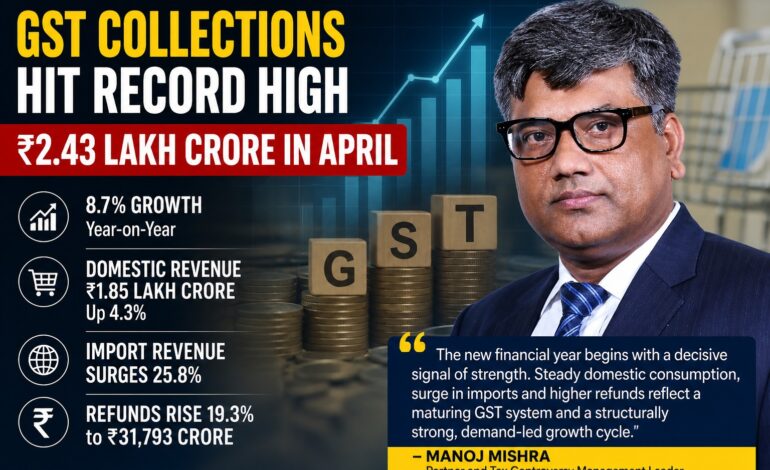
Manoj Mishra, Partner and Tax Controversy Management Leader at Grant Thornton Bharat, said the April numbers mark a decisive signal of economic resilience.

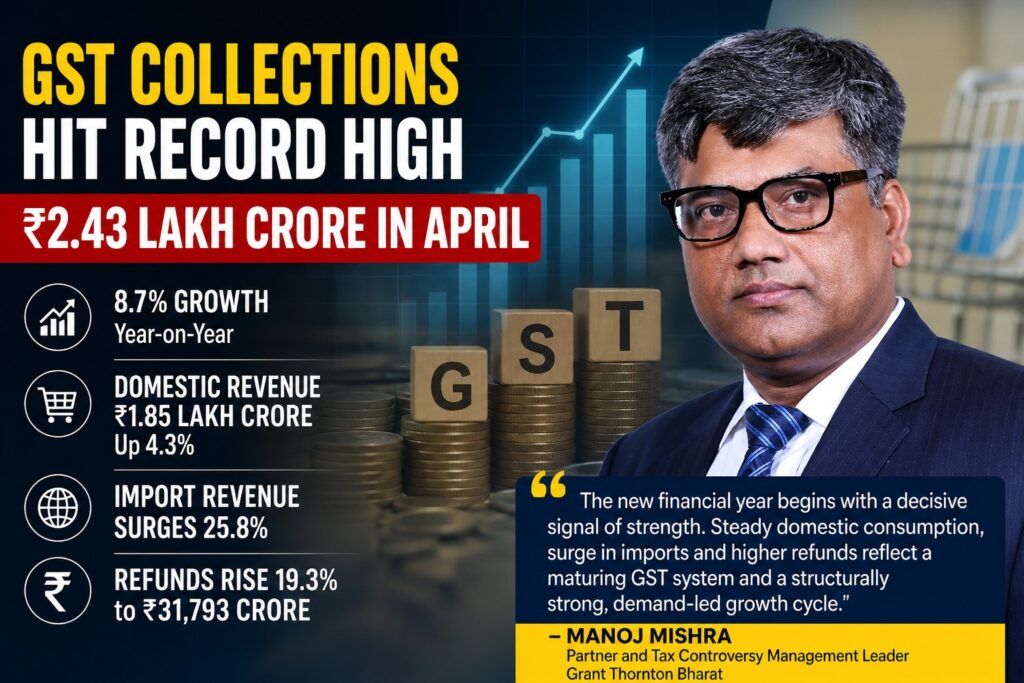
New Delhi: India’s Goods and Services Tax (GST) collections touched an all-time high of ₹2.43 lakh crore in April 2026, marking an 8.7% year-on-year increase and reinforcing the strength of the country’s consumption-led growth cycle.
According to official data, gross domestic revenue stood at ₹1.85 lakh crore, registering a 4.3% growth over April last year, indicating steady underlying consumption trends rather than one-off spikes.
Import-driven revenues recorded a sharp 25.8% surge, reflecting improving global trade linkages and supply chain normalisation. At the same time, total GST refunds rose 19.3% to ₹31,793 crore, highlighting improved liquidity flow within the system.
Expert View
Manoj Mishra, Partner and Tax Controversy Management Leader at Grant Thornton Bharat, said the April numbers mark a decisive signal of economic resilience.
“The new financial year begins with a clear sign of strength as GST collections scale a record ₹2.43 lakh crore. The growth is supported by stable domestic revenues, pointing to sustained consumption rather than volatility. The sharp rise in import revenues reflects resilient external demand and supply chain normalisation,” he said.
He added that the increase in refunds alongside higher collections reflects a maturing GST system that balances revenue buoyancy with liquidity efficiency.
Mishra noted that large, consumption-driven states such as Maharashtra, Karnataka, Gujarat and Uttar Pradesh continue to dominate collections, indicating both strong compliance and economic concentration.
He further said that India’s GST performance aligns with its broader macroeconomic trajectory as the fastest-growing major economy, with growth estimated at around 6.5%, driven by formalisation and demand expansion.
State-Level Trends
Data shows strong contributions from major industrial and consumption hubs, with states like Maharashtra, Karnataka and Telangana recording steady growth in collections, underlining the role of urban economic centres in driving tax buoyancy.