Defence Tech Push Accelerates as India Prioritises R&D, Industry Collaboration
Focus on AI, Hypersonics, Quantum and Space Technologies to Shape Future Warfare Landscape
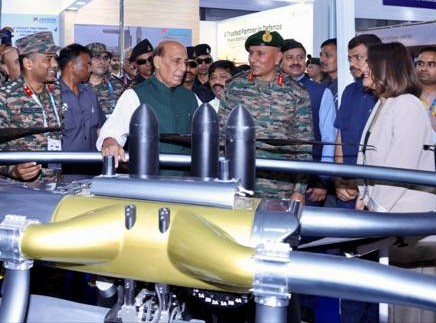
The Defence Acquisition Council (DAC), chaired by Defence Minister Rajnath Singh, accorded Acceptance of Necessity (AoN) for a wide range of platforms and systems for the Indian Army, Navy and Air Force, with approximately 98% of the procurements to be sourced from Indian industry, in New Delhi on Monday.

Prayagraj: India is intensifying its push towards advanced defence technologies, with a sharp focus on research, innovation and industry collaboration to stay ahead in an increasingly unpredictable global security environment.
Addressing stakeholders at the North Tech Symposium in UP’s Prayagraj on Monday, Defence Minister Rajnath Singh highlighted that rapid technological transformation is redefining modern warfare, shifting the emphasis from conventional platforms to emerging tools such as drones, sensors and AI-driven systems.
He noted that future conflicts will be shaped in laboratories as much as on battlefields, underlining that countries capable of adapting swiftly to technological disruption will hold a decisive strategic advantage.
The government has placed defence research at the core of its policy framework, expanding collaboration with industry, academia and start-ups. Around 25 percent of the defence R&D budget has been allocated to these stakeholders, with over ₹4,500 crore already utilised to drive innovation and technology development.
In a significant policy shift, the Defence Research and Development Organisation has waived technology transfer fees and opened access to patents and testing facilities, enabling private players to accelerate product development and scale manufacturing capabilities.
More than 2,200 technologies have already been transferred to industry, reflecting a growing emphasis on building a self-reliant defence ecosystem supported by domestic innovation.
The government is now pushing industry to scale capabilities in critical future domains, including directed energy weapons, hypersonic systems, underwater surveillance, space situational awareness, quantum technologies and artificial intelligence.
India’s defence manufacturing sector is also witnessing strong growth. Domestic production reached a record ₹1.54 lakh crore in FY 2025–26, while defence exports touched an all-time high of ₹38,424 crore, signalling increasing global competitiveness of Indian firms.
Industry participation is being further strengthened through initiatives such as iDEX, ADITI and the Technology Development Fund, aimed at fostering innovation and enabling start-ups and MSMEs to contribute to defence capabilities.
The symposium also highlighted the need to translate innovation into deployable systems. Senior military officials pointed to the growing importance of unmanned aerial systems, counter-drone technologies, AI-enabled decision tools and precision strike capabilities in modern warfare environments.
With 284 companies showcasing indigenous technologies at the event, the defence ecosystem is increasingly aligning towards a model where research, industry and operational requirements converge.
The government’s strategy reflects a broader shift towards technological self-reliance and future-readiness, positioning India to emerge as a major global defence manufacturing and innovation hub in the coming decade.