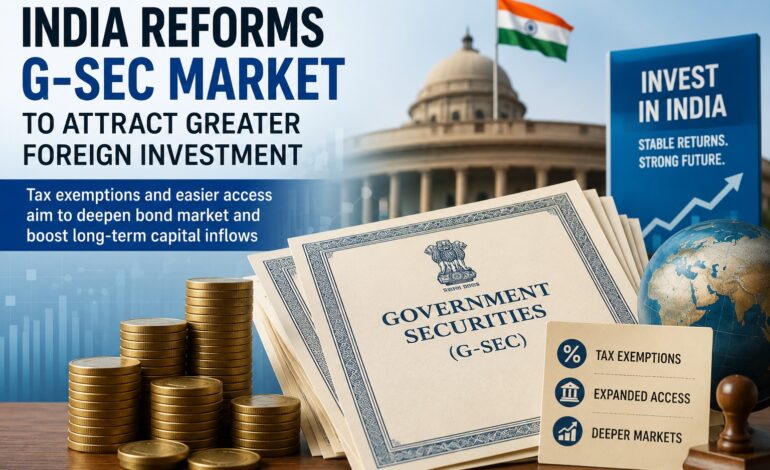
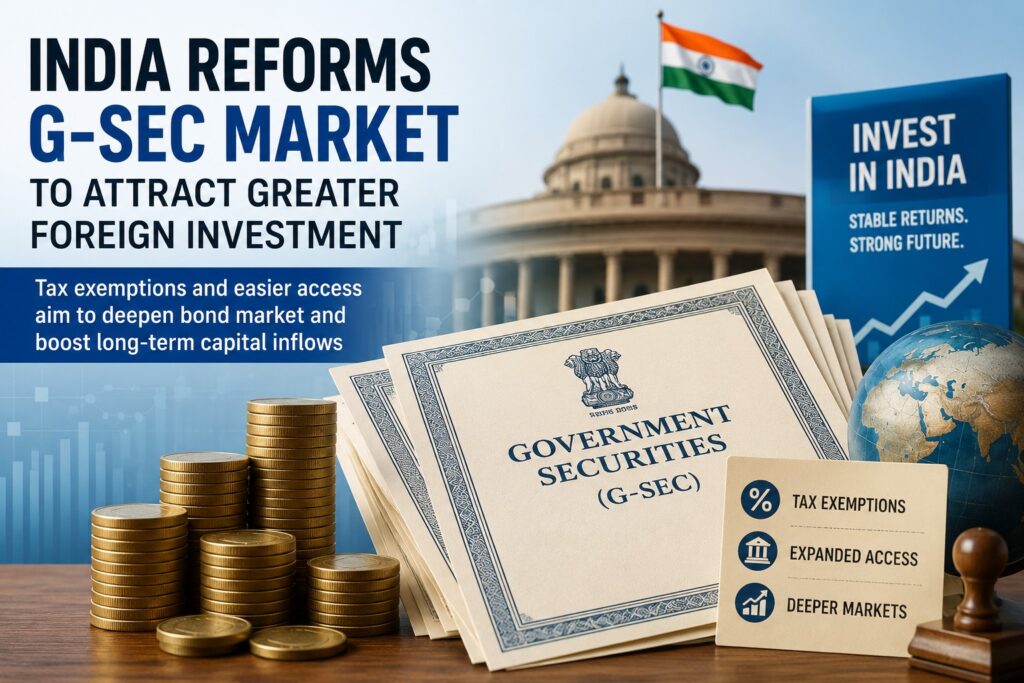
India Unveils Reforms to Boost Foreign Investment in G-Secs
Tax exemptions, expanded investment access aim to deepen bond market and attract long-term global capital
According to official data, foreign investors held government securities worth ₹3.75 lakh crore as of May 12, 2026, representing 3.34% of the total outstanding G-Sec stock of ₹112.42 lakh crore.

New Delhi: The Government of India has announced a series of reforms aimed at increasing foreign participation in the country’s government securities (G-Sec) market, including sweeping tax exemptions and easier investment norms designed to attract long-term global capital and deepen domestic bond markets.
The measures are part of the government’s broader strategy to strengthen India’s position as a global investment destination while improving liquidity, price discovery and efficiency in the sovereign debt market. Officials expect the reforms to attract institutional investors such as pension funds, insurance companies and sovereign wealth funds, bringing more stable capital flows into the country.
A key reform is the introduction of tax exemptions for Foreign Portfolio Investors (FPIs) and Foreign Institutional Investors (FIIs) investing in government securities. Under the new regime, interest income as well as capital gains arising from the sale, transfer, exchange or redemption of G-Secs will be exempt from tax for eligible foreign investors. The exemptions will apply to income earned on or after April 1, 2026.
Prior to the reform, foreign investors were required to pay 20% tax on interest income from government securities, while short-term capital gains were taxed at 30% and long-term capital gains at 12.5%. The government believes eliminating these taxes will improve the attractiveness of Indian sovereign debt relative to competing global markets.
The reforms also expand the scope of the Fully Accessible Route (FAR), which allows foreign investors to invest in designated government securities without many of the restrictions applicable under the General Route. The expanded framework will now include new issuances of 15-year, 30-year and 40-year government securities, along with sovereign green bonds issued in eligible tenors.
In another significant move, the government has removed several investment restrictions under the General Route, including short-term investment limits, concentration limits and security-wise investment caps. However, overall foreign investment limits remain unchanged at 6% of the outstanding stock of central government securities and 2% of state government securities.
According to official data, foreign investors held government securities worth ₹3.75 lakh crore as of May 12, 2026, representing 3.34% of the total outstanding G-Sec stock of ₹112.42 lakh crore. The majority of these investments were made through the Fully Accessible Route, which accounted for holdings of ₹3.21 lakh crore.
Government officials said greater foreign participation in the G-Sec market would provide an additional source of funding for infrastructure development, manufacturing, urban projects and climate-related initiatives. Increased investor participation is also expected to support the development of a more efficient yield curve, strengthen market benchmarks and improve the transmission of monetary policy across the economy.
The reforms are expected to support India’s ongoing efforts to integrate more closely with global financial markets and enhance the appeal of Indian bonds among international investors. Policymakers believe the measures could pave the way for larger foreign inflows into both debt and equity markets while reinforcing India’s reputation as one of the world’s fastest-growing major economies.
What Are G-Secs?
Government Securities, commonly known as G-Secs, are tradable debt instruments issued by the central and state governments to finance public expenditure, manage fiscal deficits and regulate market liquidity. Foreign investors can participate in this market through approved investment routes, making G-Secs an important component of India’s financial architecture.