India Reaffirms Commitment to WTO-Centred, Fair Trade System at SCO Trade Ministers’ Meeting
New Delhi, September 7: India underlined the need for collective action to strengthen regional trade and economic resilience at the Shanghai Cooperation Organisation (SCO) Trade Ministers’ Meeting held in Vladivostok

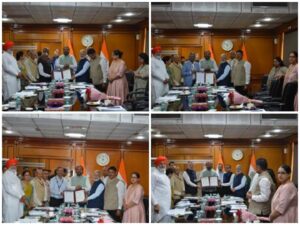
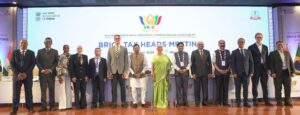
Delegates at the Shanghai Cooperation Organisation (SCO) Trade Ministers’ Meeting held in Vladivostok on September 6.

New Delhi, September 7: India underlined the need for collective action to strengthen regional trade and economic resilience at the Shanghai Cooperation Organisation (SCO) Trade Ministers’ Meeting held in Vladivostok on September 6. Stressing the importance of export diversification and building robust supply chains, India called on member states to leverage the SCO’s collective strengths for shared prosperity. The bloc represents 42 percent of the global population and 17.2 percent of world trade.
Representing Commerce and Industry Minister Amitabh Kumar, Additional Secretary in the Department of Commerce highlighted India’s support for an open, fair, inclusive and non-discriminatory multilateral trading system with the World Trade Organization (WTO) at its core. He emphasised the need for a development-centred agenda that addresses food security through a permanent solution on Public Stockholding (PSH), ensures effective Special and Differential Treatment (S&DT) for developing nations, and restores a fully functional WTO dispute settlement system. He also stressed the significance of services trade, including the temporary movement of skilled professionals, in boosting growth and enabling greater participation of MSMEs in global value chains.
India flagged the need to diversify and de-risk supply and production chains through wider geographical spread, interoperable logistics, predictable market access and enhanced connectivity. It cautioned that export-related measures should not be weaponised to distort markets or disrupt supply chains, and said calibrated, transparent use of such measures was vital to maintain trust in global commerce.
On the digital economy, India showcased its Digital Public Infrastructure (DPI) achievements, including UPI for real-time payments, India Stack for identity and consent management, and ONDC for open digital commerce. It proposed SCO cooperation on fair and secure e-commerce frameworks, voluntary sharing of best practices, and capacity-building to support innovation-led digitalisation. These initiatives, India noted, offer low-cost, replicable models that reduce MSME costs, expand access to markets and enable real-time settlements.
On sustainability, India reiterated its commitment to equity and the principle of Common but Differentiated Responsibilities and Respective Capabilities (CBDR-RC). It drew attention to the Mission LiFE (Lifestyle for Environment) initiative and warned that trade-linked climate measures must not become tools for arbitrary or unjustified discrimination. It also highlighted the importance of finance and technology flows for effective climate action.
The meeting also spotlighted India’s Animation, Visual Effects, Gaming and Comics (AVGC) sector as a driver of jobs, exports and creative growth. India recalled the successful hosting of the first World Audio Visual and Entertainment Summit (WAVES 2025), which led to initiatives such as Waves Bazaar for global media collaboration, WaveX for creative start-up funding, and Creatosphere for talent development. With 17 co-production agreements already in place, and the India Cine Hub emerging under simplified regulatory frameworks, the country is positioning itself as a global hub for film and media production.
Thanking the Russian Presidency for advancing a substantive trade and economic agenda, India reaffirmed its readiness to work with Tajikistan, which assumes the SCO chairmanship for 2026–27, to promote inclusive and sustainable economic growth across the region.