Coal India expands beyond coal with technology-led push into energy, minerals and advanced materials
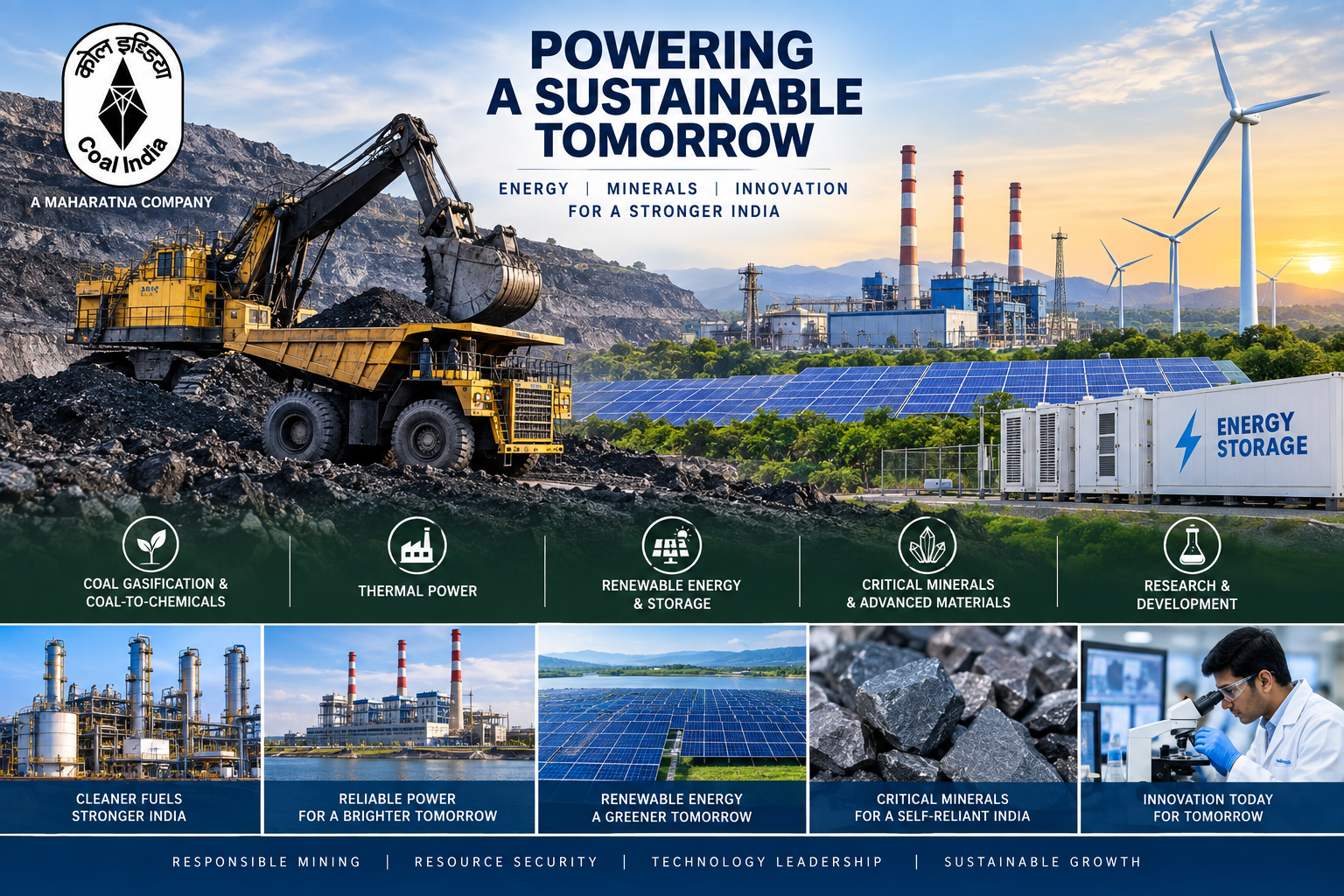
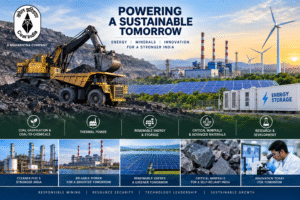
Coal India is building a diversified portfolio spanning coal gasification, thermal power, renewables, battery storage, critical minerals and advanced materials, backed by a growing R&D ecosystem.
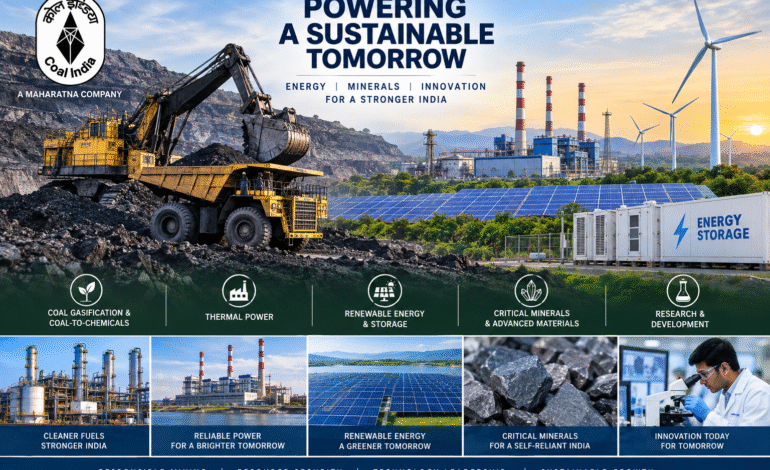
The company’s Business Development portfolio is organised around five platforms: coal gasification and coal-to-chemicals; thermal power; renewable energy and storage; critical minerals and advanced materials; and diversified minerals, including iron ore.

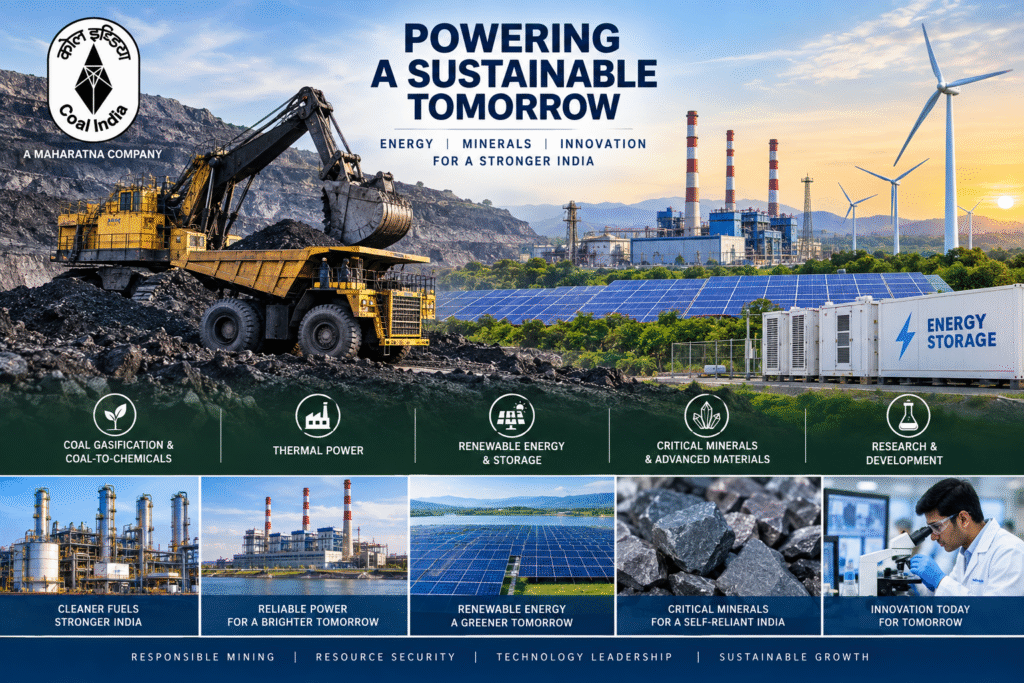
NEW DELHI: Coal India Limited (CIL) is expanding beyond conventional coal mining with a technology-driven diversification strategy covering energy, minerals, advanced materials and research, with projects ranging from coal-to-chemicals and ultra-supercritical power to renewable energy, battery storage and critical minerals.
The company’s Business Development portfolio is organised around five platforms: coal gasification and coal-to-chemicals; thermal power; renewable energy and storage; critical minerals and advanced materials; and diversified minerals, including iron ore.
CIL said the portfolio already includes around ₹69,346 crore across four coal-to-chemicals initiatives, a 2×800 MW Chandrapura ultra-supercritical expansion, about 550 MW of commissioned solar capacity, grid-scale battery energy storage projects and opportunities in critical minerals and downstream materials.
Coal gasification and coal-to-chemicals
Coal gasification converts coal into synthesis gas, or syngas, which can be used to produce products such as synthetic natural gas, ammonia, urea, ammonium nitrate and methanol.
CIL’s four major coal-to-chemicals projects include Talcher Fertilizers, with a 1.27 MMTPA urea plant and estimated cost of ₹19,062.22 crore; Bharat Coal Gasification & Chemicals, with 0.66 MMTPA ammonium nitrate capacity and an estimated cost of ₹25,015.89 crore; Coal Gas India, with annual SNG capacity of 633.6 million Nm³ and an estimated cost of ₹13,052.81 crore; and the CIL-BPCL Chandrapur coal-to-SNG project, also with annual capacity of 633.6 million Nm³ and an estimated cost of ₹12,214.86 crore.
The company is also pursuing underground coal gasification through a phased pilot at the Kasta West Block of Eastern Coalfields. Phase I was completed in May 2025 and Phase II began in June 2025, with completion scheduled for 2026.
Renewables, thermal power and storage
CIL and Damodar Valley Corporation are pursuing a proposed 50:50 joint venture for a 2×800 MW ultra-supercritical brownfield expansion at Chandrapura, Jharkhand. CIL has also commissioned approximately 550 MW of solar capacity and is developing additional rooftop, ground-mounted, captive, interstate and market-linked projects.
A 20 MW AC floating solar project is being developed at Chilwa Taal in Gorakhpur, while battery storage initiatives include a 187.5 MW/750 MWh four-hour BESS project at Choutuppal in Telangana and an 80 MW/320 MWh portfolio across four locations in Odisha.
Critical minerals and graphite value chain
CIL is exploring graphite assets in Madhya Pradesh and Chhattisgarh, along with rare earth element and rare-metal opportunities in Andhra Pradesh and Maharashtra.
The company aims to build an integrated graphite value chain covering mining, beneficiation, purification, spheronisation and coating, followed by production of anode materials. A demonstration plant for coated spherical purified graphite with a proposed purity of at least 99.95% is being developed with the Non-Ferrous Technology Development Centre.
Digital architecture and risk management
CIL plans to establish a common digital architecture covering mining, process industries, power, renewable energy, grid services and advanced materials. This will include project dashboards, GIS-based opportunity mapping, standard financial models and digital engineering requirements.
A stage-gate system will guide projects from opportunity screening and feasibility through demonstration and commercial operation. The company will also use joint ventures and strategic partnerships to access specialised technologies and markets, with emphasis on technology transfer and localisation.
R&D gains larger role
CIL’s R&D framework, which traces its institutional evolution to the Standing Committee on Science and Technology established in 1975, has now moved to an independent R&D Policy and Guidelines framework for 2026, prioritising projects at Technology Readiness Level 4 and above.
The R&D focus includes artificial intelligence, machine learning and IoT-based smart mining, environmental sustainability, waste-to-wealth, technology indigenisation, alternative uses of coal, renewable energy, clean coal, beneficiation and mineral processing.
CIL-supported Centres of Excellence include facilities at IIT Madras and IIT Hyderabad, as well as centres at IIT (ISM) Dhanbad focusing on Mining 4.0, smart mines, IoT, immersive technologies, 5G, incubation and automation.
The current R&D portfolio comprises 20 projects with an approved outlay of ₹231 crore. CIL reported R&D expenditure of ₹61.31 crore in FY2023-24, ₹245.38 crore in FY2024-25 and ₹183.88 crore in FY2025-26. Planned expenditure rises to ₹225 crore in FY2026-27, ₹350 crore in FY2027-28, ₹400 crore in FY2028-29 and ₹500 crore in FY2029-30.
During FY2026-27, CIL has filed five patents, with two more under process, while one patent for bifacial perovskite solar cells has been granted. The company has also transferred technology for commercialisation of Velocity of Detonation measurement equipment.
The company said its next phase will focus on converting technology initiatives into scalable and commercially sustainable projects through validation, indigenous capability, strategic partnerships, disciplined investment and digital governance. Strengthening the R&D hub-and-spoke ecosystem is expected to accelerate the movement of research from laboratories to field deployment.