PM-AASHA gets ₹7200 crore allocation as government expands MSP-based price support for farmers
PM-AASHA has received a ₹7,200 crore allocation for 2026-27, with expanded procurement, digital reforms and price support mechanisms aimed at improving farmers’ price realisation.
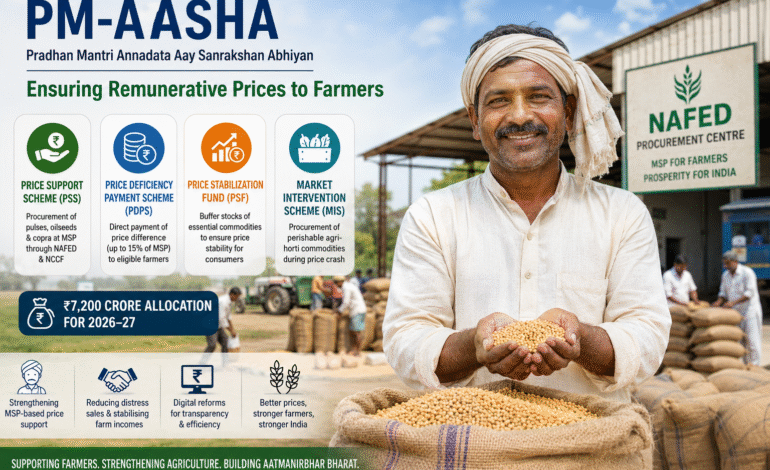
Launched in September 2018, PM-AASHA brings together multiple price-support mechanisms covering procurement, price deficiency payments, price stabilisation and market intervention.

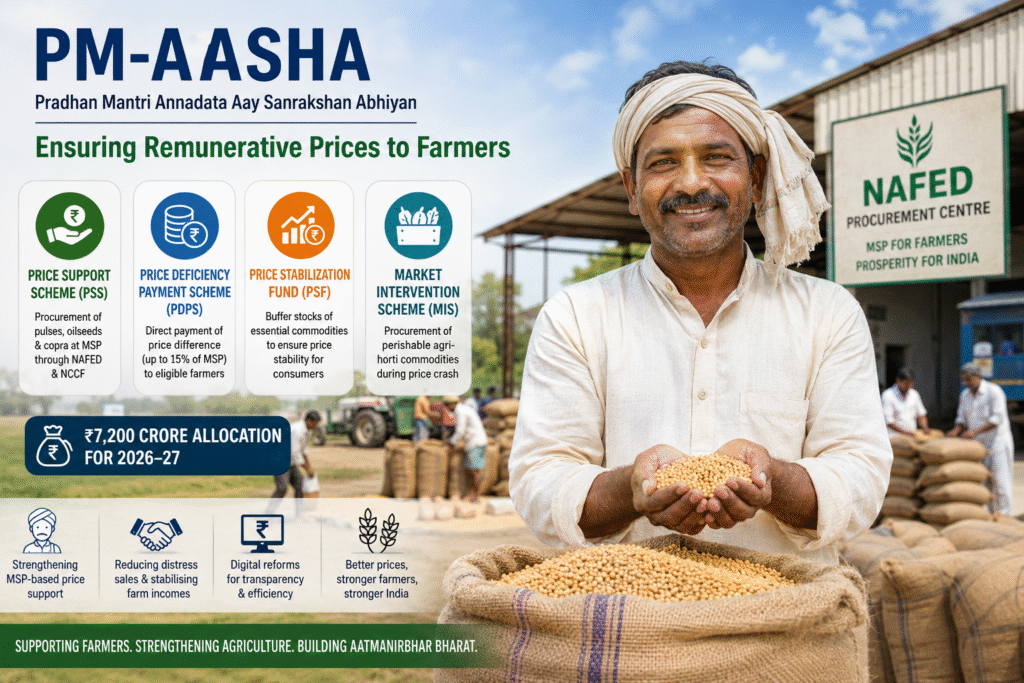
NEW DELHI: The government has allocated ₹7,200 crore to the Pradhan Mantri Annadata Aay Sanrakshan Abhiyan (PM-AASHA) for 2026-27 as it strengthens mechanisms aimed at ensuring remunerative prices for farmers and reducing distress sales.
Launched in September 2018, PM-AASHA brings together multiple price-support mechanisms covering procurement, price deficiency payments, price stabilisation and market intervention. The framework is intended to improve farmers’ price realisation while also helping maintain price stability for consumers.
The scheme comprises four major components: the Price Support Scheme (PSS), Price Stabilization Fund (PSF), Price Deficiency Payment Scheme (PDPS) and Market Intervention Scheme (MIS).
Under PSS, pulses, oilseeds and copra are procured at MSP when market prices fall below the support price. Procurement is carried out through agencies including NAFED and NCCF at the request of state governments. Since the 2024-25 procurement year, procurement of these commodities has generally been allowed up to 25% of a state’s or Union Territory’s production, while procurement of Tur, Urad and Masur has been permitted up to 100% of state production to encourage domestic pulse production and reduce imports.
The Price Stabilization Fund maintains buffer stocks of essential commodities such as pulses, onions and potatoes. Commodities are procured during harvest and released during lean periods to moderate price spikes and maintain consumer affordability. The PSF has been merged with PM-AASHA but continues to be managed by the Department of Consumer Affairs.
Under PDPS, farmers do not have to physically sell their produce to procurement agencies. Instead, eligible farmers receive the difference between the MSP and the actual market price in the notified market, subject to a limit of 15% of the MSP value. The mechanism is mainly used for oilseeds.
The Market Intervention Scheme covers perishable agricultural and horticultural commodities such as tomatoes, onions and potatoes, for which MSP does not apply. It can be activated when market prices fall by at least 10% compared with the previous normal season’s rates, with operations undertaken through a cost-sharing arrangement between the Centre and states.
The PM-AASHA allocation has risen from actual expenditure of ₹5,437.99 crore in 2024-25 to a budget allocation of ₹6,941.36 crore in 2025-26 and ₹7,200 crore in 2026-27.
The framework also highlights the gap between production costs and MSP for several major crops in 2026-27. Paddy (common) has a reported production cost of ₹1,627 per quintal against an MSP of ₹2,441, while soybean has a cost of ₹3,805 against an MSP of ₹5,708. Wheat has a production cost of ₹1,239 against an MSP of ₹2,585, while jute has a cost of ₹3,662 against an MSP of ₹5,925.
The document also points to wider investments in agricultural marketing and post-harvest infrastructure. The Agriculture Infrastructure Fund has sanctioned loans worth ₹96,426 crore for 2,14,437 projects, while e-NAM has integrated 1,656 mandis across 23 states and four Union Territories, facilitating trade worth ₹4,94,847 crore. The government has also sanctioned 50,249 warehouses with storage capacity of 992.6 lakh metric tonnes.
In Bihar, organised procurement of masoor has been initiated for the first time through NCCF, with operations covering 48 Primary Agricultural Credit Societies and Farmer Producer Organisations. As of August 10, 2026, NCCF had procured 1,042.65 tonnes of masoor, while NAFED had procured 1,814.13 tonnes.
In Chhattisgarh, PM-AASHA procurement has been expanded through 200 operational PACS and 12 FPOs. As of August 10, NCCF had procured 18,392.228 tonnes of chana, 22.231 tonnes of masoor and 1,035.0205 tonnes of mustard, while NAFED had procured 17,020.65 tonnes of chana and 355.05 tonnes of masoor.
The government said digital reforms, including biometric farmer authentication, direct procurement from pre-registered farmers and digital procurement platforms, have strengthened transparency and efficiency. The overall framework is aimed at improving price realisation, reducing distress sales and supporting a more stable agricultural economy.