Digital India at 11: How a Government Programme Became the Operating System of a New India
From digital payments and healthcare to education, governance and artificial intelligence, Digital India has evolved into the country's most influential public technology platform, reshaping everyday life for more than 1.4
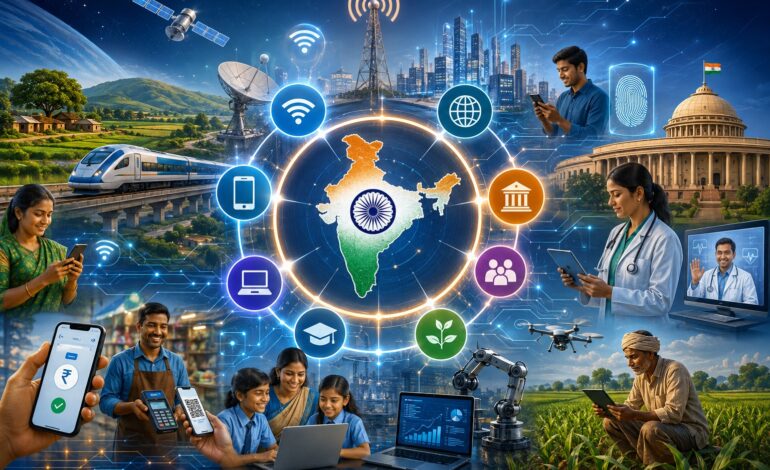
Today, Digital India powers nearly every aspect of India's governance ecosystem - from banking and healthcare to education, agriculture, taxation, commerce, logistics and justice. It has quietly become the digital operating system of the world's largest democracy.

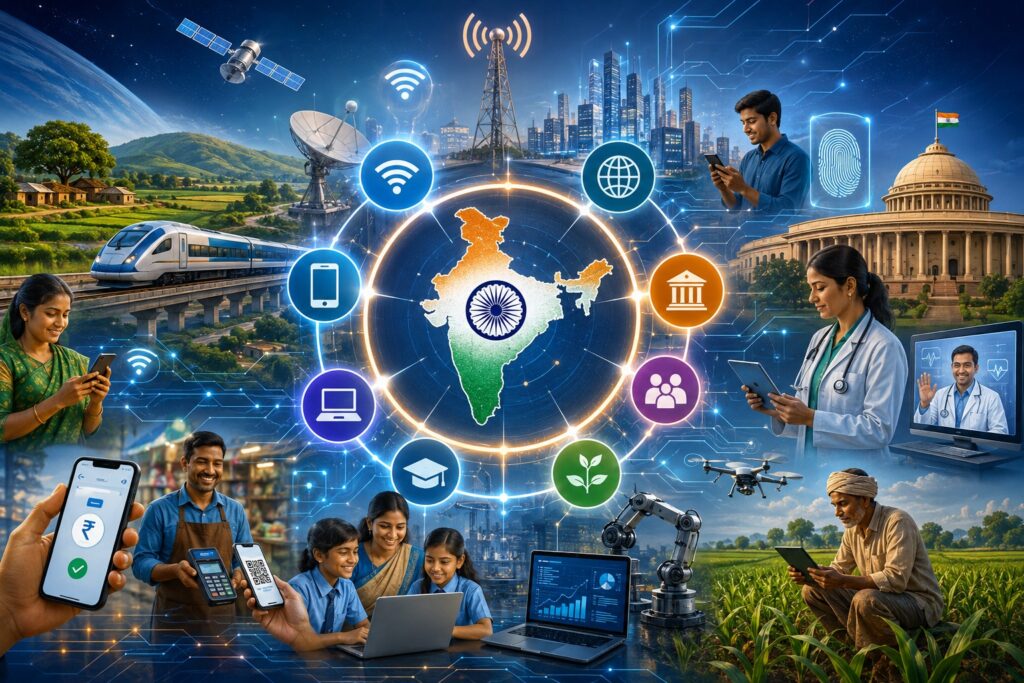
New Delhi: When the Government of India launched the Digital India programme on July 1, 2015, the objective appeared straightforward: improve internet connectivity, digitise government services, and reduce paperwork.
Eleven years later, that vision has expanded far beyond administrative reform.
Today, Digital India powers nearly every aspect of India’s governance ecosystem – from banking and healthcare to education, agriculture, taxation, commerce, logistics and justice. It has quietly become the digital operating system of the world’s largest democracy.
Unlike many technology missions centred on hardware or software alone, Digital India has built something much larger: an integrated Digital Public Infrastructure (DPI) ecosystem where identity, payments, documentation, healthcare, education and public services interact seamlessly.
The transformation has positioned India as one of the world’s leading examples of population-scale digital governance.
From Connectivity to Capability
The first phase of Digital India focused on building infrastructure.
Broadband highways, mobile connectivity, Common Service Centres and public internet access sought to bridge India’s enormous digital divide. Today, nearly all Gram Panchayats have broadband connectivity through BharatNet, more than 106 crore broadband subscribers use internet services, and over 6.5 lakh Common Service Centres deliver government services in rural India.
This physical digital infrastructure created the foundation upon which every subsequent digital platform was built.
Unlike conventional infrastructure projects that end with construction, Digital India created a continuously expanding ecosystem where every new platform strengthens the others.
The JAM Revolution
Perhaps no initiative illustrates this better than the JAM Trinity—Jan Dhan, Aadhaar and Mobile connectivity.
Together, these three pillars fundamentally changed the way governments deliver welfare.
Bank accounts became universal.
Digital identity became verifiable.
Mobile phones became government service terminals.
Direct Benefit Transfers eliminated multiple intermediaries, enabling more than ₹51 lakh crore to be transferred directly into beneficiaries’ accounts while improving transparency and reducing leakages.
For millions of Indians, Digital India was not simply about technology—it meant receiving subsidies, pensions and welfare benefits without standing in long queues or depending on middlemen.
UPI: India’s Biggest Global Technology Export
No discussion of Digital India is complete without the Unified Payments Interface (UPI).
What began as a domestic payment platform has transformed into the world’s largest real-time digital payment ecosystem.
From street vendors to multinational retailers, UPI has made cashless transactions an everyday reality. Annual transactions have grown from just a few crore in its early years to more than 24,000 crore transactions annually, while the platform has expanded internationally, enabling cross-border digital payments in multiple countries.
UPI’s success has also altered global perceptions.
For decades, developing countries imported digital payment technologies.
India is now exporting one.
Countries across Asia, Africa and Europe are studying or adopting elements of India’s digital payments architecture.
Healthcare Without Boundaries
Healthcare has emerged as one of Digital India’s most significant success stories.
Platforms such as eSanjeevani have enabled remote consultations for patients in villages who previously travelled hundreds of kilometres to access specialist doctors.
Digital appointment systems, electronic hospital management, online blood bank networks and CoWIN collectively demonstrated that healthcare delivery can be transformed through digital platforms.
During the COVID-19 pandemic, CoWIN became an international case study in managing vaccination at unprecedented scale, while Aarogya Setu demonstrated how digital platforms could support public health surveillance.
Telemedicine is no longer an emergency solution—it has become mainstream healthcare delivery.
Education Beyond Classrooms
Digital India has similarly transformed learning.
Platforms such as DIKSHA, SWAYAM, SWAYAM Prabha and PM e-Vidya have expanded educational access beyond traditional classrooms.
Students now access digital textbooks, online courses, recorded lectures, interactive learning modules and AI-enabled educational resources regardless of geographical location.
The introduction of APAAR IDs further signals India’s intention to create lifelong digital academic records that simplify admissions, scholarships and verification processes.
Digital education is gradually shifting from supplementary learning to becoming a core component of India’s education system.
Agriculture Goes Digital
India’s farmers are increasingly becoming participants in the digital economy.
AgriStack, Farmer IDs, e-NAM and AI-enabled advisory platforms such as Kisan e-Mitra are helping integrate agricultural information with credit, insurance, subsidies and market access.
Rather than treating technology as an urban phenomenon, Digital India has increasingly focused on enabling rural productivity and informed decision-making.
The next frontier will likely involve precision agriculture powered by satellite imagery, AI and real-time advisory services.
Commerce Without Platforms
Another significant evolution has been the Open Network for Digital Commerce (ONDC).
Instead of creating another e-commerce marketplace, ONDC attempts to create open digital rails where buyers and sellers can transact irrespective of platform ownership.
This philosophy mirrors India’s broader Digital Public Infrastructure approach.
Rather than building monopolies, the government has increasingly focused on creating interoperable digital ecosystems where innovation happens above common digital infrastructure.
Government e-Marketplace (GeM), meanwhile, has similarly digitised public procurement, making government purchasing more transparent, competitive and accessible to MSMEs.
Building India’s AI Future
The next chapter of Digital India is increasingly centred on Artificial Intelligence.
The IndiaAI Mission seeks to build AI infrastructure, computing capacity, datasets, responsible AI frameworks and talent development.
FutureSkills Prime, Skill India Digital Hub and various digital skilling programmes are preparing India’s workforce for AI-driven industries.
Unlike earlier phases focused on digitisation, the coming decade will likely focus on intelligent digital governance where AI assists decision-making across healthcare, agriculture, education and public administration.
India’s Global Digital Diplomacy
One of Digital India’s most remarkable achievements is its international influence.
Countries across the world are now examining India’s Digital Public Infrastructure model.
India Stack, Aadhaar, UPI, DigiLocker and CoWIN are increasingly viewed as scalable digital governance frameworks suitable for emerging economies.
India has signed cooperation agreements with numerous countries to share digital public infrastructure expertise, signalling that Digital India has evolved into an important instrument of technology diplomacy.
This represents a shift in India’s global identity—from being merely a technology services provider to becoming an architect of digital governance models.
Challenges Remain
Despite impressive achievements, important challenges remain.
Digital inclusion must continue addressing gaps in digital literacy, cyber security awareness and affordable internet access.
Data privacy, responsible AI, cyber resilience and digital trust will become increasingly important as more services move online.
Technology must continue serving citizens without excluding those who remain digitally disadvantaged.
The long-term success of Digital India will depend not only on technological innovation but also on governance frameworks that ensure security, transparency and public confidence.
The Road to Viksit Bharat
As Digital India enters its second decade, its role is expanding beyond digitising government.
It is becoming the foundational infrastructure for India’s economic transformation.
Whether through digital payments, AI, smart manufacturing, digital commerce, online education or citizen-centric governance, Digital India has demonstrated that technology can become an equaliser when designed at population scale.
Few government programmes have influenced daily life as comprehensively.
From a villager receiving welfare directly into a bank account, to a student attending an online lecture, a patient consulting a specialist remotely, an entrepreneur selling products nationwide, or an international traveller using UPI abroad—the Digital India programme is increasingly invisible precisely because it has become indispensable.
That may ultimately be its greatest achievement.
Digital India is no longer merely a flagship programme.
It has become the digital foundation upon which the next generation of India’s economic growth, governance and global competitiveness will be built.