Centre lays out framework to balance power costs and financial sustainability
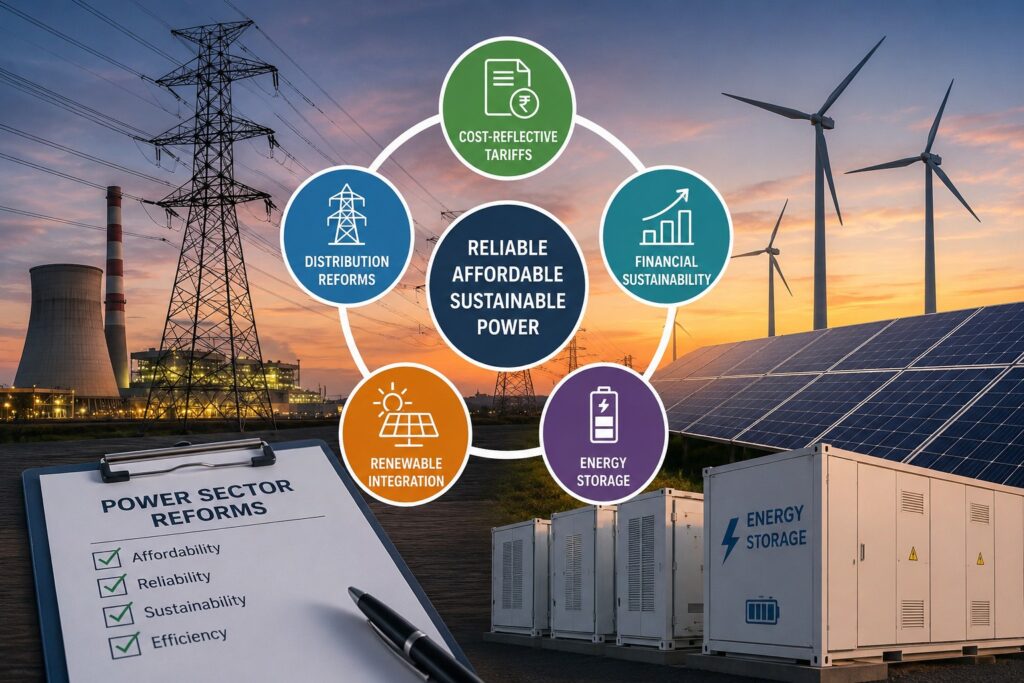
India is strengthening the power sector with cost-reflective tariffs, distribution reforms, large-scale capacity additions, energy storage and renewable integration to ensure reliable and affordable electricity.
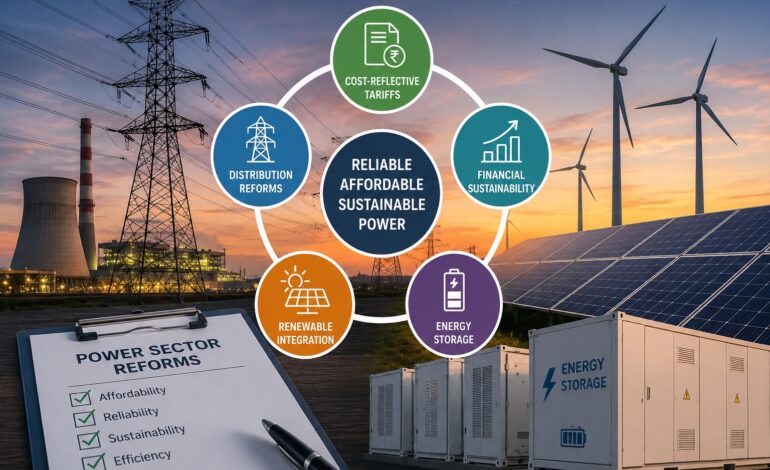
The framework brings together tariff reforms, distribution-sector restructuring, generation-capacity expansion, renewable-energy integration, energy storage and transmission-system modernisation.

NEW DELHI: India is putting in place a comprehensive policy and regulatory framework aimed at balancing three competing priorities in the electricity sector – financial sustainability of power utilities, affordability for consumers and the need to ensure reliable electricity supply as demand and renewable energy capacity continue to grow.
The framework, outlined by the Ministry of Power in a written reply in the Rajya Sabha on Monday, brings together tariff reforms, distribution-sector restructuring, generation-capacity expansion, renewable-energy integration, energy storage and transmission-system modernisation. The government has said the measures are intended to strengthen the electricity sector while safeguarding consumer interests.
The framework operates under the Electricity Act, 2003, and includes the National Electricity Policy, the Tariff Policy and subordinate legislation framed by the appropriate governments, the Central Electricity Authority and Electricity Regulatory Commissions.
Tariffs to reflect cost of supply
Electricity tariffs in India are determined by the appropriate electricity regulatory commissions under the Electricity Act, 2003. At the state level, regulatory commissions determine retail tariffs after taking into account power procurement, transmission, wheeling and supply costs.
State governments can provide subsidies to particular classes of consumers, including domestic consumers, within the tariff framework determined by the respective State Electricity Regulatory Commission.
The Draft National Electricity Policy, 2026, proposes a further evolution of tariff design. It calls for distribution licensees to prepare resource adequacy plans so that power procurement is based on the least system cost.
It also proposes that tariffs progressively recover fixed costs through demand or fixed charges, making tariff structures more closely reflect the underlying cost of supply while encouraging efficient consumption.
Another important proposal is the automatic monthly pass-through of variations in power purchase costs, including fuel costs, through fuel and power purchase cost adjustment mechanisms. The draft policy also envisages suitable stabilisation funds to moderate the impact of fluctuations in power purchase costs on consumers.
At the same time, State Electricity Regulatory Commissions are expected to ensure that tariffs progressively reflect the prudent cost of supply without allowing the creation of regulatory assets. The draft policy proposes timely annual tariff revisions and, where appropriate, indexation-based mechanisms in cases where tariff orders are not issued within prescribed timelines.
The government has also clarified that changes in fuel prices or electricity demand can affect consumer tariffs only through applicable regulatory mechanisms. Any recovery through tariffs is subject to scrutiny by the State Electricity Regulatory Commissions.
Focus shifts to financially sustainable distribution
A major component of the government’s strategy is the financial and operational restructuring of the electricity distribution sector.
The Revamped Distribution Sector Scheme (RDSS), launched in July 2021, is central to this effort. The scheme has an outlay of Rs 3,03,758 crore and an estimated Gross Budgetary Support of Rs 97,631 crore from the Central Government.
Under RDSS, financial assistance is being provided to eligible distribution licensees for loss-reduction infrastructure and smart-metering projects. Projects worth Rs 1.53 lakh crore for loss-reduction infrastructure and Rs 1.31 lakh crore for smart-metering works have been sanctioned.
The government says these investments are expected to improve the reliability and quality of electricity supply while helping distribution utilities become more operationally efficient.
The framework is also backed by financial and regulatory measures. States can receive additional borrowing consent equivalent to 0.5% of Gross State Domestic Product, subject to undertaking specified power-sector reforms.
Additional prudential norms have also been introduced for sanctioning loans to state-owned power utilities, with lending linked to the performance of power distribution licensees against prescribed conditions.
The government has further established rules governing fuel and power purchase cost adjustment and cost-reflective tariffs, along with procedures for proper subsidy accounting and timely payment.
The long-term objective is to reduce distribution losses to single-digit levels through measures such as smart metering, regular energy audits, GIS-based asset mapping and consumer indexing. The Draft National Electricity Policy, 2026, also proposes stronger corporate governance of distribution licensees and the creation of Distribution System Operators to facilitate the integration of distributed renewable energy, energy storage and vehicle-to-grid technologies.
Power supply reliability improves
The government’s approach also focuses on the consumer side of electricity delivery.
The Electricity (Rights of Consumers) Rules, 2020, prescribe standards relating to new connections, quality and reliability of supply, metering, billing, grievance redressal and compensation for specified service deficiencies.
The Draft National Electricity Policy, 2026, proposes that distribution licensees ensure a reliable, affordable and quality 24×7 electricity supply. It also seeks stronger online grievance-redressal mechanisms covering complaint registration, tracking and disposal, including virtual hearings by Consumer Grievance Redressal Forums and the Ombudsman.
The impact of distribution reforms is already visible in supply hours, according to the government. Average electricity supply in rural areas has increased from 12.5 hours in FY14 to 22.6 hours in FY26, while supply in urban areas has risen from 22.1 hours in FY14 to 23.4 hours in FY26.
Generation capacity being planned ahead of demand
The government is simultaneously preparing for a substantial increase in electricity demand.
According to the National Electricity Plan (Generation), India’s installed generation capacity is likely to reach 874 GW by 2031-32. To ensure that generation capacity remains ahead of projected demand, states, in consultation with the Central Electricity Authority, have prepared resource adequacy plans.
These are dynamic 10-year rolling plans covering both power generation and power procurement.
States have also been advised to initiate the process of creating or contracting generation capacity from different sources in accordance with their Resource Adequacy Plans.
Thermal power remains part of the capacity strategy
Despite the rapid expansion of renewable energy, the government’s capacity planning continues to include a substantial thermal component.
The projected requirement for coal- and lignite-based thermal capacity by 2035-36 is estimated at approximately 315,000 MW. To meet this requirement, the Ministry of Power has envisaged an additional minimum 105,000 MW of coal- and lignite-based thermal capacity.
Around 21,080 MW of thermal capacity has been commissioned between April 2023 and June 30, 2026. Another 47,545 MW of thermal capacity, including 4,845 MW from stressed thermal power projects, is under construction, while contracts for another 16,000 MW have been awarded and are due for construction.
Hydro and nuclear capacity are also being expanded. The Central Electricity Authority has projected around 16,448 MW of hydro capacity addition between 2026-27 and 2031-32. Of this, 400 MW had been commissioned by June 30, 2026, while 12,973 MW was under construction.
In nuclear power, 8,000 MW of capacity is under construction and targeted for completion by 2031-32, with another 5,600 MW at various stages of planning and approval.
Renewables emerge as the largest-capacity pipeline
The scale of renewable-energy development is particularly significant.
As of June 30, 2026, 147,720 MW of renewable capacity was under construction, including 119,580 MW of solar capacity, including hybrid-solar projects, and 27,720 MW of wind capacity, including hybrid-wind projects.
Another 47,830 MW of renewable capacity, including 44,440 MW of solar, was at various stages of planning and targeted for completion by 2029-30.
This expanding renewable pipeline is accompanied by a parallel effort to strengthen the grid. The government is developing renewable-energy zones and pooling stations, establishing regional energy management centres for better forecasting and grid management, and strengthening transmission networks to evacuate renewable power.
The Green Energy Corridor programme is being used to support intra-state transmission projects for renewable-energy integration.
Grid operations are also being strengthened through improved forecasting, scheduling, real-time dispatch and ancillary services, while real-time electricity markets and flexibility mechanisms are intended to improve the utilisation of existing resources and reduce system-integration costs.
Energy storage becomes a central pillar
One of the most important elements of the emerging electricity framework is the growing role of energy storage.
As renewable generation increases, the electricity system needs greater flexibility to balance variations in solar and wind generation. The government’s strategy therefore combines renewable capacity expansion with battery storage, pumped storage and other grid-management technologies.
As of June 30, 2026, pumped storage projects with a capacity of 15,870 MW/95,220 MWh were under construction. Another 6,580 MW/39,480 MWh of pumped-storage capacity had been concurred and was yet to be taken up for construction.
Battery energy storage system projects totalling 15,754 MW/42,530 MWh were under construction, while 11,747 MW/38,425 MWh had been awarded and another 19,192 MW/67,574 MWh was at the tendering stage.
The transmission planning framework envisages around 47 GW of battery energy storage systems for integration by 2031-32. A roadmap has also been prepared for integrating 100 GW of pumped storage plants between 2025-26 and 2035-36.
Policy support for battery storage
The government is creating an ecosystem intended to accelerate deployment of energy storage technologies.
The National Programme on Advanced Chemistry Cell Battery Storage, approved in May 2021, carries an outlay of Rs 18,100 crore for establishing 50 GWh of domestic advanced chemistry cell manufacturing capacity. Ten GWh of this capacity is earmarked for grid-scale stationary storage applications.
The Ministry of Power has also issued guidelines for procurement and utilisation of battery energy storage systems as part of generation, transmission and distribution assets, along with ancillary services.
Tariff-based competitive bidding guidelines have been notified for the procurement of energy storage systems, covering both BESS and pumped storage, creating a mechanism for large-scale storage procurement.
A National Framework for Promotion of Energy Storage Systems was issued in September 2023 to provide a roadmap for deployment, market integration and regulatory facilitation.
The government has also approved viability-gap funding mechanisms. A BESS capacity of 13.22 GWh is under implementation under a VGF scheme with a budgetary allocation of Rs 3,760 crore. In June 2025, another VGF scheme was approved for 30 GWh of BESS capacity with financial support of Rs 5,400 crore from the Power System Development Fund.
The government has additionally provided transmission-charge waivers for specified BESS and pumped-storage projects to improve their economic viability.
Storage moves closer to consumers
The policy direction is also opening up energy storage beyond utility-scale projects.
An amendment to the Electricity Rules in September 2025 permitted energy storage systems to be developed, owned, leased or operated by consumers, expanding the possible ownership structures and business models for storage.
In February 2025, the Central Electricity Authority issued an advisory on co-location of energy storage systems with solar power projects, recommending storage capacity equivalent to at least 10% of installed solar capacity for a minimum duration of two hours to improve the dispatchability of solar power.
Transmission network prepares for the renewable transition
The transition toward a more renewable-heavy electricity system is also driving changes in transmission planning.
The National Electricity Plan (Transmission) provides for coordinated transmission planning to avoid congestion, minimise curtailment and optimise network augmentation.
The government is promoting combinations of energy storage and hybrid solutions to manage renewable intermittency and maintain grid stability. The Draft National Electricity Policy, 2026, also envisages modernisation of the transmission network through technologies such as Flexible AC Transmission Systems, Dynamic Line Rating and underground cabling where appropriate.
Other proposals include simplified utilisation-based transmission connectivity, using dated thermal generating stations as synchronous condensers and accelerating the deployment of energy storage systems.
The government is also addressing right-of-way challenges for transmission projects. Ministry of Power guidelines issued in 2024 and 2025 link land rates for Right of Way compensation to prevailing market rates, addressing disputes arising when landowners seek compensation above rates determined by state governments.
A broader shift in India’s electricity architecture
Taken together, the measures indicate that India’s electricity policy is moving beyond simply adding generation capacity.
The emerging framework seeks to address the entire electricity value chain — from generation and procurement to transmission, distribution, storage, tariff design and consumer services.
The proposed resource adequacy plans are intended to align generation and procurement with future demand. Tariff reforms seek to improve cost recovery while protecting consumers through regulatory oversight. RDSS is targeting distribution losses and operational inefficiencies. Renewable-energy programmes are expanding clean generation, while storage and transmission investments are being positioned as critical enablers of grid stability.
The government is also pursuing a more technology-intensive distribution network, with smart meters, GIS-based asset mapping, consumer indexing, distribution system operators and vehicle-to-grid technologies forming part of the longer-term policy vision.
The central challenge will be to ensure that the financial sustainability of electricity distribution companies does not come at the expense of affordability for consumers, even as the system requires large investments in generation, transmission, storage and digital infrastructure.
The framework outlined by the Ministry of Power attempts to address that balance through a combination of cost-reflective tariffs, targeted subsidies, regulatory oversight, financial reforms and large-scale infrastructure investment.
The information was provided by Minister of State in the Ministry of Power Shripad Naik in a written reply in the Rajya Sabha.