India accelerates space ambitions with private sector push as Gaganyaan targets first uncrewed mission in Q4 2026
India is strengthening its space ecosystem through major private-sector reforms while Gaganyaan advances toward its first uncrewed mission in Q4 2026, with the Bharatiya Antariksh Station targeted for 2035.
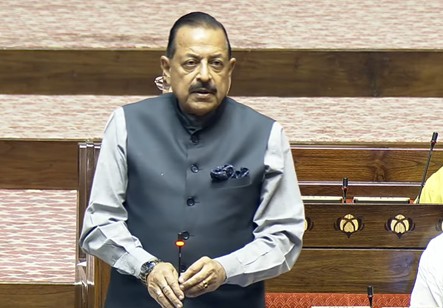
Union Minister of State (Independent Charge) for Science & Technology, Earth Sciences, Atomic Energy and Space, Dr. Jitendra Singh

NEW DELHI: India is accelerating its space ambitions on two parallel fronts—building a globally competitive private space manufacturing ecosystem while advancing the country’s first indigenous human spaceflight mission, Gaganyaan, with the first uncrewed mission carrying the Vyommitra humanoid now targeted for the fourth quarter of 2026.
The government informed Parliament that it has rolled out a series of policy reforms, funding mechanisms and infrastructure initiatives to strengthen domestic space technology manufacturing, even as ISRO has achieved key human-rating milestones required for the Gaganyaan programme.
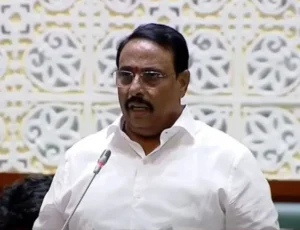
Responding to separate questions in the Rajya Sabha, Union Minister of State (Independent Charge) for Science & Technology, Earth Sciences, Atomic Energy and Space, Dr Jitendra Singh, said the government is creating an enabling ecosystem for private participation while simultaneously preparing India for its maiden human spaceflight and the planned Bharatiya Antariksh Station by 2035.
To boost India’s space industry, the government has introduced a liberalised Foreign Direct Investment (FDI) policy for the space sector, launched a ₹1,000 crore Venture Capital Fund for space startups and a ₹500 crore Technology Adoption Fund to accelerate the development and commercialisation of indigenous space technologies.
Private companies are also being provided discounted access to ISRO facilities, technical expertise and mentorship, along with technology transfers for commercialisation. The government has launched skill development programmes, established a Technical Centre offering affordable testing and validation facilities, introduced the Satellite Bus as a Service (SBaaS) initiative to accelerate indigenous satellite development, and is encouraging states to establish manufacturing clusters and common testing infrastructure.
The minister said these initiatives are being implemented across the country through IN-SPACe, which is promoting awareness among startups, MSMEs, academia and industry through workshops, stakeholder consultations, webinars, conferences and outreach programmes. As the private space sector remains in a developmental phase, government interventions are currently focused on creating baseline infrastructure, facilitating technology transfer and attracting investments.
On the human spaceflight programme, Dr Jitendra Singh said ISRO has completed the development and ground testing of all propulsion stages and structures of the Human Rated Launch Vehicle (HLVM3). Critical systems including the Crew Module and Service Module propulsion systems, Environmental Control and Life Support System (ECLSS), Thermal Protection System, Deceleration System, Crew Module Up-righting System and end-to-end avionics have also been successfully developed and tested.
Significant progress has also been made in crew safety. All five motors of the Crew Escape System have been developed and successfully tested, while essential mission infrastructure—including the Orbital Module Preparation Facility, Gaganyaan Control Centre, Crew Training Facility and modifications to the Second Launch Pad—has been completed.
ISRO has successfully conducted the TV-D1 Test Vehicle Mission to validate the Crew Escape System in flight, while Integrated Air Drop Tests have confirmed the performance of the crew module’s deceleration system. Preparations for the next test mission, TV-D2, are currently underway.
According to the mission roadmap, the first uncrewed Gaganyaan mission carrying the Vyommitra half-humanoid is scheduled for the fourth quarter of 2026. It will be followed by two additional uncrewed missions in the crewed-flight configuration before India’s first human orbital mission, currently planned for 2027.
Looking beyond Gaganyaan, the Minister said the Bharatiya Antariksh Station is expected to become operational by 2035. ISRO has finalised the overall configuration of the five-module space station, and the government has already approved the development and launch of the first module, BAS-01.
Dr Jitendra Singh also noted that the Union Cabinet approved ₹20,193 crore in September 2024 for eight missions under India’s Human Spaceflight Programme. ISRO is working with international partners including the European Space Agency (ESA), Australian Space Agency (ASA), France’s CNES and Russia’s Roscosmos on mission support, astronaut training, crew recovery and specialised human spaceflight technologies.
The twin announcements underscore the government’s strategy of simultaneously nurturing a vibrant commercial space ecosystem and strengthening India’s indigenous capabilities in advanced human space exploration, positioning the country for a larger role in the global space economy.