PM SVANidhi pushes street vendors deeper into formal credit economy: Govt
An ISB study found average annualised business income among PM SVANidhi borrowers rose by around 20% between 2023 and 2025, alongside a significant rise in digital payments.
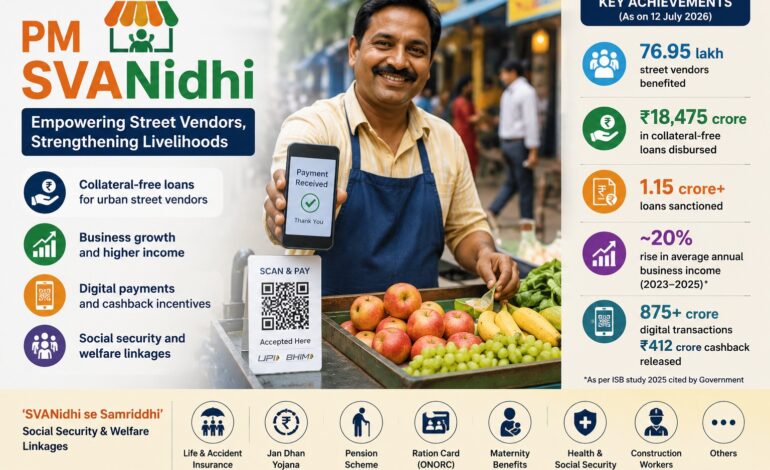
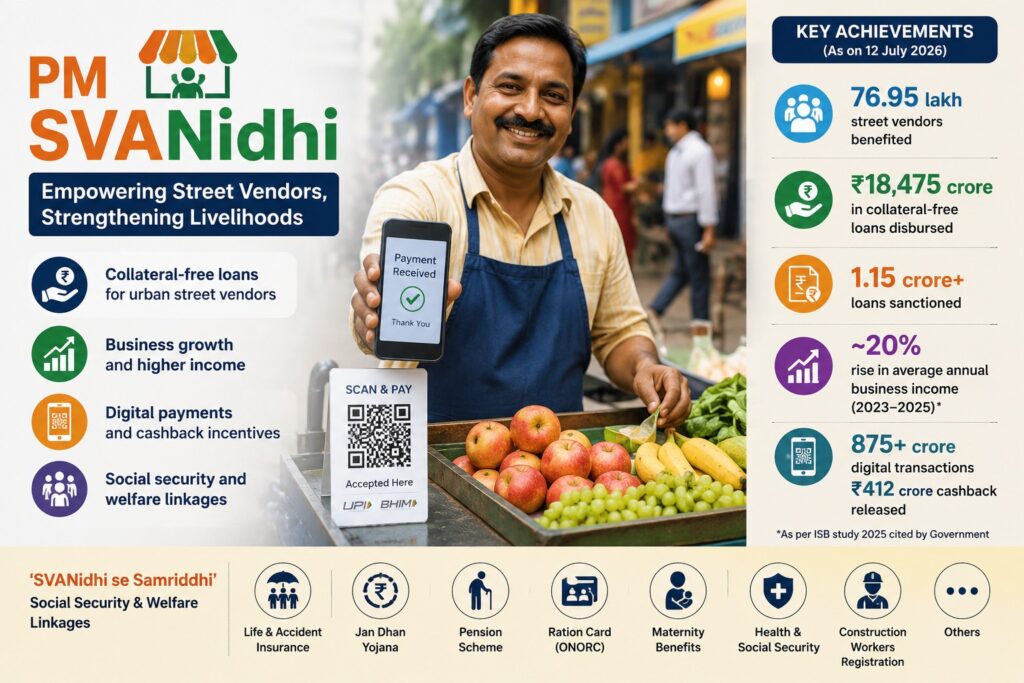
Since its launch on June 1, 2020, the scheme has enabled 76.95 lakh street vendors to access more than 1.15 crore collateral-free loans worth ₹18,475 crore.

NEW DELHI: India’s street vendors are increasingly moving from informal borrowing to the formal financial system, with the PM Street Vendor’s AtmaNirbhar Nidhi (PM SVANidhi) scheme emerging as an important gateway to institutional credit and digital payments.
Since its launch on June 1, 2020, the scheme has enabled 76.95 lakh street vendors to access more than 1.15 crore collateral-free loans worth ₹18,475 crore, according to data presented by the Ministry of Housing and Urban Affairs.
The information was provided by Minister of State for Housing and Urban Affairs Tokhan Sahu in a written reply in the Rajya Sabha on Monday.
But the significance of PM SVANidhi extends beyond the volume of loans disbursed.
Studies conducted by the Indian School of Business (ISB), Hyderabad, in 2023 and 2025 indicate that the scheme is changing how street vendors access credit, conduct business and manage their household finances.
For 95% of beneficiaries covered by the 2023 ISB study, the PM SVANidhi loan was their first loan from a bank. The study, conducted across 100 urban local bodies and covering more than 5,000 beneficiaries, found that the loans were primarily used to expand their businesses.
The 2025 study, conducted across 99 Urban Local Bodies and covering more than 5,000 beneficiaries, found that average annualised business income among PM SVANidhi borrowers grew by around 20% between 2023 and 2025.
The findings point to an important shift: a small working-capital loan is not merely helping a vendor survive a difficult period but can potentially become the first step towards building a formal financial identity.
Credit history begins with a small loan
One of the less visible impacts of the scheme is the creation of credit histories among people who previously had limited or no access to formal finance.
Around 30% of borrowers across all loan cycles reported holding loans other than PM SVANidhi loans, according to the 2025 study.
This indicates that the scheme is helping some street vendors establish a track record with the formal financial system, potentially improving their ability to access other forms of credit.
For a section of India’s urban informal economy that has traditionally depended heavily on personal savings, family networks or informal lenders, the transition to institutional credit can be as significant as the initial loan itself.
The scheme’s design reinforces this progression.
Street vendors who repay their loans can graduate to higher loan tranches, creating an incentive for timely repayment while allowing businesses that demonstrate financial discipline to access larger amounts of working capital.
As of July 12, 2026, 29.71 lakh vendors had availed themselves of the second loan tranche, while 8.49 lakh had moved to the third tranche.
Digital payments become another transformation
PM SVANidhi is also pushing street vendors towards India’s expanding digital payments ecosystem.
The scheme provides cashback incentives to encourage beneficiaries to conduct digital transactions. Vendors can receive cashback of up to ₹100 per month for 12 months, with a maximum digital incentive of ₹1,200 a year, for every loan tranche.
The restructured scheme also provides a cashback incentive of up to ₹100 per quarter for four quarters for digital transactions relating to wholesale purchases of at least ₹2,000.
The impact is visible in the transaction numbers.
Since the scheme’s inception until May 2026, more than 875 crore digital transactions have been carried out by beneficiaries, while ₹412 crore has been released as cashback incentives.
The ISB study also found that adoption of digital payments among street vendors increased significantly between 2023 and 2025.
This matters because digital transactions can do more than provide an alternative to cash. They can create a transaction trail for businesses that traditionally operate outside formal financial documentation.
The street vendor becomes more visible to the formal economy with every digital payment, loan repayment and recorded business transaction.
The impact reaches beyond the vending business
The government’s assessment also indicates that the effects of PM SVANidhi are extending into household welfare.
The ISB study found that by easing credit constraints and stabilising household cash flows, the scheme has helped beneficiary families improve living conditions, strengthen food security, increase access to healthcare and support children’s education.
This broadens the significance of the scheme from a microcredit program to an intervention affecting the economic resilience of urban households.
For many street vendors, the business and the household are closely connected. Working capital used to maintain inventory or expand a vending operation can therefore have consequences far beyond the stall itself.
Social security added to the credit architecture
The government has also attempted to extend the scheme beyond credit through the ‘SVANidhi se Samriddhi’ component, launched on January 4, 2021.
The component is designed to create a social safety net for beneficiaries and their families by linking them with eight Central Government welfare schemes.
These include the Pradhan Mantri Jeevan Jyoti Bima Yojana, Pradhan Mantri Suraksha Bima Yojana, Pradhan Mantri Jan Dhan Yojana, registration under the Building and Other Construction Workers framework, Pradhan Mantri Shram Yogi Maandhan Yojana, One Nation One Ration Card portability benefits under the National Food Security Act, Pradhan Mantri Janani Suraksha Yojana and Pradhan Mantri Matru Vandana Yojana.
As of July 12, 2026, socio-economic profiling had been completed for 50.63 lakh PM SVANidhi beneficiaries, with a total of 1.56 crore scheme sanctions extended to them.
That creates a second layer to the program: credit for the vendor and social security linkages for the household.
From survival capital to growth capital
The numbers suggest that PM SVANidhi is gradually evolving beyond its original role of providing working capital to street vendors.
The first loan can help a vendor obtain formal credit. Timely repayment can open the door to larger loans. Digital transactions can establish a financial trail. Increased business income can strengthen household finances. Welfare linkages can provide an additional layer of social protection.
That progression is particularly relevant to India’s urban informal economy, where millions of livelihoods depend on small businesses operating with limited access to formal finance.
The scheme’s achievement, therefore, cannot be measured only by ₹18,475 crore in loans or 1.15 crore loan accounts.
Its larger test is whether a street vendor who once had no relationship with a formal bank can gradually become a creditworthy, digitally connected and financially more resilient micro-entrepreneur.
The evidence presented by the government and the ISB studies suggests that this transition is already underway.