India must stand steady amid global wars: listening to economic discipline matters now
India remains partially insulated but not immune to these shocks. A significant portion of its crude oil requirement is met through imports, making the economy sensitive to global price movements.
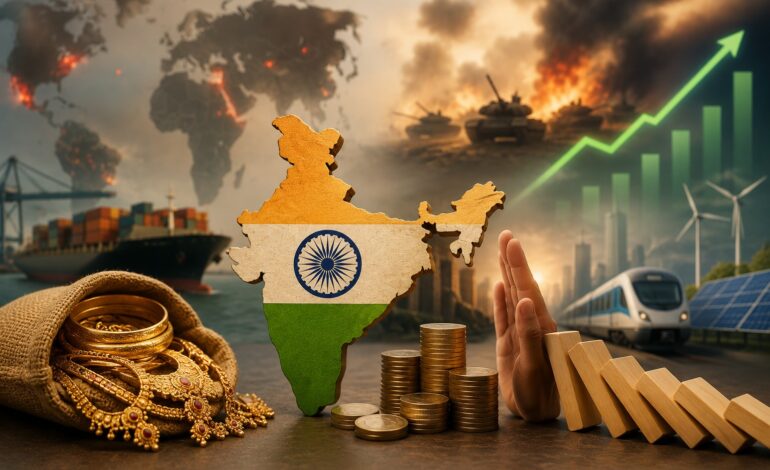
The seven-point framework presented by the Prime Minister highlights the importance of individual contributions to national economic stability.

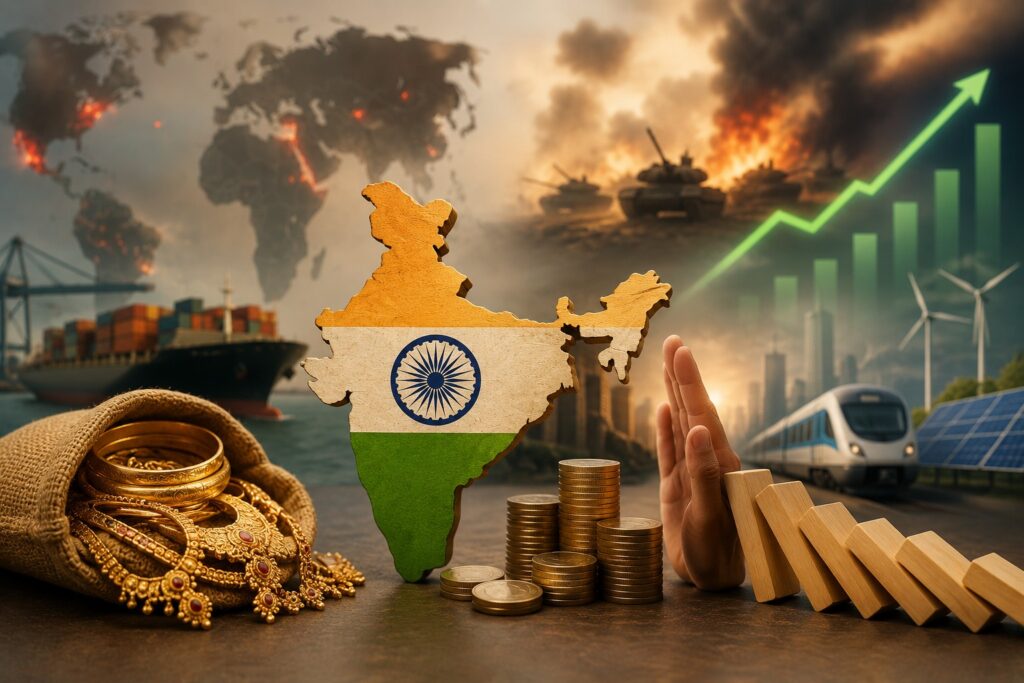
The global economy today is navigating a period of sustained uncertainty. Rising geopolitical tensions, frequent disruptions in energy supply chains, and volatile commodity prices are collectively creating pressure on both developed and developing economies. For emerging economies like India, these external shocks translate into cost pressures, import burdens, and inflationary risks that gradually affect household budgets and business stability.
In such a scenario, economic resilience is no longer shaped only by government policy frameworks but also by the consumption behaviour of citizens. The way households manage spending, savings, and imports increasingly contributes to national macroeconomic stability.
Against this backdrop, the economic message delivered by Prime Ministerr Narendra Modi at a public meeting in Hyderabad on May 10, assumes significance. The central theme highlighted the need for disciplined consumption patterns, including a call for moderation in gold purchases for a period of one year. In the Indian context, gold is not merely an asset; it represents household security, cultural value, and long-term savings. However, from a macroeconomic standpoint, gold imports exert pressure on foreign exchange reserves and contribute to the current account deficit. The emphasis, therefore, is being interpreted as a push towards balanced consumption rather than restriction.
The address also outlined a seven-point economic framework focusing on energy conservation, increased use of public transport, promotion of domestic products, expansion of the digital economy, efficient electricity usage, and household-level financial discipline. Together, these measures reflect an approach that connects individual behaviour with national economic outcomes.
Over the past decade, India’s tax architecture has undergone significant transformation, particularly through the introduction and consolidation of the Goods and Services Tax (GST). The reform replaced multiple indirect taxes with a unified structure, improving transparency and market integration. The evolving phase, often referred to as “GST 2.0,” is aimed at further simplifying compliance and rationalising tax burdens on essential goods. This has the potential to ease pressure on lower-income households and the middle class, though the full impact will unfold gradually over time.
However, India’s growth trajectory continues to be shaped by external geopolitical developments. The ongoing conflict in West Asia has led to fluctuations in crude oil supply and pricing, directly influencing transportation and production costs. Similarly, the prolonged Russia–Ukraine conflict has disrupted global supply chains for wheat, fertilisers, and energy resources, contributing to inflationary pressures worldwide.
India remains partially insulated but not immune to these shocks. A significant portion of its crude oil requirement is met through imports, making the economy sensitive to global price movements. In the last financial year, India spent approximately $134 billion (around ₹11 lakh crore) on crude oil imports, highlighting the scale of external dependency. Such expenditure continues to exert pressure on foreign exchange reserves and macroeconomic balance.
Despite these challenges, India’s economic fundamentals remain relatively stable. Strong foreign exchange reserves, expanding digital financial infrastructure, and targeted welfare transfer systems have helped maintain resilience. Recent tax reforms and ongoing GST rationalisation efforts have further strengthened fiscal efficiency and market predictability.
It is important to underline that the current global conflicts are not a reflection of domestic policy shortcomings, but rather external developments impacting global trade and energy systems. Rising logistics costs, supply disruptions, and price volatility are being transmitted through global markets into domestic economies. In such an environment, both policy direction and citizen behaviour become critical stabilising factors.
This is where the relevance of structured economic messaging becomes evident. The seven-point framework presented by the Prime Minister highlights the importance of individual contributions to national economic stability. Reduced fuel wastage, preference for public transport, support for domestic manufacturing, and responsible consumption patterns collectively strengthen macroeconomic resilience.
At the same time, democratic discourse naturally accommodates differing opinions on policy communication. However, economic debates are most productive when anchored in data, context, and long-term national interest rather than short-term perception cycles.
India today stands at a point where global headwinds are persistent but manageable. Sustaining economic stability will require a coordinated approach involving government policy, structural reforms such as GST, and citizen-level financial discipline. The convergence of these factors will determine how effectively India navigates an increasingly uncertain global environment.