
OpenAI Unveils GPT-5.5, Advancing AI from Chat Assistants to Autonomous Task Executors
Unlike earlier iterations that primarily responded to prompts, GPT-5.5 is designed to perform end-to-end tasks. It can autonomously plan workflows, use digital tools, generate structured outputs such as reports and
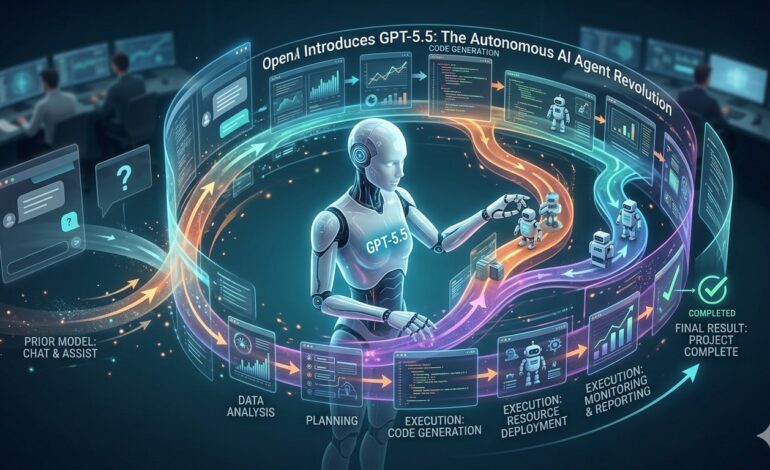
The new model, positioned as OpenAI’s most advanced to date, brings enhanced reasoning, improved coding capabilities, and the ability to function as an “agentic AI,” capable of planning and completing workflows across applications and environments.

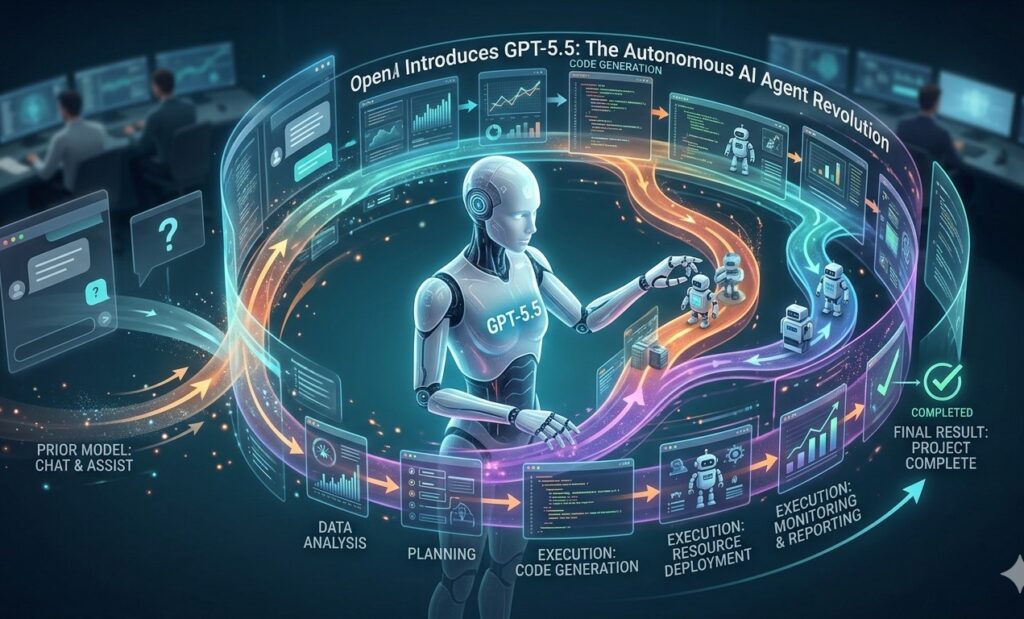
New Delhi: OpenAI has introduced its latest artificial intelligence model, GPT-5.5, marking a significant leap in the evolution of generative AI – from conversational assistants to systems capable of executing complex, multi-step tasks with minimal human intervention.
The new model, positioned as OpenAI’s most advanced to date, brings enhanced reasoning, improved coding capabilities, and the ability to function as an “agentic AI,” capable of planning and completing workflows across applications and environments.
From chatbot to task executor
Unlike earlier iterations that primarily responded to prompts, GPT-5.5 is designed to perform end-to-end tasks. It can autonomously plan workflows, use digital tools, generate structured outputs such as reports and spreadsheets, and interact with software systems.
This shift signals a broader transformation in AI – from reactive systems to proactive digital agents capable of supporting business operations, research, and software development.
Strong push in coding and technical workflows
A major highlight of GPT-5.5 is its performance in coding and software engineering tasks. The model demonstrates improved capabilities in writing, debugging, and optimizing code, handling longer and more complex programming sessions with higher accuracy.
Industry benchmarks indicate significant gains in technical problem-solving, positioning the model as a viable assistant for developers and engineering teams.
Enhanced reasoning and consistency
GPT-5.5 introduces improvements in logical reasoning and decision-making. It is better equipped to break down complex problems into structured steps, reducing inconsistencies and errors that were more common in earlier models.
The model also shows improved self-correction abilities, enabling it to refine outputs during multi-step processes.
Enterprise focus gains momentum
The rollout of GPT-5.5 reflects OpenAI’s growing emphasis on enterprise adoption. The model is being made available across premium tiers of ChatGPT, including business and enterprise offerings, targeting use cases such as workflow automation, data analysis, and content generation at scale.
Organizations are expected to leverage the model for tasks ranging from document creation and research synthesis to operational automation.
Efficiency and cost optimization
OpenAI has also focused on improving computational efficiency. GPT-5.5 is designed to deliver better performance while using fewer tokens, translating into faster response times and lower operational costs.
This efficiency is expected to accelerate enterprise adoption, particularly among companies integrating AI into large-scale workflows.
Expanding role in research and innovation
Beyond business applications, GPT-5.5 is being positioned as a tool for scientific and academic research. Its ability to process large datasets, assist in hypothesis generation, and support analytical workflows opens new possibilities in research environments.
A step toward autonomous AI systems
The launch of GPT-5.5 underscores a broader industry trend toward building autonomous AI systems capable of independent action within defined parameters. While the model still requires human oversight, its ability to handle complex, multi-stage tasks represents a notable step toward more capable AI agents.
Competitive landscape intensifies
With global technology companies accelerating investments in artificial intelligence, the release of GPT-5.5 is expected to intensify competition in the AI ecosystem. The focus is increasingly shifting toward models that can integrate seamlessly into enterprise environments and deliver measurable productivity gains.
Looking ahead
As AI systems continue to evolve, GPT-5.5 signals a transition point where artificial intelligence moves beyond assisting users to actively participating in workflows. The implications span industries – from media and governance to software development and scientific research – reshaping how organizations approach productivity and innovation.
About OpenAI
OpenAI is an artificial intelligence research and deployment company focused on developing advanced AI systems for a wide range of applications, including natural language processing, automation, and enterprise solutions.