India’s social protection coverage rises to 68.4%, reaches over one billion people
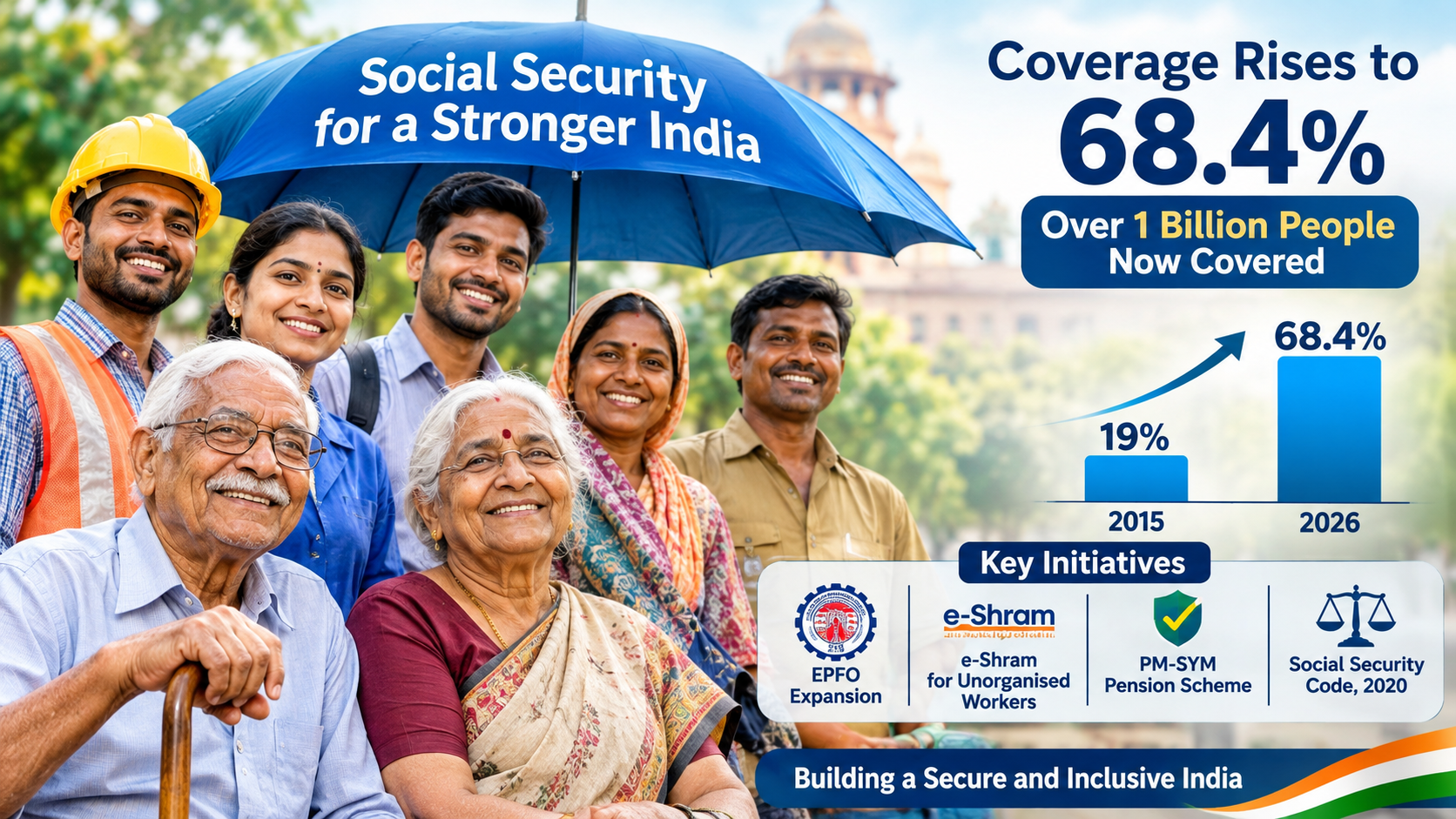
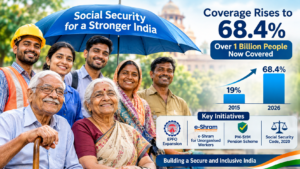
India’s social protection coverage has risen from 19% in 2015 to 68.4% in 2026, covering more than one billion people. Wider EPFO eligibility, digital service reforms and welfare schemes for
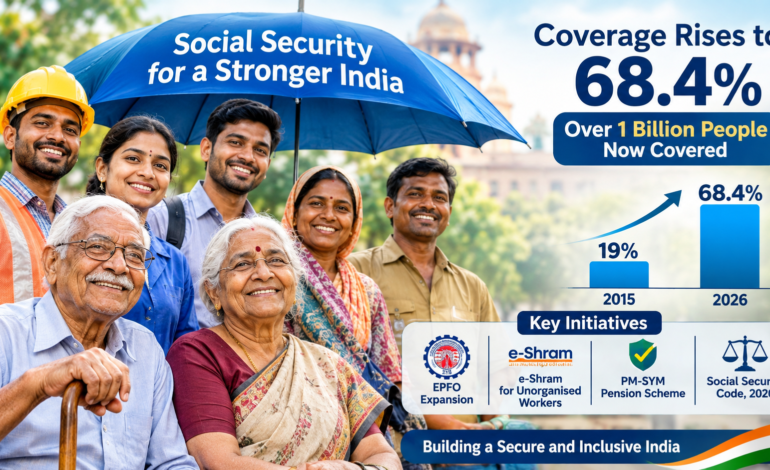
The expansion has been supported by wider coverage under the Employees’ Provident Fund Organisation (EPFO), digital reforms in benefit delivery and welfare initiatives targeting unorganised workers and vulnerable groups.

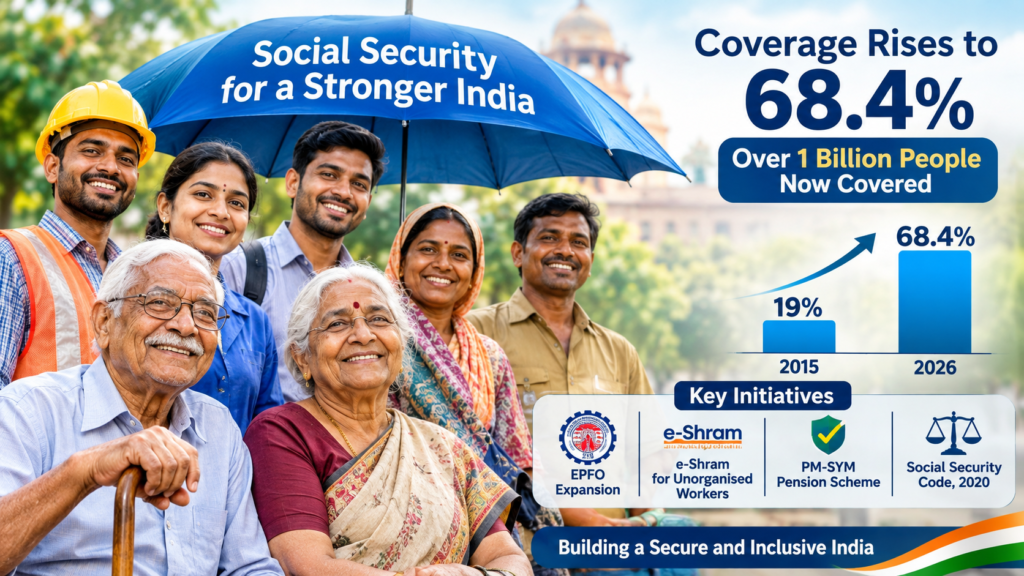
NEW DELHI: India’s social protection coverage has increased from 19% in 2015 to 68.4% in 2026, bringing more than one billion people within the country’s social protection framework, according to a government backgrounder released by the Ministry of Labour and Employment.
The expansion has been supported by wider coverage under the Employees’ Provident Fund Organisation (EPFO), digital reforms in benefit delivery and welfare initiatives targeting unorganised workers and vulnerable groups.
A key measure is the revision of the wage ceiling for mandatory EPFO coverage from ₹15,000 to ₹25,000 per month. Approved in September 2026, the revision is expected to bring more than 51 lakh additional employees under the provident fund framework, subject to applicable statutory provisions. The ceiling was last revised in September 2014.
EPFO’s contributing membership has grown from 3.49 crore in 2014-15 to approximately 7.98 crore as of September 16, 2026. The number of establishments contributing to the organisation stood at 7.68 lakh in September 2026.
The number of pensioners receiving EPFO benefits has also increased, from 51.04 lakh in 2014-15 to around 82 lakh by September 2026. The organisation settled 6.42 crore claims during the one-year period up to October 2026, compared with 1.30 crore claims in 2014-15.
EPFO expands digital services
The government has outlined a series of measures aimed at simplifying access to provident fund and pension services, reducing paperwork and accelerating claim settlement.
These include simplified partial withdrawal rules, automated processing of eligible advance claims and the removal of the requirement to upload cheque-leaf images or attested bank passbooks for eligible online claims.
EPFO has consolidated 13 provisions governing partial withdrawals into three categories: essential needs, housing needs and special circumstances. The revised framework allows up to 10 withdrawals for education and five for marriage, compared with an earlier combined limit of three. Eligible members can also withdraw up to 75% of their PF balance, subject to prescribed conditions.
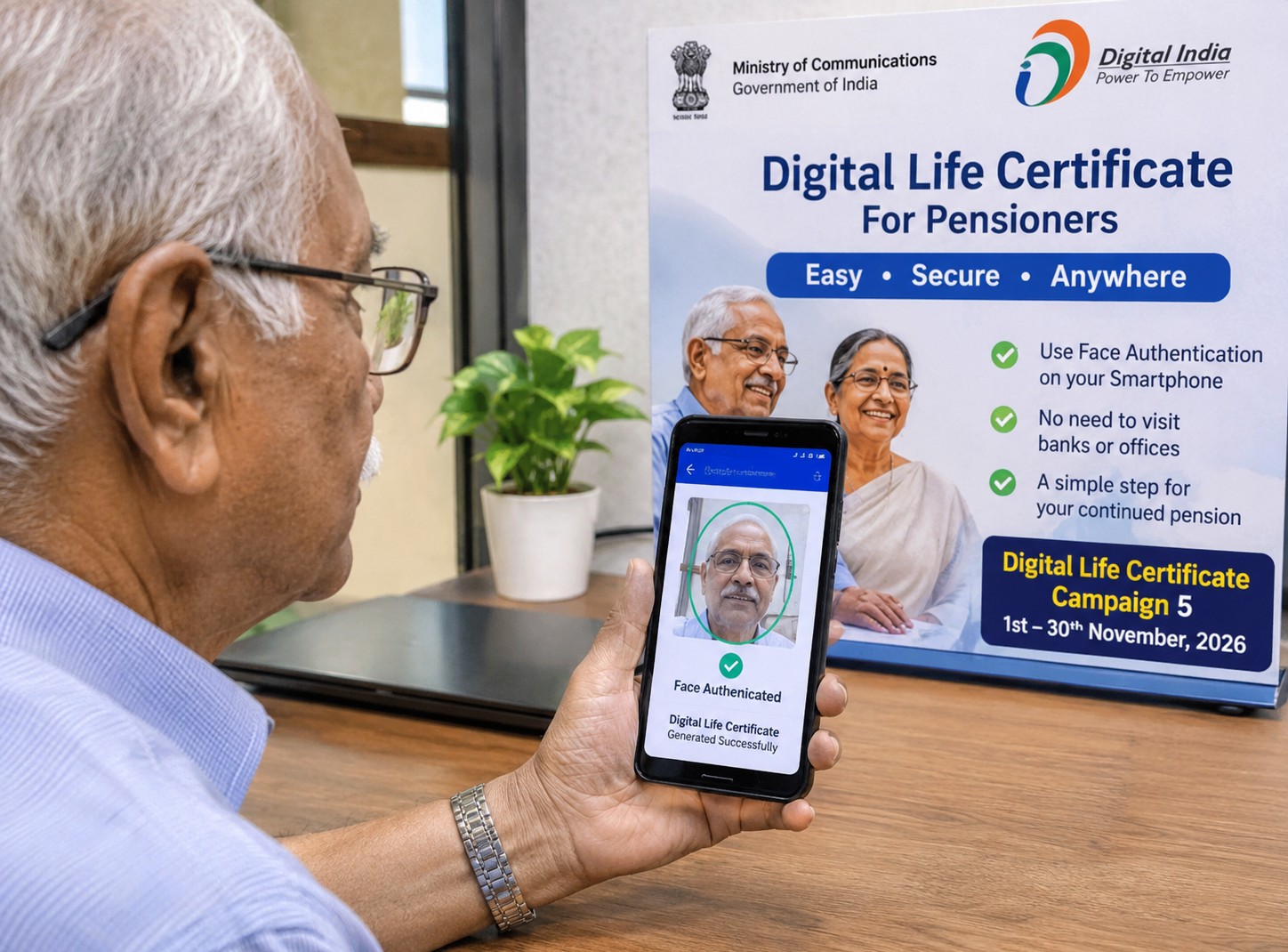
Digital access has been expanded through self-generation of Universal Account Numbers (UANs), Aadhaar-based face authentication, simplified Aadhaar seeding and correction, and the Centralised Pension Payment System. The latter enables pensioners to receive their pensions through any bank branch across the country without transferring their Pension Payment Orders when they change locations or bank branches.
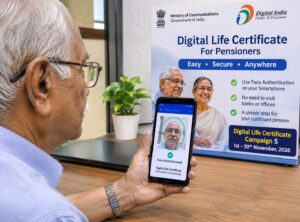
EPFO has also partnered with India Post Payments Bank to provide doorstep Digital Life Certificate services to pensioners under the Employees’ Pension Scheme. The organisation bears the cost of ₹250 per certificate, making the service free for pensioners.
The government has further highlighted EPFO 3.0, a core banking-based transformation initiative designed to integrate account management, compliance and member services through a cloud-native, API-first technology architecture.
Social security measures for unorganised workers
The social protection framework extends beyond formal-sector employees through initiatives such as e-Shram and the Pradhan Mantri Shram Yogi Maandhan (PM-SYM).
Launched in August 2021, e-Shram provides a national database of unorganised workers, with each registered worker receiving a UAN. The portal had recorded 31.89 crore registrations as of August 2026. Its One-Stop Solution integrates 15 social security and welfare schemes and connects workers with platforms for employment, skilling and access to government schemes.
PM-SYM is a voluntary, contributory pension scheme for eligible unorganised workers aged 18 to 40 years, with monthly incomes of up to ₹15,000. It provides a minimum assured pension of ₹3,000 per month after the subscriber reaches 60 years of age, subject to prescribed conditions. The Central Government makes an equal contribution to the subscriber’s monthly contribution.
The government has also highlighted the Pradhan Mantri Samajik Sahayata Yojana, which provides social assistance to eligible elderly persons, widows, persons with disabilities and bereaved families. The scheme continues the support framework of the National Social Assistance Programme and is scheduled to operate from 2026-27 to 2030-31.
Social Security Code widens the framework
The Code on Social Security, 2020 consolidates nine existing central labour laws relating to social security into a unified legislative framework. Its provisions cover provident fund, pension, insurance, maternity benefits, gratuity and other forms of worker protection.
The Code also recognises gig and platform workers within the social security framework and provides for welfare schemes supported by a social security fund. Other provisions include gratuity for eligible fixed-term employees on a proportionate basis after one year of service, subject to applicable conditions, and maternity benefits of up to 26 weeks for eligible women.
The government says the combined measures are intended to extend social protection across organised and unorganised employment, improve access to benefits and strengthen financial security during working life and retirement.