Centre calls for climate-risk mapping to guide coastal infrastructure and investment
A national workshop is examining ecosystem restoration, community livelihoods and climate finance, drawing on coastal resilience projects in Andhra Pradesh, Maharashtra and Odisha.
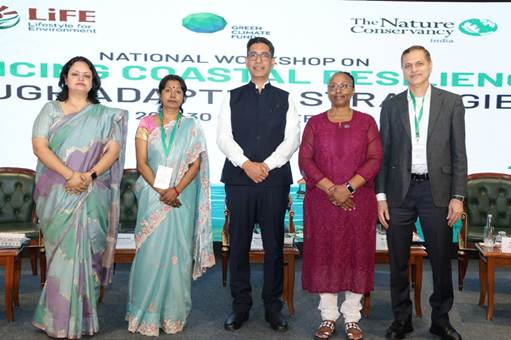
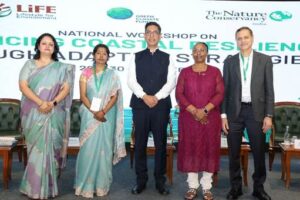
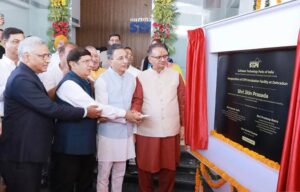
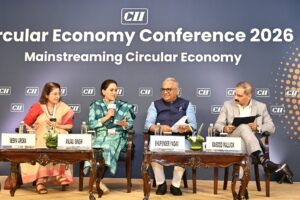
Environment Secretary Narendra Bhooshan (center) with other dignitaries at the inauguration of a two-day national workshop on “Enhancing Coastal Resilience through Adaptive Strategies” in New Delhi on October 29.

NEW DELHI: The Union Environment Ministry has called for shoreline assessments, hazard maps and coastal vulnerability data to guide planning, infrastructure and investment decisions, as India strengthens adaptation measures for vulnerable coastal communities.
Environment Secretary Narendra Bhooshan outlined the priority while inaugurating a two-day national workshop on “Enhancing Coastal Resilience through Adaptive Strategies” in New Delhi on October 29, according to the Ministry of Environment, Forest and Climate Change.
Bhooshan said India had strengthened the scientific foundations for coastal planning through shoreline-change assessments, hazard-line mapping, vulnerability studies and ecosystem information. The next task was to translate that evidence into decisions at state, district and local levels, he said.
He highlighted the importance of mangroves, seagrasses, salt marshes and coral reefs in protecting biodiversity, supporting livelihoods and providing coastal protection.
The October 29–30 workshop is being organised under the Green Climate Fund-supported project, Enhancing Climate Resilience of India’s Coastal Communities (GCF-ECRICC). The project focuses on restoring coastal ecosystems while strengthening livelihoods in highly vulnerable areas.
Bhooshan said the National Coastal Mission would serve as a focal point for coastal resilience and adaptation interventions, building on the project’s outputs.
The workshop reviewed progress under GCF-ECRICC in Andhra Pradesh, Maharashtra and Odisha, alongside opportunities to replicate and expand successful interventions.
Ministry Senior Economic Advisor Rajasree Ray emphasised the need to connect scientific knowledge, implementation experience and financing approaches with national and state priorities.
A community outreach model involving women from coastal communities, known as “ECRICC Didis”, was presented as an approach with potential for wider adoption. These climate champions help translate technical knowledge on climate action into locally accessible information.
UNDP India Resident Representative Angela Lusigi highlighted the links between coastal ecosystem restoration, livelihood support and women’s enterprises.
Sushil Saigal, Interim Managing Director of The Nature Conservancy India, emphasised knowledge exchange to help expand proven approaches and develop practical solutions.
Close to 150 participants attended, including government officials, coastal zone management authorities, forest departments, researchers, civil society organisations, financial institutions and philanthropic bodies.
Recommendations from the workshop are expected to inform broad guidelines for adaptive coastal resilience, drawing on national programmes, state priorities and implementation experience.