Union Budget 2026–27 Places Textiles at the Core of India’s Manufacturing, Employment and Export Strategy
New Delhi: The Union Budget 2026–27 has positioned India’s textile and apparel sector at the centre of the country’s manufacturing-led growth strategy, unveiling a comprehensive policy framework that seeks to
As one of India’s oldest and most labour-intensive industries, textiles occupy a unique place in the economy, contributing nearly 2 percent to GDP, around 11 percent to manufacturing gross value added, and close to 9 percent of total exports.

New Delhi: The Union Budget 2026–27 has positioned India’s textile and apparel sector at the centre of the country’s manufacturing-led growth strategy, unveiling a comprehensive policy framework that seeks to strengthen the entire value chain—from fibre and yarn to finished apparel, exports and livelihoods.
As one of India’s oldest and most labour-intensive industries, textiles occupy a unique place in the economy, contributing nearly 2 percent to GDP, around 11 percent to manufacturing gross value added, and close to 9 percent of total exports. With direct employment for over 45 million people—many of them women and rural workers—the sector has been identified as a critical engine for inclusive growth, job creation and sustainable industrialisation.
Integrated Programme to Strengthen the Textile Value Chain
At the heart of the Budget’s textile push is a new Integrated Programme for the Textile Sector, designed to improve competitiveness, build self-reliance and support large-scale employment. The programme brings together five interlinked components that span manufacturing, skills, sustainability and heritage preservation.
The National Fibre Scheme aims to reduce India’s dependence on imported raw materials by strengthening domestic availability of natural fibres such as silk, wool and jute, while simultaneously promoting man-made fibres and new-age materials. The policy thrust reflects a conscious effort to diversify beyond cotton and enhance India’s capabilities in high-performance and specialised textiles.
Complementing this is the Textile Expansion and Employment Scheme, which focuses on modernising traditional textile clusters through capital support for machinery upgrades, technology adoption and common testing and certification facilities. The objective is to improve productivity, quality compliance and export readiness, particularly for small and medium manufacturers.
Boost for Handlooms, Handicrafts and Rural Livelihoods
Recognising the socio-economic importance of handlooms and handicrafts, the Budget proposes a unified National Handloom and Handicraft Programme by integrating existing schemes under a single framework. The initiative is aimed at providing targeted support to weavers and artisans, improving incomes, preserving traditional skills and strengthening market linkages, both domestic and global.
In a related move, the Mahatma Gandhi Gram Swaraj Initiative has been announced to reinforce khadi, village industries and handicrafts. The programme emphasises branding, quality improvement, skilling and global market access, while aligning with the One District One Product initiative to support rural entrepreneurship.
Sustainability and Skills as Strategic Priorities
Sustainability has emerged as a defining theme in the Budget’s textile roadmap. The Tex-Eco Initiative seeks to align Indian textile and apparel manufacturing with global environmental standards, enabling access to emerging green markets and reinforcing India’s credibility as a responsible sourcing destination.
On the human capital front, Samarth 2.0, an upgraded skilling programme, aims to modernise the textile skill ecosystem through closer collaboration between industry and academic institutions. The initiative is expected to ensure a steady supply of industry-ready manpower across the value chain, from shop-floor operations to advanced manufacturing.
Mega Textile Parks and Technical Textiles
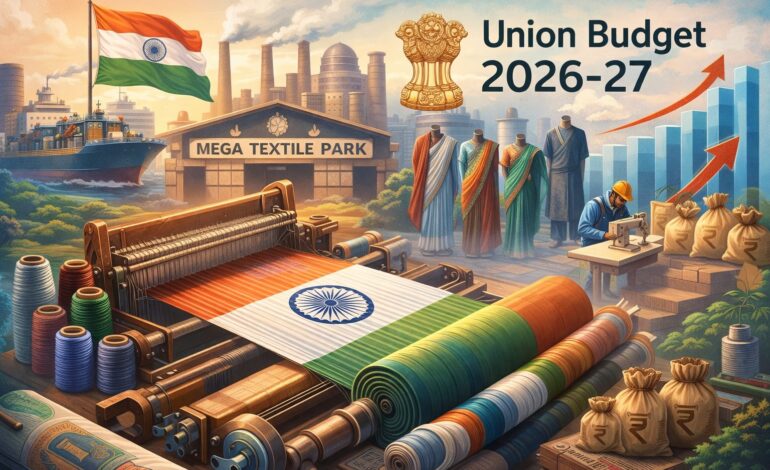
To achieve scale efficiencies and value addition, the Budget proposes the development of Mega Textile Parks through a challenge-based approach. These parks are envisioned as integrated manufacturing hubs that support large-scale production and foster the growth of technical textiles—an emerging segment with applications in defence, healthcare, infrastructure and industrial use.
The policy direction builds on the momentum of the PM MITRA scheme, under which seven mega integrated textile parks are already under development, with significant investment commitments and employment potential.
Export Push and Liquidity Support for MSMEs
The Budget also addresses key operational constraints faced by exporters and MSMEs. To ease compliance and improve working capital management, the export obligation period for textile and allied exporters using duty-free imported inputs has been extended from six months to twelve months.
Liquidity access for textile MSMEs has been strengthened through enhancements to the Trade Receivables Discounting System (TReDS). Measures include mandatory onboarding of CPSEs, credit guarantee support for invoice discounting, linkage of government procurement through GeM, and the introduction of TReDS receivables as asset-backed securities.
In addition, a dedicated ₹10,000 crore SME Growth Fund has been announced to support the emergence of “Champion SMEs”, incentivising scale, competitiveness and long-term viability.
Exports, Employment and Global Integration
Despite a challenging global trade environment, India’s textile and apparel exports rose to USD 37.75 billion in FY25, up from USD 35.87 billion in the previous year, supported by diversified markets and growth in value-added segments. India remains the world’s sixth-largest exporter of textiles and apparel, with exports recorded across more than 118 countries.
The Budget’s textile strategy aligns with broader trade developments, including the India–EU free trade agreement, which is expected to significantly improve duty conditions for Indian textiles and garments, particularly benefiting labour-intensive segments.
A Long-Term Vision for Textiles
With a clear focus on scale, sustainability, technology and inclusion, the Union Budget 2026–27 lays the foundation for deeper integration of India’s textile sector into global value chains. By strengthening manufacturing capabilities, supporting MSMEs and artisans, and aligning production with international standards, the government has signalled its intent to position textiles as a cornerstone of India’s journey towards a resilient, export-driven and employment-rich economy.