India’s Labour-Intensive Textile Sector Posts 2.1% Export Growth in FY26
Total textile exports, including handicrafts, rose to ₹3,16,334.9 crore in FY26 from ₹3,09,859.3 crore in the previous financial year, according to data released by the government. New Delhi India’s textile
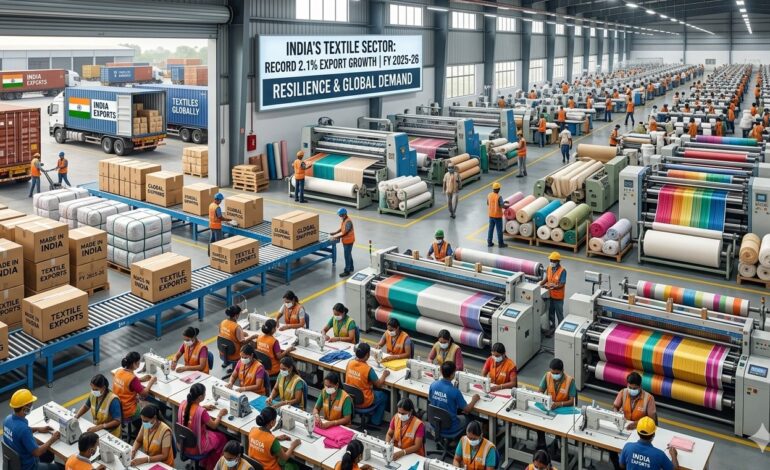
India’s textile exports expanded across more than 120 global destinations, signalling broad-based geographical diversification.

Total textile exports, including handicrafts, rose to ₹3,16,334.9 crore in FY26 from ₹3,09,859.3 crore in the previous financial year, according to data released by the government.
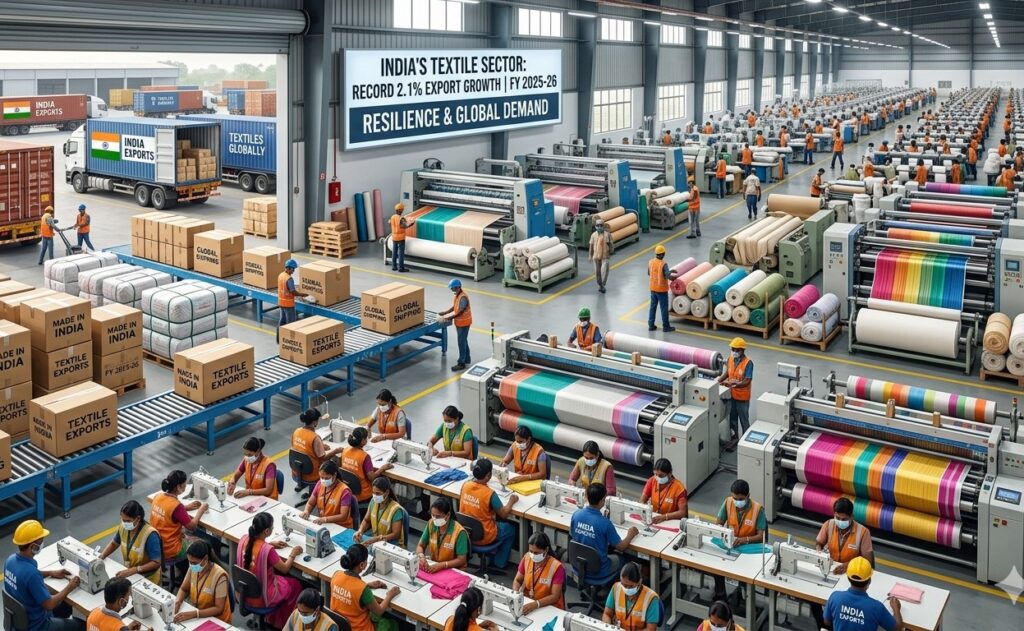
New Delhi India’s textile sector, one of the country’s largest employment generators and a key pillar of export-led manufacturing, recorded a 2.1% growth in exports in FY 2025–26, reflecting resilience amid evolving global demand conditions.
Total textile exports, including handicrafts, rose to ₹3,16,334.9 crore in FY26 from ₹3,09,859.3 crore in the previous financial year, according to data released by the government.
Ready-made garments (RMG) continued to dominate India’s textile export basket, registering a 2.9% increase to ₹1,39,349.6 crore, maintaining its position as the largest contributor. Cotton yarn, fabrics, made-ups and handloom products remained largely stable with marginal growth of 0.4%, while man-made textiles showed stronger momentum with a 3.6% rise in exports.
Among value-added segments, handicrafts excluding handmade carpets recorded the highest growth at 6.1%, indicating increasing global demand for artisanal and niche products.
India’s textile exports expanded across more than 120 global destinations, signalling broad-based geographical diversification. Key markets such as the UAE, UK, Germany, Spain, Japan, and several African nations recorded notable growth, reflecting strengthening trade linkages and market penetration.
The government has continued to support the sector through export facilitation measures, including the extension of schemes such as RoSCTL and RoDTEP beyond March 2026, aimed at improving cost competitiveness in global markets.
In parallel, India’s trade strategy saw significant momentum during the year, with multiple free trade agreements and economic partnerships concluded or announced with key economies including the UK, EU, Oman, New Zealand and the EFTA bloc. These agreements are expected to enhance preferential market access, reduce tariff barriers, and strengthen India’s integration into global textile value chains.
Industry observers note that while the overall growth remains moderate, the sector’s resilience is underpinned by diversification across products and markets, along with a gradual shift towards higher value-added segments.
The continued expansion of textile exports, supported by policy interventions and global trade partnerships, is expected to play a crucial role in boosting employment, strengthening manufacturing competitiveness, and advancing India’s position in the global textile trade.