India builds cyber-physical systems ecosystem to drive next generation of intelligent technologies
India is building a national Cyber-Physical Systems ecosystem through NM-ICPS, linking research, industry and government to develop indigenous technologies across healthcare, agriculture, mining, mobility and cybersecurity.
The development is being driven through the National Mission on Interdisciplinary Cyber-Physical Systems (NM-ICPS), implemented by the Department of Science and Technology (DST).

NEW DELHI: India is building a national ecosystem for Cyber-Physical Systems (CPS) that brings together computing, communication and physical processes to create machines and infrastructure capable of sensing, analysing and responding to changing conditions in real time.
The development is being driven through the National Mission on Interdisciplinary Cyber-Physical Systems (NM-ICPS), implemented by the Department of Science and Technology (DST). The Union Cabinet approved the mission in 2018 with an outlay of ₹3,660 crore over nine years. The mission brings research institutions, industry, government and international organisations onto a common platform, covering the journey from research and technology development to product development and startup incubation.
The latest PIB backgrounder, Cyber-Physical Systems: Foundation for a Technology-Driven Future, released on August 31, 2026, describes CPS as a convergence of the physical and digital worlds in which sensors, software and communication networks allow systems to perceive their surroundings, process information and respond in real time.
From research laboratories to commercialisation
A major component of the government’s strategy is the creation of 25 Technology Innovation Hubs (TIHs) as Section 8 companies at leading academic institutions. The hubs work across technology development, human-resource and skill development, innovation and startup development, and international collaboration.
The mission has also moved beyond research towards technology translation and commercialisation. In 2025, four high-performing TIHs were selected as Technology Translation Research Parks (TTRPs) at IIT Kanpur, IISc Bengaluru, IIT (ISM) Dhanbad and IIT Indore.
The four parks specialise in strategic areas: cybersecurity at IIT Kanpur, robotics and AI systems at IISc Bengaluru, mining technologies at IIT (ISM) Dhanbad, and digital healthcare at IIT Indore.
1,146 technologies and 1,136 startups
The scale of the ecosystem is reflected in the mission’s reported outcomes. As of August 2026, NM-ICPS had enabled 1,146 technologies and contributed to 1,329 technology products across areas including agriculture, healthcare, mining, cybersecurity, advanced communication and positioning.
The mission has also supported 5,824 fellowships through its CHANAKYA Fellowship Programme and provided skills-development training to more than 2.46 lakh professionals.
Its entrepreneurship ecosystem has incubated 1,136 startups and spin-offs, contributing to more than 24,000 jobs. NM-ICPS has additionally established 200 international collaborations.
BharatGen adds an AI layer
The CPS ecosystem is also being complemented by indigenous artificial intelligence capabilities through BharatGen, supported under NM-ICPS.
Led by IIT Bombay with a consortium of academic institutions, BharatGen is developing sovereign AI capabilities covering text, speech and vision-language technologies. Its Param-2 foundation model has 17 billion parameters and supports all 22 Scheduled Indian languages.
The initiative has also developed Shrutam speech-to-text and Sooktam text-to-speech models supporting 12 Indian languages, while Patram, developed under the DocBodh framework, provides multilingual access to complex Indian documents. Domain-specific models include Ayur Param, Agri Param and Legal Param.
The combination of indigenous AI with connected physical systems could enable more locally relevant human-machine interaction and decision-making in areas such as healthcare, agriculture and governance.
CPS moves into real-world applications
The mission’s technologies are already being applied across several sectors.
Healthcare: The Drishti CPS Foundation at IIT Indore has developed CharakDT, a digital twin of the human body that simulates the lungs, eyes and heart to study disease progression and test treatments virtually. A digital twin essentially creates a live virtual representation of a physical object, process or system using real-time sensor data.
Agriculture: IIT Bombay’s Agri-IoT Farm Management System uses real-time information on soil, weather and micro-climate conditions to support more efficient use of water and fertilisers while improving farm productivity.
Mining: The TEXMiN hub at IIT (ISM) Dhanbad has developed drones capable of transmitting data over distances of up to 50 km, enabling real-time monitoring while reducing human exposure to hazardous mining environments.
Advanced communications: A 5G-Advanced ORAN Massive MIMO Radio Unit (32TR RU) developed at IIIT Bengaluru is aimed at delivering high-speed, reliable and cost-effective connectivity, particularly in underserved and remote areas.
Cybersecurity: The IHUB NTIHAC Foundation at IIT Kanpur is developing technologies to secure critical infrastructure and CPS environments. Its IT-OT Security Operations Centre monitors Information Technology and Operational Technology environments, while its Crypto-Forensic Tools are designed to assist law-enforcement agencies in investigating cryptocurrency-related crimes.
Mobility and autonomous systems: The TiHAN Foundation at IIT Hyderabad has established a dedicated proving ground for autonomous navigation, enabling testing of aerial and terrestrial autonomous vehicles before deployment. At IISc Bengaluru, the I-Hub for Robotics and Autonomous Systems is developing intelligent mobility technologies, including iRASTE, which identifies accident-prone locations and provides real-time alerts to drivers. The system is currently being piloted in Nagpur.
Building the infrastructure for a technology-driven India
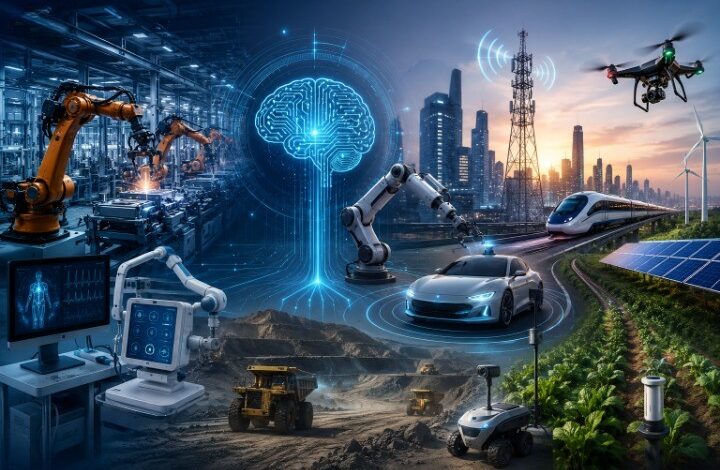
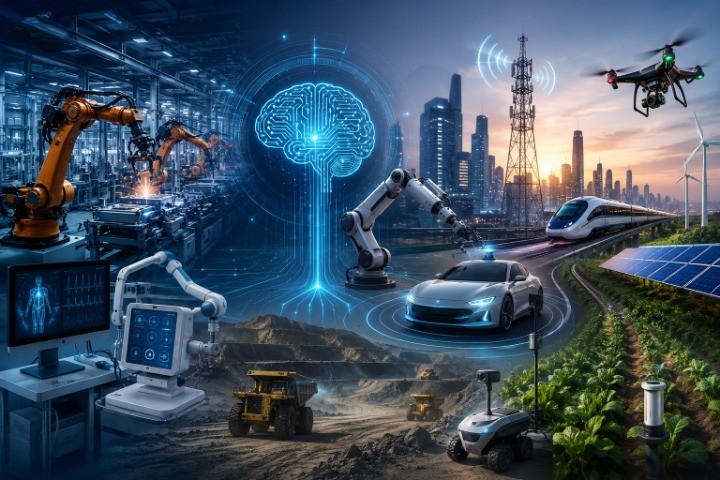
The significance of CPS lies in its ability to connect India’s research capabilities with physical infrastructure and real-world services. Rather than treating AI, robotics, sensors, communications and physical infrastructure as separate technology domains, CPS brings them together into integrated systems capable of responding intelligently to their environments.
The NM-ICPS architecture is designed to support that convergence—from research and talent development to startups, international partnerships, technology validation and commercialisation.
The government’s broader objective is to build indigenous capabilities that can make connected systems more intelligent, secure, accessible and responsive to Indian needs. The backgrounder says wider deployment of indigenous CPS could support smarter infrastructure, more efficient services and new economic opportunities, contributing to a technology-driven, innovation-led and self-reliant Viksit Bharat.
Digital India Times Digest | What is a Cyber-Physical System?
Cyber-Physical Systems are essentially where the physical world meets the digital world. Sensors collect information from machines or environments; software and AI process that information; and connected systems use the results to take action—often automatically and in real time.
The concept extends from autonomous vehicles and smart factories to medical devices, agriculture, mining, smart buildings and critical infrastructure. The NM-ICPS framework seeks to build India’s capabilities across this entire technology chain.