Nano Fertilizer Adoption Surges as Government Pushes Drone-Led Agriculture and Efficiency Gains
New Delhi: The Union government has reported a sharp rise in the adoption of nano fertilizers, alongside a parallel push for drone-led precision agriculture, as part of efforts to improve
Field trials conducted by institutions under the Indian Council of Agricultural Research (ICAR) and state agricultural universities indicate that nano fertilizers can significantly improve nutrient efficiency.

New Delhi: The Union government has reported a sharp rise in the adoption of nano fertilizers, alongside a parallel push for drone-led precision agriculture, as part of efforts to improve nutrient efficiency and reduce dependence on conventional fertilizers.
The information was provided in the Lok Sabha by Minister of State for Chemicals and Fertilizers Anupriya Patel on Friday.
According to the minister, cumulative sales of nano fertilizers have reached 1,593.37 lakh bottles (500 ml each), including 1,219.27 lakh bottles of nano urea and 374.10 lakh bottles of nano DAP.
Significant reduction in urea usage
Field trials conducted by institutions under the Indian Council of Agricultural Research (ICAR) and state agricultural universities indicate that nano fertilizers can significantly improve nutrient efficiency.
Studies show that nano urea applied as a foliar spray, along with standard fertilizer doses, can reduce conventional urea usage by 25–50%, while maintaining comparable crop yields. In some cases, yield gains of 3–8% have been observed.
Similarly, nano DAP trials suggest that up to 50% substitution of phosphorus fertilizers can be achieved in certain crops, such as potato, without compromising productivity.
Government launches research to validate long-term impact
To assess long-term outcomes, the government has initiated multiple research projects.
A Phase-II study with the national productivity council (NPC), launched in November 2025, aims to evaluate the extent of urea replacement, while a five-year network project with ICAR is examining nitrogen use efficiency across different agro-climatic zones.
Officials acknowledged that higher substitution levels (around 50%) may lead to inconsistent results, particularly in low-fertility soils, and said corrective measures are being implemented through standardised application protocols and balanced nutrient usage.
Push for drone-based application
A key component of the strategy is the use of drone technology for precise fertilizer application.
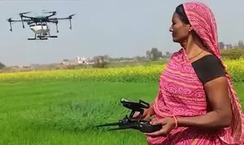
Under the Namo Drone Didi scheme, with an outlay of ₹1,261 crore, the government has facilitated the distribution of 1,094 drones to women self-help groups, including 500 drones specifically under the scheme.
Beneficiaries have been trained at DGCA-authorised training centres to operate drones for spraying fertilizers and pesticides, improving efficiency and reducing labour dependency.
In addition, ₹52.50 crore has been allocated to ICAR under the sub-mission on agricultural mechanisation, through which 297 drones have been deployed and 36,882 field demonstrations conducted, covering over 38,000 hectares.
Awareness campaigns and farmer outreach
To promote adoption, the government has undertaken multiple outreach initiatives.
Nano fertilizers are being promoted through field demonstrations, kisan sammelans, webinars and awareness campaigns, and are being made available through Pradhan Mantri Kisan Samridhi Kendras (PMKSKs).
A nationwide campaign is also underway to promote nano DAP across 15 agro-climatic zones, along with demonstrations of nano urea plus in 100 districts.
Towards sustainable agriculture
Officials said the combined push for nano fertilizers and drone-based application is aimed at enhancing nutrient use efficiency, reducing input costs and improving environmental sustainability.
By integrating advanced inputs with precision technologies, the government is seeking to transition Indian agriculture towards a more efficient, technology-driven and sustainable model.