AI in Education: India Building Talent Pipeline for Global AI Leadership
New Delhi: India is rapidly integrating artificial intelligence (AI) into its education ecosystem to build a strong talent pipeline capable of supporting the country’s ambition to become a global AI
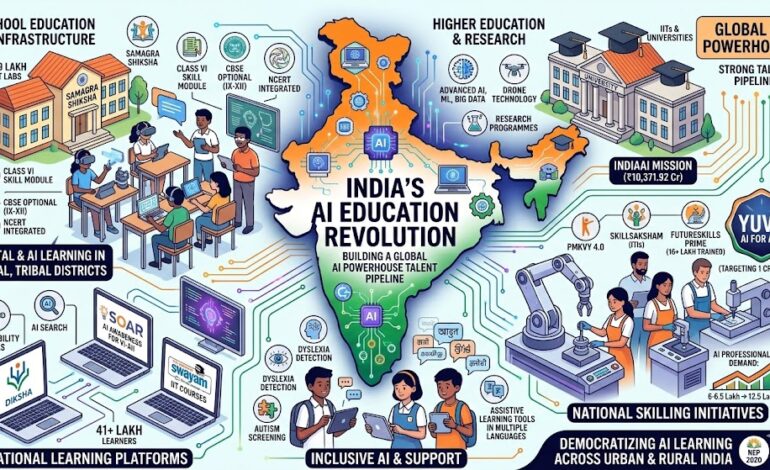
India’s AI education strategy — aligned with the National Education Policy 2020 and the IndiaAI Mission — integrates curriculum reform, infrastructure development, teacher training, research support and national skilling initiatives.

New Delhi: India is rapidly integrating artificial intelligence (AI) into its education ecosystem to build a strong talent pipeline capable of supporting the country’s ambition to become a global AI powerhouse. According to a policy brief released by the PIB Research Unit, the initiative spans school education, higher education, skilling programmes and research innovation.
Growing Demand for AI Talent
India’s AI sector is expanding quickly, with 89% of new startups AI-powered and 87% of enterprises already using AI technologies. The country currently has an estimated 6–6.5 lakh AI professionals, but demand is expected to exceed 12.5 lakh by 2027, reflecting the rapid growth of the sector.
Infrastructure Expansion in Schools
Under the Samagra Shiksha programme, the government has approved over 1.79 lakh ICT laboratories with an investment of ₹7,634 crore, extending digital and AI learning infrastructure to rural, tribal and aspirational districts.
AI learning has been integrated into school curricula through CBSE and NCERT.
- CBSE offers a 15-hour AI skill module starting from Class VI.
- AI is available as an optional subject for Classes IX–XII.
- NCERT has incorporated AI content into computer science and informatics textbooks.
Digital Platforms and AI Learning
Several national platforms are supporting AI learning for students and teachers:
- DIKSHA provides AI-enabled search tools and accessibility features for students and educators.
- SOAR (Skilling for AI Readiness) introduces AI awareness modules for Classes VI–XII and a 45-hour AI training programme for teachers.
- SWAYAM offers 110+ AI courses from IITs and IISc, with more than 41 lakh learners enrolled.
AI in Higher Education and Research
Universities are incorporating advanced AI technologies such as machine learning, big data analytics and drone technologies in undergraduate curricula. Institutions like IITs are also conducting specialised courses and research programmes in AI.
The IndiaAI Mission, launched in 2024 with an allocation of ₹10,371.92 crore, aims to provide computing infrastructure, develop datasets and support AI innovation across sectors including education.
National Skilling Initiatives
A number of national skilling programmes are preparing India’s workforce for AI-driven industries:
- PMKVY 4.0 – AI training with a focus on women’s participation.
- SkillSaksham – AI training in industrial training institutes.
- FutureSkills PRIME – over 16 lakh learners trained in emerging technologies.
- YUVA AI for All – a national programme targeting 1 crore citizens with foundational AI literacy courses.
Inclusive AI Development
AI applications are also being developed to support children with learning disabilities, including tools for dyslexia detection, autism screening and assistive learning technologies in multiple Indian languages.
Conclusion
India’s AI education strategy — aligned with the National Education Policy 2020 and the IndiaAI Mission — integrates curriculum reform, infrastructure development, teacher training, research support and national skilling initiatives. The approach aims to democratise AI learning across urban and rural India while preparing the country to lead in the global AI economy.