TRAI Drive Test Finds Reliance Jio Leading Mobile Network Performance Across Punjab Cities and Rail Corridor
Independent assessment covers Bathinda, Sri Muktsar Sahib and Amritsar-Bathinda railway route; highlights strengths and gaps across operators
The tests, conducted in March 2026 under the supervision of TRAI's Jaipur regional office, evaluated network performance across voice and data services, including coverage, call drops, call setup success rates, download and upload speeds, latency and packet loss.

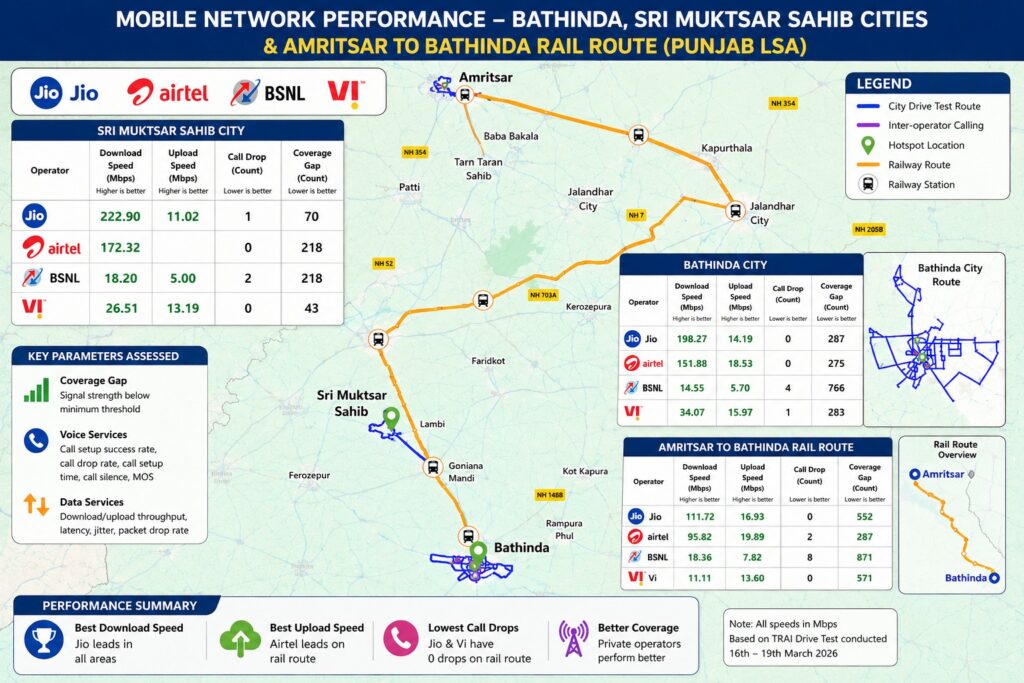
New Delhi: The Telecom Regulatory Authority of India (TRAI) has released the findings of an Independent Drive Test (IDT) conducted across Bathinda, Sri Muktsar Sahib and the Amritsar-Bathinda railway route in Punjab, providing a detailed assessment of mobile network quality offered by major telecom service providers.
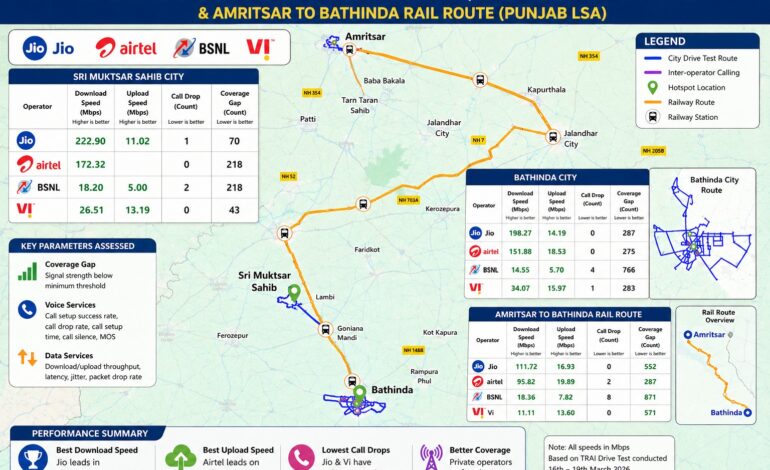
The tests, conducted in March 2026 under the supervision of TRAI’s Jaipur regional office, evaluated network performance across voice and data services, including coverage, call drops, call setup success rates, download and upload speeds, latency and packet loss. The exercise covered 276.8 km of city routes, six hotspot locations and 282.8 km of railway corridors.
Jio records highest download speeds
Reliance Jio emerged as the best-performing operator in terms of download speeds across all three test areas.
In Bathinda city, Jio recorded an average download speed of 198.27 Mbps, outperforming Airtel at 151.88 Mbps, Vodafone Idea at 34.07 Mbps and BSNL at 14.55 Mbps.
In Sri Muktsar Sahib, Jio achieved 222.90 Mbps, followed by Airtel at 172.32 Mbps, Vodafone Idea at 26.51 Mbps and BSNL at 18.20 Mbps.
Along the Amritsar-Bathinda rail route, Jio again led with 111.72 Mbps, ahead of Airtel’s 95.82 Mbps, BSNL’s 18.36 Mbps and Vodafone Idea’s 11.11 Mbps.
Airtel tops upload performance on railway corridor
While Jio dominated downloads, Airtel delivered the highest upload speed on the railway route at 19.89 Mbps, compared with Jio’s 16.93 Mbps, Vodafone Idea’s 13.60 Mbps and BSNL’s 7.82 Mbps.
In Bathinda city, Airtel also led upload performance at 18.53 Mbps, followed by Vodafone Idea at 15.97 Mbps and Jio at 14.19 Mbps.
Voice quality largely satisfactory
The drive test found very low call-drop rates across operators in both cities. In Bathinda, Airtel and Jio recorded zero dropped calls, while BSNL reported four dropped calls and Vodafone Idea one dropped call during testing.
In Sri Muktsar Sahib, Airtel and Vodafone Idea reported no dropped calls, Jio recorded one and BSNL reported two dropped calls.
On the railway route, Jio registered zero dropped calls, Vodafone Idea none, Airtel two and BSNL eight dropped calls.
Coverage gaps remain limited
TRAI’s assessment of coverage gaps—areas where signal strength fell below prescribed thresholds—showed relatively low levels of poor coverage across operators. However, BSNL recorded higher instances of weak signal coverage compared with private operators on several routes.
The regulator said the findings have been shared with telecom service providers for corrective action wherever required. Detailed route maps identifying coverage gaps, dropped-call locations and call-silence instances have also been made available through the complete report.
The drive tests covered major urban localities in Bathinda and Sri Muktsar Sahib as well as key stations and rail segments between Amritsar and Bathinda, including Beas, Jalandhar City, Kapurthala, Sultanpur Lodhi, Lohian Khas, Makhu, Firozpur Cantonment, Faridkot and Kot Kapura.
About the drive test
TRAI conducts independent drive tests periodically to assess the real-time quality of voice and data services offered by telecom operators. The results are published to inform consumers and encourage operators to improve network performance and service quality.