Strengthening Indigenous Manufacturing Capabilities for Strategic Industries and the Evolution of Advanced Manufacturing in India
India’s push to strengthen indigenous manufacturing capabilities is rooted in both economic ambition and strategic necessity. The Government of India has laid out a ten-year roadmap to raise manufacturing’s share
The Government of India has laid out a ten-year roadmap to raise manufacturing’s share of GDP to over 25 percent by 2035.

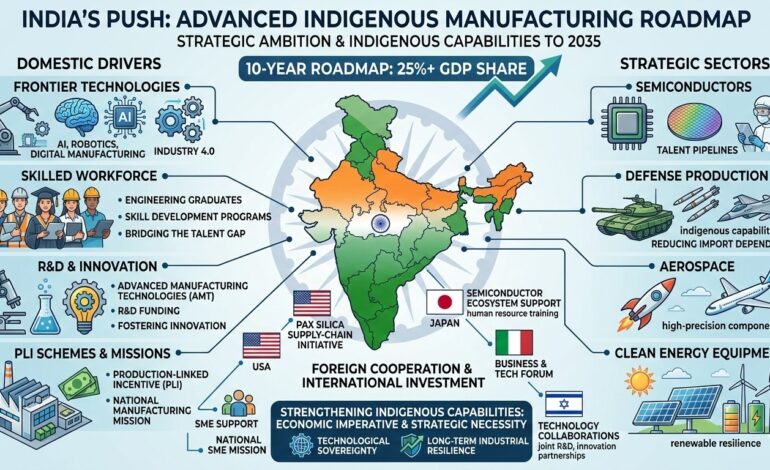
India’s push to strengthen indigenous manufacturing capabilities is rooted in both economic ambition and strategic necessity. The Government of India has laid out a ten-year roadmap to raise manufacturing’s share of GDP to over 25 percent by 2035. This transformation is not limited to expanding output; it is centered on integrating frontier technologies such as artificial intelligence, robotics, advanced materials, and digital manufacturing systems across key industries. By boosting research and development (R&D), infrastructure, and skilled labour, India aims to reduce import dependence and build resilience in strategic sectors including semiconductors, defence production, aerospace, and clean energy equipment. Initiatives such as the National Manufacturing Mission and Production-Linked Incentive (PLI) schemes are designed to attract investment, foster innovation, and anchor high-value manufacturing within the country.
India’s greatest structural advantage in this transformation is its vast human resource pool. As one of the youngest countries in the world, India produces large numbers of engineering and diploma graduates each year. These graduates traditionally flow into sectors such as automotive manufacturing, electronics assembly, aerospace components, heavy industry, and industrial machinery. However, the demands of advanced manufacturing differ significantly from conventional production. High-technology sectors such as semiconductors, advanced materials, precision engineering, and Industry 4.0-driven manufacturing require specialized capabilities that go beyond standard engineering curricula. Despite the large talent base, there remains a shortage of highly trained technicians, process engineers, automation experts, and cleanroom-certified professionals capable of operating in high-precision environments. Bridging this gap is central to the success of India’s manufacturing ambitions.
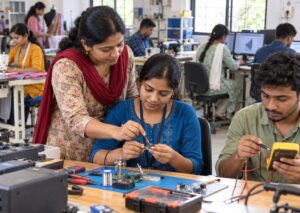
We must significantly expand industry-aligned training systems. This includes hands-on internships, structured apprenticeship models, and scalable reskilling programs that prepare technicians and engineers in process engineering, robotics, AI/ML integration, and high-precision fabrication techniques. The transition toward smart factories and digitally integrated supply chains requires a workforce proficient in automation, data-driven production systems, and advanced materials handling. Stronger collaboration between academia, industry, and research institutions is essential to ensure that curriculum design reflects real-world technological needs. Without sustained investment in skill transformation, India risks remaining competitive in assembly-based manufacturing while falling short in high-value, technology-intensive production.
Recognizing this challenge, the government has launched multiple initiatives to promote advanced manufacturing and innovation. Under the National SME Manufacturing Mission, comprehensive skill development programs aim to train workers in advanced manufacturing techniques and build industry-aligned competencies among small and medium enterprises. SME’s are a backbone for the manufacturing industry. The Department of Science and Technology’s Advanced Manufacturing Technologies (AMT) program supports design innovation, advanced materials processing, and productivity improvements through targeted R&D funding.
India’s strategy also recognizes that indigenous capability does not mean isolation. Foreign cooperation and international investment play a critical role in accelerating technological depth. India’s participation in the Pax Silica supply-chain initiative with the United States and its partners aims to strengthen semiconductor talent pipelines and secure trusted supply chains. Japan has publicly committed support to India’s semiconductor ecosystem, including human resource training and ecosystem development, reflecting deeper bilateral cooperation in advanced manufacturing. Additional platforms such as the India–Italy Business and Tech Forum and emerging India–Israel technology collaborations foster joint R&D, innovation partnerships, and Industry 4.0 linkages.
Together, these domestic programs and global partnerships combine R&D investment, industry-aligned skilling, and strategic cooperation to position India as a competitive hub for advanced manufacturing. Strengthening indigenous capabilities in this way is not only an economic imperative but a strategic one, ensuring technological sovereignty and long-term industrial resilience.

Authored by Smriti Sakhamuri, Executive Director and Board Member at HHV Advanced Technologies Pvt Ltd (HHVAT); views are personal.