India’s Bioeconomy Gets a Push with Tata Chemicals–TERI Centre of Excellence on Biochemicals
New Delhi, September 24: India’s transition toward sustainable biochemical production received a major boost today with the inauguration of the Tata Chemicals Limited (TCL)–TERI Centre of Excellence on Biochemicals. The
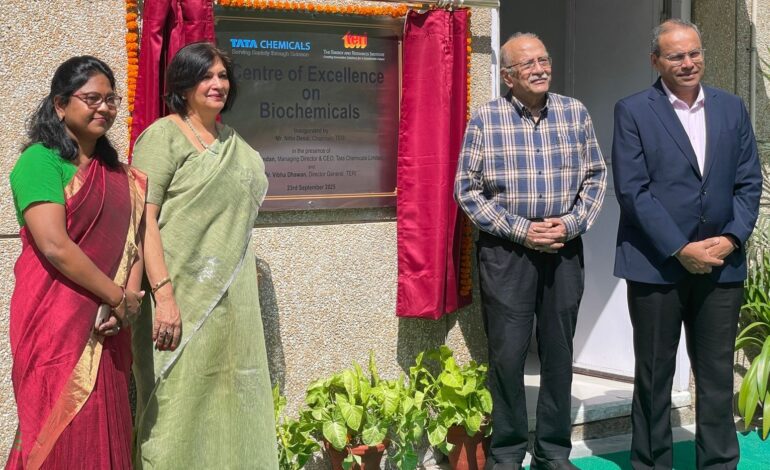
The Centre was formally opened by Nitin Desai, Chairman, TERI; R Mukundan, Managing Director & CEO, Tata Chemicals Limited; and Dr Vibha Dhawan, Director General, TERI.

New Delhi, September 24: India’s transition toward sustainable biochemical production received a major boost today with the inauguration of the Tata Chemicals Limited (TCL)–TERI Centre of Excellence on Biochemicals. The Centre was formally opened by Nitin Desai, Chairman, TERI; R. Mukundan, Managing Director & CEO, Tata Chemicals Limited; and Dr Vibha Dhawan, Director General, TERI.
The jointly established Centre has been conceived to develop cost-effective, innovative technologies for platform and specialty biochemicals from renewable first- and second-generation feedstocks. Equipped with bioreactor facilities across scales and pilot-scale downstream recovery systems, it provides the infrastructure to validate integrated bioprocess technologies at demonstration scale – a critical step toward commercialization. Its initial focus is on demonstration-scale production of 2,3-Butanediol, a versatile platform chemical with applications in plastics, polymers, pharmaceuticals, paints, food additives, rubber, and as a precursor for bio-jet fuel.
Speaking at the inauguration, TERI Chairman Nitin Desai emphasized that India’s chemical industry must move from fossil-based processes to sustainable alternatives if it is to achieve the vision of a US$1 trillion market by 2040 while meeting climate goals. R. Mukundan of Tata Chemicals described the Centre as a “crucible for cutting-edge research, scalable technologies and skilled talent” that will help build a resilient, circular bioeconomy. TERI’s Director General Dr Vibha Dhawan noted that the facility would bridge the gap between lab-scale innovation and commercial-scale production, aligning with the Government of India’s Bio-E³ policy for biotechnology-driven green growth.
India’s chemical industry, currently valued at around US$220 billion and ranked sixth globally, supplies critical inputs for pharmaceuticals, agrochemicals, textiles, paints, and polymers. However, it remains heavily dependent on fossil-based feedstocks, which contribute significantly to greenhouse gas emissions. Biotechnology offers a viable pathway, with fermentation-derived enzymes, metabolites, fatty acids, pigments, and biopolymers already used in multiple industries. Yet, specialty biochemicals like 2,3-Butanediol, propanediol, and succinic acid are not produced commercially in India due to the high cost of downstream recovery.
Aligned with the Department of Biotechnology’s Bio-E³ (Biotechnology for Economy, Environment and Employment) policy, the new Centre will support high-performance biomanufacturing, advance clean biomolecules, and build domain expertise. By fostering public-private partnerships and training skilled professionals, the initiative is expected to accelerate India’s shift towards green chemistry, reduce reliance on fossil feedstocks, and position the country as a global leader in sustainable biomanufacturing.