Regenerative agriculture emerges as a pathway to rebuild soil health, strengthen farm resilience
India is expanding natural farming, agroforestry, micro-irrigation and integrated farming to restore soil health, improve resource efficiency and help farmers withstand climate and market shocks.
About 109 lakh hectares had been brought under the Per Drop More Crop programme by May 2026, while 25.89 crore soil health cards had been generated since the scheme's inception as of March 2026.

NEW DELHI: India is increasingly turning to regenerative agriculture practices to restore soil health, improve farm resilience and strengthen the long-term sustainability of its agricultural systems, even as the sector continues to record strong growth.
India’s agriculture and allied sectors recorded a decadal growth of 4.45% during FY2016-FY2025, the highest across previous decades. However, intensive cultivation, heavy chemical use and increasingly erratic rainfall are putting pressure on soil health, farm productivity and farmer incomes.
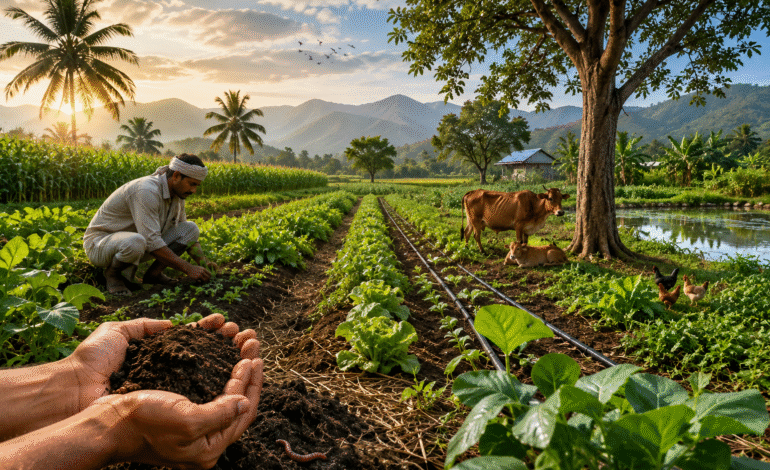
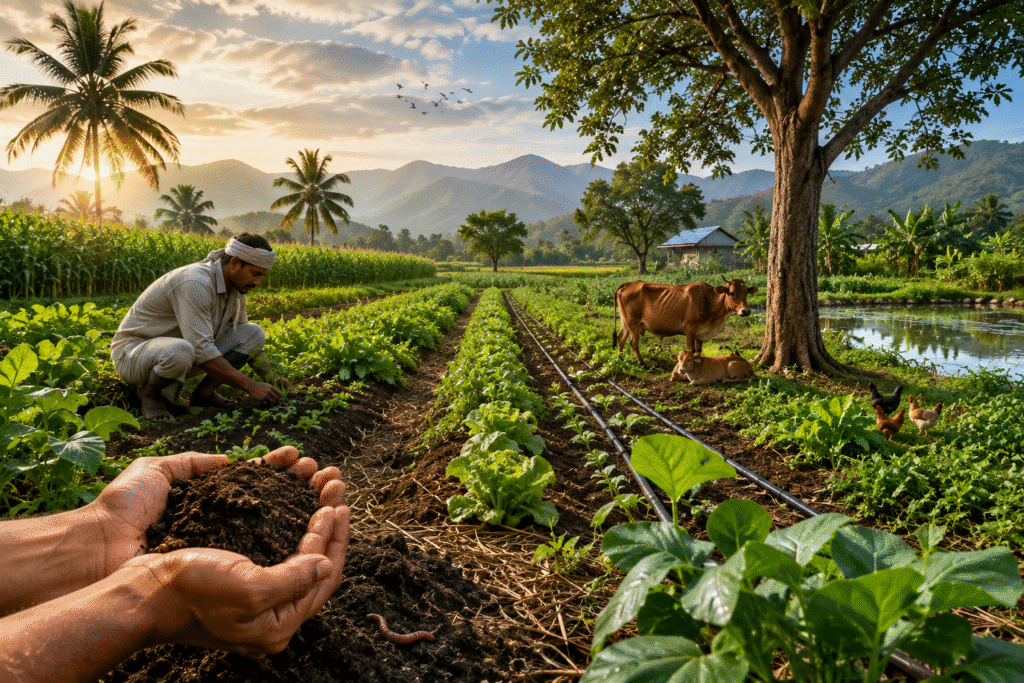
Regenerative agriculture seeks to address these challenges by actively rebuilding soil health, enhancing biodiversity and strengthening ecosystem resilience rather than merely maintaining existing conditions. Its core principles include minimising soil disturbance, protecting living roots of perennial crops, maintaining soil cover, integrating livestock, limiting chemical inputs and enhancing biodiversity.
The approach encompasses a range of practices already being adopted in India, including natural farming, agroforestry, micro-irrigation, integrated farming systems, farm mechanisation, nitrogen fertiliser management and climate-resilient agriculture.
As of March 2026, natural farming clusters covered 8.80 lakh hectares and enrolled 18.19 lakh farmers. About 109 lakh hectares had been brought under the Per Drop More Crop programme by May 2026, while 25.89 crore soil health cards had been generated since the scheme’s inception as of March 2026.
Micro-irrigation systems such as drip and sprinkler irrigation can improve water-use efficiency by delivering water closer to plant roots, while farm mechanisation can reduce wastage of water, fuel and fertilisers through more precise farm operations.
Natural farming, meanwhile, relies on on-farm biological inputs and traditional knowledge systems while promoting practices such as cover cropping, multi-cropping, mulching and minimal soil disturbance. Integrating livestock with diversified cropping systems can further support soil health and reduce input costs.
Soil health management practices such as green manuring, cover cropping and mulching are also central to the regenerative approach. These practices can improve soil fertility and structure, protect against erosion, conserve moisture, support nutrient cycling and encourage beneficial microbial activity.
Integrated farming systems combine crops with livestock, fisheries and allied activities such as horticulture, agroforestry and apiculture. Crop rotation, intercropping, multi-cropping and mixed farming can help diversify farm incomes while reducing the risks associated with crop failure and climate extremes.
Agroforestry adds another dimension by integrating perennial trees with fruit and plantation crops. The practice can provide farmers with additional income while improving soil moisture, regulating local temperatures and increasing carbon storage. It can be particularly relevant in rainfed regions facing unpredictable rainfall and degraded land.
The benefits extend beyond soil and water. Regenerative practices can enhance biodiversity, improve water retention, reduce runoff and erosion, and contribute to climate-change mitigation through greater carbon storage. Economically, healthier soils can reduce dependence on synthetic fertilisers, pesticides and irrigation, potentially lowering input costs and improving farm incomes.
The approach is also aligned with Sustainable Development Goal 13 on Climate Action, particularly Target 13.1, which focuses on strengthening resilience and adaptive capacity to climate-related risks and natural disasters.
Several government programmes are supporting elements of regenerative agriculture. The National Mission on Natural Farming, launched in 2024, provides an output-based incentive of ₹4,000 per acre per year for two years, covering up to one acre per farmer. It also provides for 10,000 need-based bio-input resource centres and the formation of natural farming clusters.
As of March 5, 2026, 18,786 natural farming clusters had been formed across the country, covering 8.80 lakh hectares, with 18.19 lakh farmers enrolled. A total of 33,676 Community Resource Persons had also been trained to support farmers.
The Paramparagat Krishi Vikas Yojana supports organic farming, certification and market access, providing farmers ₹31,500 per hectare over three years. The scheme had covered 16.90 lakh hectares as of October 31, 2025.
Under Per Drop More Crop, the government provides financial assistance of 55% to small and marginal farmers and 45% to other farmers for micro-irrigation systems. The programme had covered about 109 lakh hectares and released ₹26,325 crore in central assistance as of May 2026.
The Rainfed Area Development Programme promotes integrated farming through clusters combining crops with horticulture, livestock, fisheries and apiculture. Since its inception, ₹2,251.98 crore in central assistance has been provided to states for integrated farming systems, covering 9.53 lakh hectares and benefiting 15.73 lakh farmers as of December 2025.
The Agroforestry Component under the Pradhan Mantri Rashtriya Krishi Vikas Yojana supports nurseries and the production of quality planting material. During 2025-26, sanctions of ₹78.31 crore had been issued to 27 States and Union Territories as of October 31, 2025, while 135 new nurseries were established and about 176.59 lakh saplings were raised in 614 existing nurseries.
The Soil Health Card Scheme, launched in 2015, provides farmers with scientific, plot-wise soil assessments covering 12 key parameters and crop-specific recommendations for fertilisers, bio-fertilisers, organic inputs and soil treatments. As of March 13, 2026, 25.89 crore Soil Health Cards had been generated since inception.
The broader shift towards regenerative agriculture is aimed at making Indian farming more resource-efficient, environmentally sustainable and economically resilient. The underlying approach is to begin with healthier soils and build towards more resilient farms and more secure livelihoods.