From Enterprise to Empowerment: How India’s MSMEs Are Driving the Next Phase of Economic Growth
Contributing 31.1% of GDP and employing nearly 39 crore people, India's MSME sector is emerging as the backbone of innovation, manufacturing, exports and inclusive development
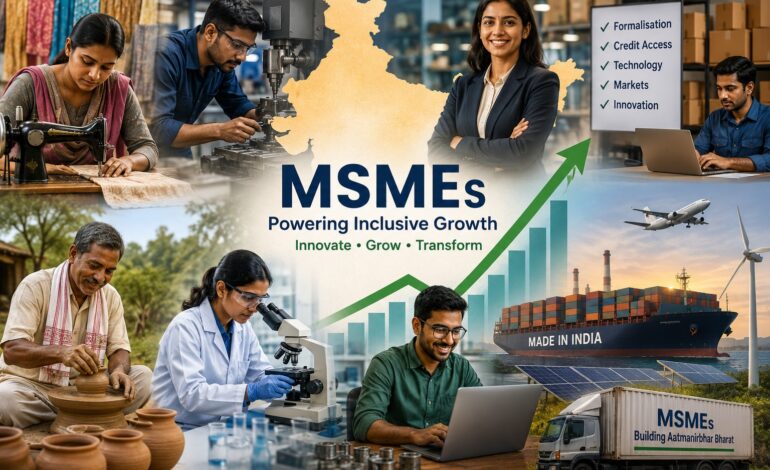
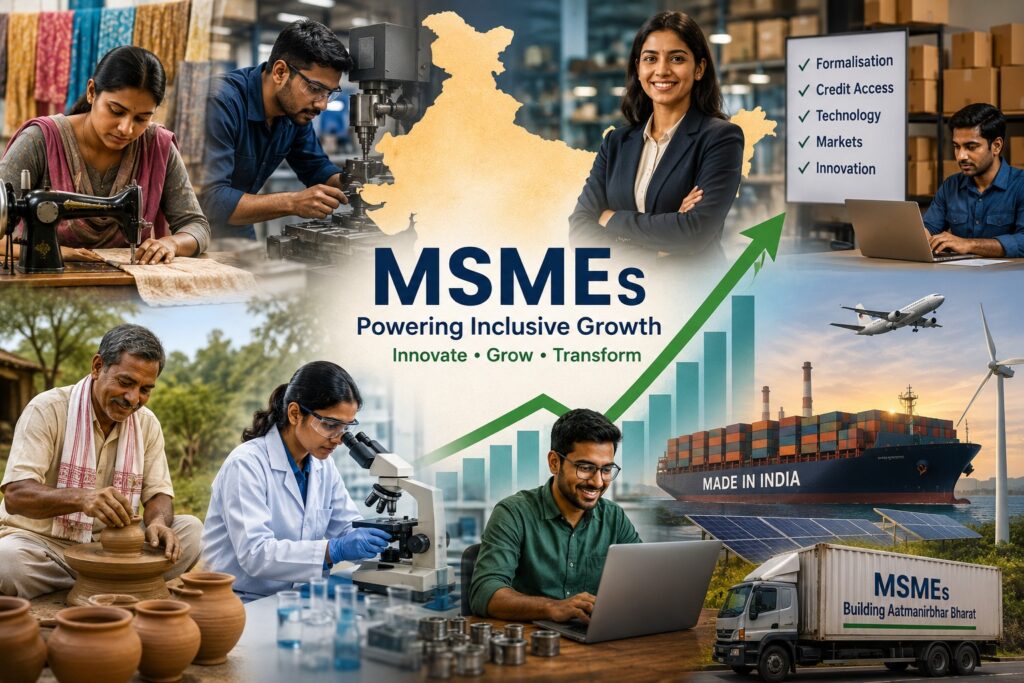
India's MSME ecosystem—from artisans and rural enterprises to technology-driven manufacturers and startups—is emerging as a key driver of inclusive growth, innovation and employment under the vision of Viksit Bharat 2047.

New Delhi: From neighbourhood workshops and rural artisans to technology startups and export-oriented manufacturers, India’s Micro, Small and Medium Enterprises (MSMEs) have evolved into one of the country’s most powerful engines of economic growth.
Ahead of United Nations MSME Day (June 27), a government background paper highlights how sustained policy reforms, digitalisation and improved access to finance are transforming the sector into a key pillar of Aatmanirbhar Bharat and the vision of Viksit Bharat 2047. Today, MSMEs are no longer viewed merely as small businesses—they have become catalysts for employment, innovation, exports and regional development.
A Sector Powering India’s Economy
The numbers illustrate the scale of the transformation.
According to the Ministry of MSME, the sector now contributes 31.1% of India’s GDP, 35.4% of manufacturing output, and 48.58% of the country’s exports. More importantly, MSMEs provide employment to over 38.9 crore people, making them the country’s second-largest source of employment after agriculture.
The government also revised the MSME classification in April 2025 by increasing investment and turnover thresholds, allowing enterprises greater room to grow while continuing to receive policy support.
Formalisation Reaches Record Levels
One of the biggest shifts has been the rapid formalisation of India’s small businesses.
Registrations under the Udyam Registration Portal and Udyam Assist Platform have crossed 8.7 crore, bringing millions of previously informal enterprises into the formal economy. Formalisation has improved their access to institutional finance, government procurement, subsidies and digital services.
Technology has also transformed credit delivery.
The government’s Credit Assessment Model (CAM) enables banks to digitally evaluate MSME loan applications using verified data, significantly reducing processing time. Between April and December 2025 alone, public sector banks sanctioned more than 3.96 lakh MSME loans worth over ₹52,300 crore using the digital assessment platform.
Credit Access Expands
Access to finance continues to be one of the strongest enablers of MSME growth.
The Credit Guarantee Fund Trust for Micro and Small Enterprises (CGTMSE) completed 25 years during 2025-26, while approving 29.03 lakh guarantees worth ₹3.77 lakh crore. The government also doubled the collateral-free guarantee ceiling from ₹5 crore to ₹10 crore, enabling larger businesses to access institutional credit.
Meanwhile, the Self-Reliant India (SRI) Fund has emerged as an important source of equity capital for high-growth enterprises. Supported by an additional ₹2,000 crore allocation in the Union Budget 2026-27, the fund has already invested ₹2,851 crore in 761 MSMEs.
Government Schemes Build Entrepreneurial Ecosystem
Rather than relying on a single programme, the government has developed an ecosystem of complementary initiatives supporting entrepreneurs at different stages of business growth.
The PM Vishwakarma Scheme, focused on artisans and craftspeople, achieved its target of 30 lakh registrations within just two years. More than 24 lakh beneficiaries have completed skill training, while collateral-free loans exceeding ₹5,133 crore have been sanctioned to nearly 6 lakh artisans.
Similarly, the Prime Minister’s Employment Generation Programme (PMEGP) has supported over 10.84 lakh micro-enterprises, generated employment for more than 97 lakh people, and disbursed ₹29,623 crore in subsidies since its inception.
The ASPIRE Scheme continues to promote rural entrepreneurship through incubation centres, training more than 1.23 lakh beneficiaries and supporting the establishment of over 1,000 rural enterprises.
Innovation, Sustainability and Competitiveness
The next phase of MSME growth is increasingly being driven by technology, intellectual property and sustainability.
Under the MSME Champions Scheme, hundreds of incubation centres, design projects and intellectual property initiatives are helping enterprises innovate and commercialise new products. Parallel programmes such as Zero Defect Zero Effect (ZED) certification and the LEAN Manufacturing Scheme are encouraging globally competitive manufacturing with higher productivity and lower environmental impact.
Technology Centres, Common Facility Centres and industrial clusters are also helping smaller manufacturers access advanced equipment and skilled manpower without bearing the full cost of infrastructure.
Beyond Manufacturing
MSME development is increasingly becoming an instrument of social inclusion.
Government programmes now specifically target women entrepreneurs, SC/ST enterprises, artisans, traditional industries, rural businesses and startups.
At the 44th India International Trade Fair, over two-thirds of MSME stalls were allotted to women entrepreneurs, while more than one-third were allocated to SC/ST entrepreneurs, reflecting efforts to broaden participation in enterprise-led growth.
Dedicated programmes such as the National SC-ST Hub, SFURTI, and cluster development initiatives are helping smaller businesses improve market access, productivity and competitiveness across the country.
Building the Foundation for Viksit Bharat
India’s MSME sector is increasingly shaping the country’s long-term economic trajectory.
As manufacturing expands, digital public infrastructure deepens, and global supply chains diversify, MSMEs are expected to play an even larger role in exports, innovation and employment generation.
The government’s emphasis on formalisation, easier access to finance, digital governance, technology adoption and entrepreneurship reflects a broader shift—from supporting individual enterprises to building a resilient, innovation-driven business ecosystem capable of sustaining India’s ambition of becoming a developed economy by 2047.
For More Information
Ministry of MSME
- https://msme.gov.in/
- https://msme.gov.in/sites/default/files/Scheme-booklet-Eng.pdf
- https://msme.gov.in/sites/default/files/MSMEANNUALREPORT2025-26ENGLISH_0.pdf
PM Vishwakarma
Udyam Registration
Udyam Assist Platform
ZED Certification
ASPIRE
PMEGP Dashboard
MSME Day (United Nations)