BHASHINI and NITI Aayog join hands to take multilingual AI into governance
BHASHINI already powers more than 800 government websites and processes over 24 million AI inferences daily, supporting 36 Indian text languages and 23 Indian voice languages.
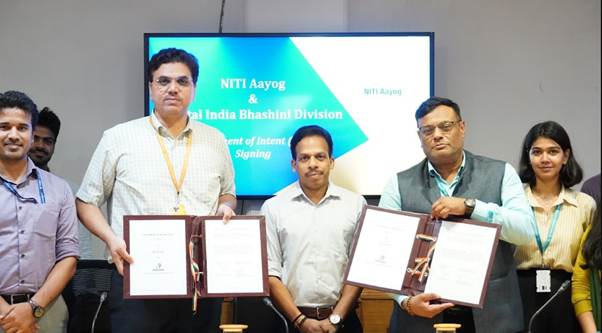
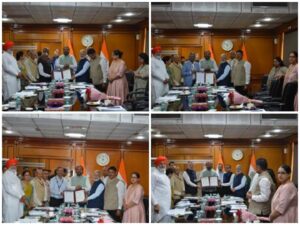
The Statement of Intent was signed by Amitabh Nag, CEO, Digital India BHASHINI Division, and Shoyabahmed Kalal, Director, NITI Aayog, in New Delhi on Wednesday.

NEW DELHI: India is taking another step towards making government services accessible in citizens’ preferred languages, with the Digital India BHASHINI Division (DIBD) and NITI Aayog signing a Statement of Intent to develop multilingual, voice-first artificial intelligence solutions for governance and public service delivery.
The partnership will bring BHASHINI’s multilingual AI ecosystem into NITI Aayog’s digital platforms and services under the BHASHINI for Seva/Sanchalan initiative, with the objective of reducing language barriers between government and citizens.
The Statement of Intent was signed by Amitabh Nag, CEO, Digital India BHASHINI Division, and Shoyabahmed Kalal, Director, NITI Aayog.
The collaboration is intended to make government information and services available in citizens’ preferred Indian languages while strengthening two-way communication between government institutions and the public.
The partnership will cover several components of the BHASHINI ecosystem, including BHASHINI Udyat, BHASHINI Mitra, BHASHINI AppMitra, BHASHINI Sahayogi and BHASHINI Pravakta.
Under the agreement, BHASHINI’s language translation APIs and reference applications will be integrated with NITI Aayog’s digital platforms, document management systems and communication workflows.
The two organisations will also work on improving translation models and developing language technologies capable of handling specialised terminology and sector-specific requirements.
The focus on voice-first technology is particularly significant for citizens who may face difficulties navigating conventional text-heavy digital services.
The collaboration envisages the development of reference applications and voice bots for specific NITI Aayog sectors, potentially allowing citizens and officials to interact with digital services through natural-language interfaces in Indian languages.
The partnership will also use BHASHINI Sahayogi and the BhashaDaan initiative to collect, curate and disseminate linguistic data.
NITI Aayog officials and citizens will be encouraged to contribute text, audio and video samples, helping expand the linguistic data available for developing and improving AI language models.
Another component, BHASHINI Pravakta, will focus on expanding awareness and adoption of BHASHINI tools and services across districts.
Training, technical assistance and supporting resources will be provided to help ensure that multilingual digital services can be used by people with different levels of digital literacy.
The initiative also builds on NITI Aayog’s NITI TARA, or Toolkit for Analysis, Review & Action, which is being used to strengthen data-driven decision-making at the grassroots level.
More than 200 capacity-building sessions have been conducted under NITI TARA, reaching over 4,000 officials from districts and blocks.
The platform uses interactive multi-sectoral dashboards, visualisations and collaborative planning tools to support government reviews, improve coordination between departments and enable evidence-based decision-making.
The two organisations are also working with SMRITI — System for Meeting Recording, Information & Transcription Interface — developed in collaboration with BHASHINI.
SMRITI uses automated meeting transcription and multilingual translation to streamline the preparation of meeting minutes and improve communication across language barriers.
The integration of such tools could make multilingual AI part of routine administrative processes rather than limiting it to citizen-facing translation.
The scale of BHASHINI’s existing ecosystem gives the partnership a substantial technology base to build upon.
According to the government, BHASHINI currently powers more than 800 government websites and has enabled over 9 billion cumulative AI inferences.
The platform processes more than 24 million AI inferences every day and supports 36 Indian text languages, 23 Indian voice languages and 35 international languages.
The numbers underline the scale at which language AI is already being deployed across India’s digital public infrastructure.
The new partnership seeks to take that capability deeper into governance by connecting translation, speech and language technologies with government platforms, documents, communication systems and sector-specific services.
The larger objective is not simply to translate government information.
It is to enable citizens to communicate with government systems in languages they are comfortable using, while allowing government institutions to operate across India’s linguistic diversity.
That could become increasingly important as more public services move online.
Digital public infrastructure can only be truly inclusive if citizens can access and interact with it regardless of their language or level of digital literacy.
The BHASHINI-NITI Aayog collaboration therefore places language AI at the intersection of technology and public-service delivery.
If the planned voice bots, translation tools and multilingual applications are successfully integrated into government workflows, the partnership could provide a model for making India’s expanding digital governance ecosystem more accessible to a linguistically diverse population.
The collaboration is ultimately aimed at making technology less dependent on the language of the interface — and more responsive to the language of the citizen.