India’s skilling push gains momentum across sectors, targets future-ready workforce
Education, healthcare, AVGC and tourism sectors see targeted initiatives to align skills with emerging industry demand
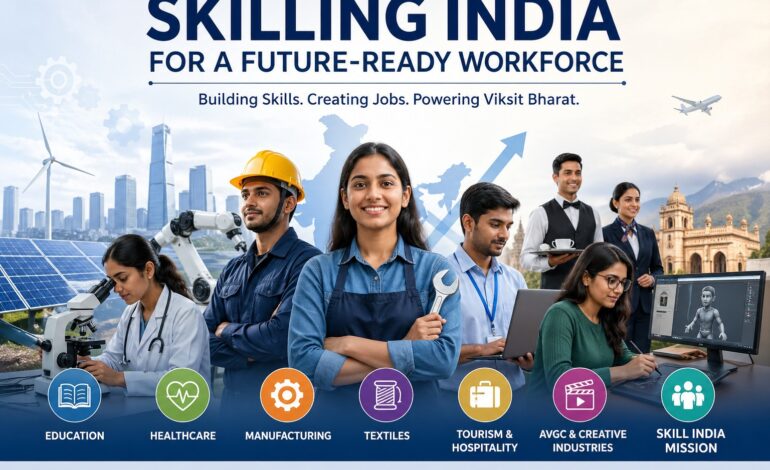
Union Budget 2026–27 integrates skilling across sectors, with major push in education, healthcare, AVGC, tourism and ITI modernisation

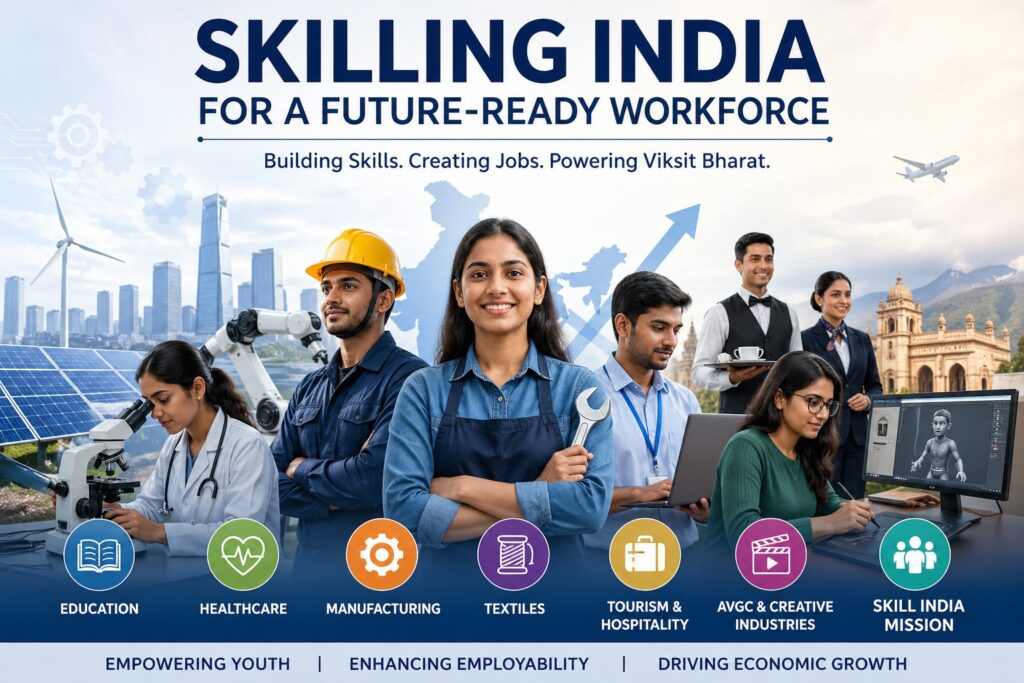
New Delhi: India’s skilling ecosystem is undergoing a structural transformation, with the Union Budget 2026–27 placing skill development at the centre of economic growth, productivity and employment generation.
The Economic Survey 2025–26 highlights that employment-focused skilling initiatives are critical to bridging skill gaps, improving productivity and enabling social mobility, particularly in a country with one of the world’s youngest workforces.
The Budget reinforces this approach by positioning skilling as a cross-sectoral priority, backed by targeted investments in education, healthcare, textiles, tourism, creative industries and emerging technologies.
Education, infrastructure see ₹1.39 lakh crore boost
The education sector has been allocated ₹1.39 lakh crore, marking an 8.27% increase over the previous year. The focus is on expanding access, strengthening infrastructure and aligning curricula with industry needs.
Key initiatives include the creation of five university townships near industrial corridors, establishment of girls’ hostels in every district to improve access to higher education, and development of advanced telescope infrastructure to support scientific research, according to a government release on Wednesday.
Sectoral skilling push across economy
The Budget outlines targeted interventions across sectors:
- Textiles: Expansion schemes, Mega Textile Parks and Samarth 2.0 to modernise the workforce and support MSME clusters
- Healthcare: ₹980 crore phased outlay for allied health workforce expansion, with plans to add 1 lakh professionals and train 1.5 lakh caregivers
- AYUSH: ₹4,408 crore allocation to strengthen traditional medicine systems and global positioning
- Tourism: Upskilling 10,000 tourist guides and establishment of hospitality institutions to bridge academia-industry gaps
- Creative economy (AVGC): Content creator labs in 15,000 schools and 500 colleges to build future talent pipelines
Skill India Mission drives large-scale impact
Flagship programmes under the Skill India Mission continue to expand reach and scale:
- PMKVY 4.0: Over 27 lakh candidates trained across 38 sectors, with new courses in AI, Industry 4.0 and green jobs
- NAPS: More than 54 lakh apprentices engaged since launch, strengthening industry-linked training
- JSS: Over 36 lakh beneficiaries trained, focusing on community-based skilling
- CTS (ITIs): Enrolment increased to 14.7 lakh, with expanded course offerings aligned to industry demand
ITI upgrade scheme to transform vocational ecosystem
The government has launched the ₹60,000 crore PM–SETU scheme to upgrade 1,000 Industrial Training Institutes through a hub-and-spoke model, introducing modern infrastructure, industry partnerships and demand-driven courses.
The initiative also includes capacity expansion of National Skill Training Institutes as Centres of Excellence with global collaborations.
Skilling central to India’s growth narrative
With labour force participation remaining stable and unemployment declining, policy focus is increasingly shifting towards quality employment and productivity enhancement.
The government’s approach integrates skilling with sectoral development, aiming to create a future-ready workforce aligned with emerging industries such as healthcare, digital services, manufacturing and creative sectors.
As India advances towards its long-term economic goals, the evolving skilling framework is expected to play a critical role in translating demographic advantage into sustainable growth.