Telangana’s Fee Reimbursement Crisis: Engineering Graduates Trapped Between Government Dues and College Demands
Unpaid dues running into thousands of crores push colleges into financial stress, while students struggle to secure certificates and jobs Hyderabad: Telangana’s flagship fee reimbursement scheme – designed to support
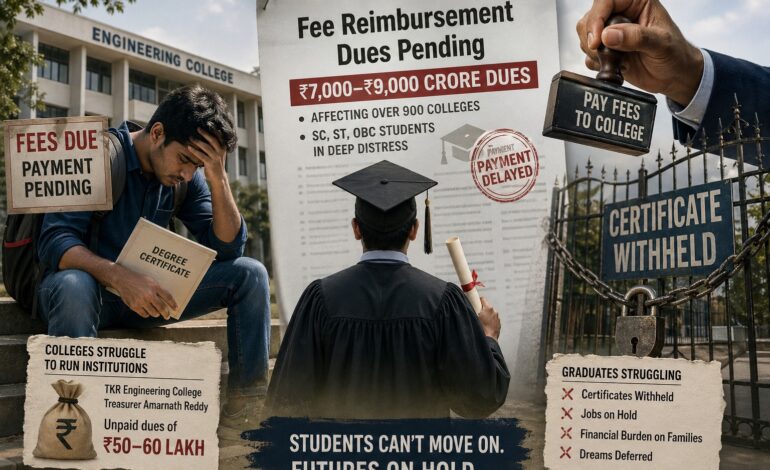
Telangana’s fee reimbursement model, once hailed as a progressive social intervention, is now at a crossroads, leaving thousands of engineering graduates stranded between unpaid government dues and mounting institutional pressure.

Unpaid dues running into thousands of crores push colleges into financial stress, while students struggle to secure certificates and jobs
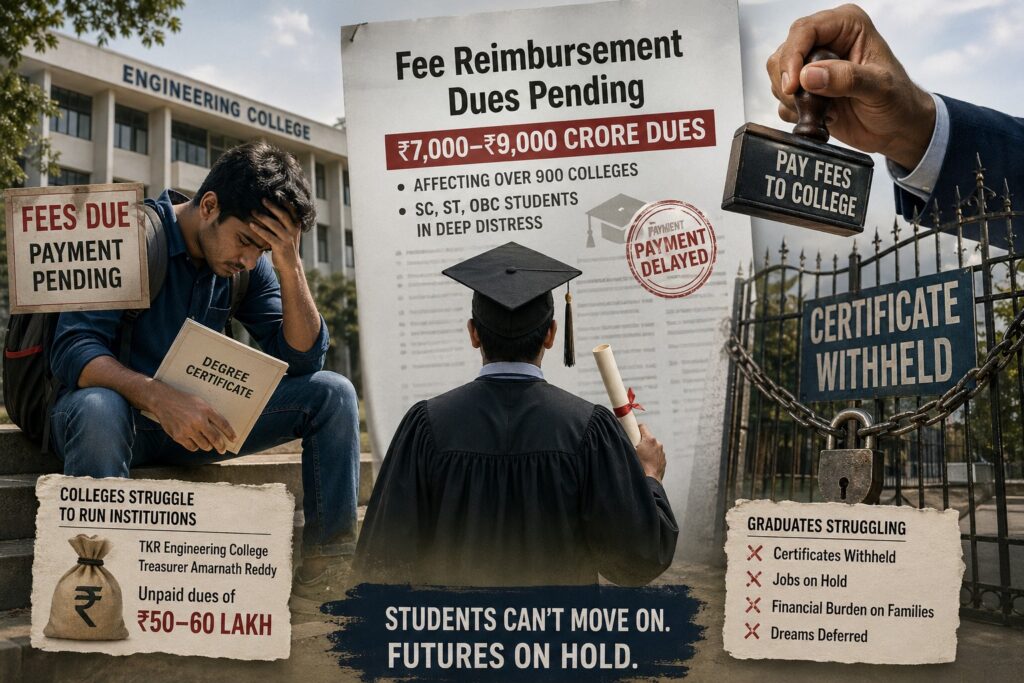
Hyderabad: Telangana’s flagship fee reimbursement scheme – designed to support students from SC, ST, BC, EBC, and minority communities – has entered a deep crisis. What was once a cornerstone of inclusive higher education is now leaving thousands of engineering graduates stranded between unpaid government dues and mounting institutional pressure.
Recent data indicates that fee reimbursement arrears total approximately ₹9,000 crore, affecting over 900 professional colleges across engineering, pharmacy, MBA, law, nursing, and allied streams.
The scale of the crisis is unprecedented. Colleges claim that dues have been pending for over two to three years, severely disrupting both academic ecosystems and student futures.
High Court Intervention: A Turning Point
In early April 2026, the Telangana High Court intervened, granting interim relief to approximately 15 private professional colleges. Justice J. Sridevi permitted these institutions to collect tuition fees directly from students – including those eligible under the reimbursement scheme – from the 2026–27 academic year, citing the government’s prolonged failure to disburse funds.
The court noted that despite repeated adjournments, the state had not filed counter-affidavits or clarified when dues would be cleared. The Special Government Pleader acknowledged that amounts were due but sought more time, citing the ongoing budget session.
While the court clarified that the order is interim and subject to final judgment – with colleges required to refund fees if the petitions are dismissed – the immediate impact has been significant:
- Colleges have begun demanding upfront fee payments
- Students are being asked to submit undertakings to pay if reimbursement fails
- Financial burden has shifted directly onto economically vulnerable families
Ripple Effect: More Colleges Preparing Legal Action
Following the interim order, the Federation of Associations of Telangana Higher Institutions (FATHI) announced that approximately 300 additional professional colleges – including engineering, pharmacy, B.Ed, MBA, MCA, nursing, and law institutions – are preparing to file implead petitions seeking similar relief.
FATHI has held a general body meeting last week to discuss further steps and plans to submit a fresh representation urging the government to resolve the issue without prolonged litigation.
Impact on Colleges: Financial Survival at Stake
Private professional colleges argue that the crisis has pushed them to the brink. Court filings revealed that at least ₹1,500 crore in dues were pending specifically for engineering colleges, with some institutions owed tens of crores individually.
Impact on Colleges: Financial Survival at Stake
Private engineering colleges argue that the crisis has pushed them to the brink.
For instance, TKR Engineering College Treasurer Amarnath Reddy noted that unpaid dues of ₹50–60 lakh have accumulated for the institution alone, affecting its ability to:
- Pay faculty and staff salaries
- Maintain infrastructure and labs
- Meet statutory financial obligations
At the macro level, petitions filed before the High Court revealed that at least ₹1,500 crore in dues were pending specifically for engineering colleges, even in earlier phases of the crisis.
The situation is compounded by the fact that colleges were previously prohibited from collecting fees directly from SC/ST/BC students under government orders—leaving them financially dependent on delayed reimbursements.
Students Bear the Brunt
The most severe impact falls on students who have already completed their degrees or are mid-course.
Thousands of engineering graduates now face a harsh reality:
- Colleges are withholding certificates due to unpaid fees
- Students cannot apply for jobs or higher education without documents
- Families are forced to arrange large sums post-graduation
“We come from families that depend entirely on the fee reimbursement scheme. Asking us to pay lakhs upfront is not just difficult, it’s impossible. This decision could force many of us to drop out,” said a second-year engineering student from Hyderabad, speaking anonymously to Digital India Times.
Fourth-year students face particular uncertainty. “I will complete my course by mid-September, but while leaving the college, I may face problems in collecting my certificate,” said R. Mohan, an engineering student from Warangal.
Student organisations including SFI, the Student Islamic Organisation, and the Association for Socio-Economic Empowerment of the Marginalised (ASEEM) report that some colleges have already informed students that fee reimbursement beneficiaries will not be admitted from the next academic year.
Structural Issues Behind the Crisis
The crisis reflects deeper structural gaps:
1. Budgetary Mismatch Despite budget allocations—including government orders in 2024 with budgetary sanction of around ₹1,500 crore—funds have not been released on time, creating a backlog cycle.
2. Scheme Expansion Without Fiscal Planning The scheme covers lakhs of students across SC, ST, BC, EBC, and minority categories, but funding has not kept pace with scale.
3. Dependency Model Colleges rely almost entirely on government reimbursement for a large segment of their student body, with no fallback during payment delays.
4. Weak Accountability Mechanisms No enforceable timeline exists for fund disbursement. Senior counsel L. Ravichander argued before the High Court that if such outstanding sums were owed by a private party, courts would have taken stringent action against the defaulter.
Ripple Effects Across the Education Ecosystem
The consequences extend beyond immediate stakeholders:
- Admissions Impact: Colleges may reduce intake of reimbursement-eligible students
- Quality Concerns: Financial stress could affect teaching standards and infrastructure maintenance
- Equity Breakdown: The very objective of social justice in education is undermined when the scheme’s beneficiaries face the greatest burden
- Migration Risk: Students may prefer states with more stable scholarship systems
What Happens Next
The Telangana High Court has posted the matter for further hearing on April 30, 2026, with directions to the state to clarify its position on clearing dues.
FATHI chairman N. Ramesh Babu noted that the present order is not final and the state government may still appeal before a division bench. The association plans to meet the government next week while simultaneously pursuing legal remedies.
A Critical Inflection Point
Telangana’s fee reimbursement model, once hailed as a progressive social intervention, is now at a crossroads.
If unresolved, the crisis risks:
- Undermining trust in public welfare systems
- Disrupting the higher education ecosystem across 900+ institutions
- Denying opportunities to the very students it aims to uplift
The challenge is no longer just fiscal – it is about restoring credibility, equity, and continuity in one of India’s most impactful educational support systems.
The matter remains sub judice. This report will be updated as developments unfold.