India to Set Up Space Labs in Colleges as Private Investment Crosses USD 600 Million: Jitendra Singh
₹1,000 crore venture fund, tech support schemes and IN-SPACe push drive rapid expansion of India’s space startup ecosystem New Delhi: India is set to establish space laboratories in universities and
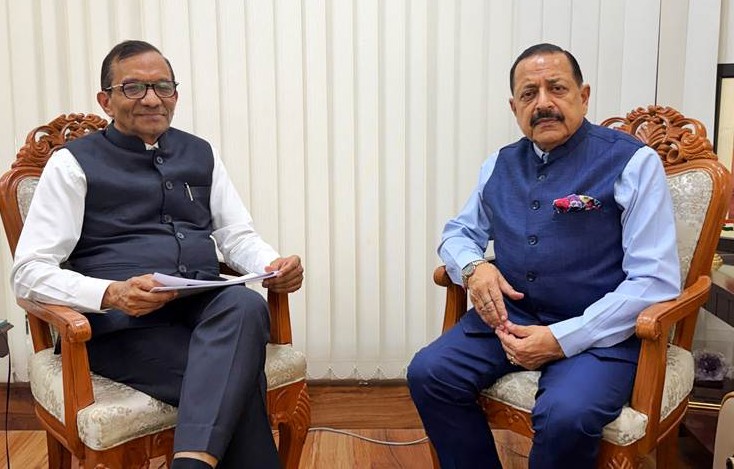
Union Minister of State for Science and Technology Jitendra Singh with Pawan Goenka, Chairman of IN-SPACe, during a review meeting on space sector reforms and the growing role of startups and industry in New Delhi on Sunday.

₹1,000 crore venture fund, tech support schemes and IN-SPACe push drive rapid expansion of India’s space startup ecosystem
New Delhi: India is set to establish space laboratories in universities and colleges to build a future-ready talent pipeline for its fast-growing space sector, Union Minister of State for Science and Technology Dr Jitendra Singh said on Sunday.
Reviewing the plan, the minister said seven space labs will be set up in the first phase, offering hands-on training in satellite systems, rocketry and mission design to students across the country.
The move comes amid rapid expansion of India’s private space ecosystem, which has attracted over USD 600 million in investment over the past five years following sectoral reforms that opened space activities to private players.
The review meeting included a detailed presentation by Pawan Goenka, Chairman of IN-SPACe, who outlined the progress of reforms and the growing role of startups and industry across the space value chain.
India’s space startup ecosystem has expanded from single digits in 2019 to over 400 startups by early 2026, now operating across launch vehicles, satellite manufacturing, ground infrastructure, data services, and emerging in-orbit technologies.
To sustain this momentum, the government is rolling out multiple funding and support mechanisms:
- A ₹1,000 crore venture capital fund, in partnership with SIDBI, to support growth-stage startups
- A ₹500 crore Technology Adoption Fund to help scale early-stage innovations
- A seed fund scheme offering grants of up to ₹1 crore for startups at ideation and prototype stages
The minister said these initiatives are aimed at strengthening India’s innovation ecosystem while enabling startups to transition from concept to commercialisation.
On the skilling front, 17 specialised training programmes have already been completed, certifying nearly 900 participants in areas such as satellite manufacturing, launch systems and space cybersecurity. The upcoming space labs are expected to significantly expand this talent pipeline by integrating practical learning into academic institutions.
Infrastructure support is also being scaled up through initiatives such as a privately led Earth observation satellite constellation, a shared satellite bus platform for startups, and expanded access to testing and integration facilities at the IN-SPACe Technical Centre in Ahmedabad.
India’s global space engagement is also deepening, with collaborations spanning over 45 countries, including recent partnerships with Singapore and the UAE. Indian space startups are increasingly participating in international forums and accessing global markets.
Since its inception, IN-SPACe has received over 1,000 applications from startups, MSMEs, academic institutions and industry, granting 129 authorisations—reflecting growing confidence in India’s reformed space ecosystem.
The minister said the combination of policy reforms, funding support, infrastructure access and skilling initiatives is positioning India as a major global player in the space economy, with strong participation from private industry and academia.