EY–HICA Report Calls for GST Cut on Household Insecticides to Boost Public Health Outcomes
Lower tax rates and improved accessibility seen as critical to tackling mosquito-borne diseases in India Mumbai: A joint report by EY and Home Insect Control Association (HICA) has recommended reducing
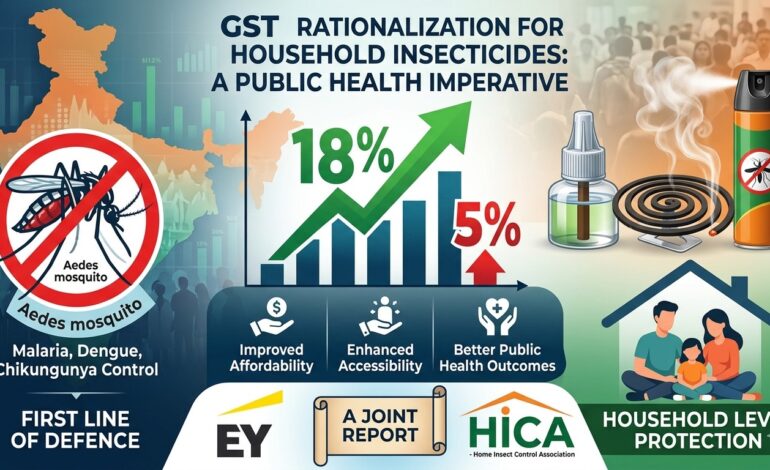
Titled “GST rationalization for household insecticides: A public health imperative,” the report highlights the critical role of products such as liquid vapourisers, coils, and aerosols in preventing vector-borne diseases like malaria, dengue, and chikungunya.

Lower tax rates and improved accessibility seen as critical to tackling mosquito-borne diseases in India
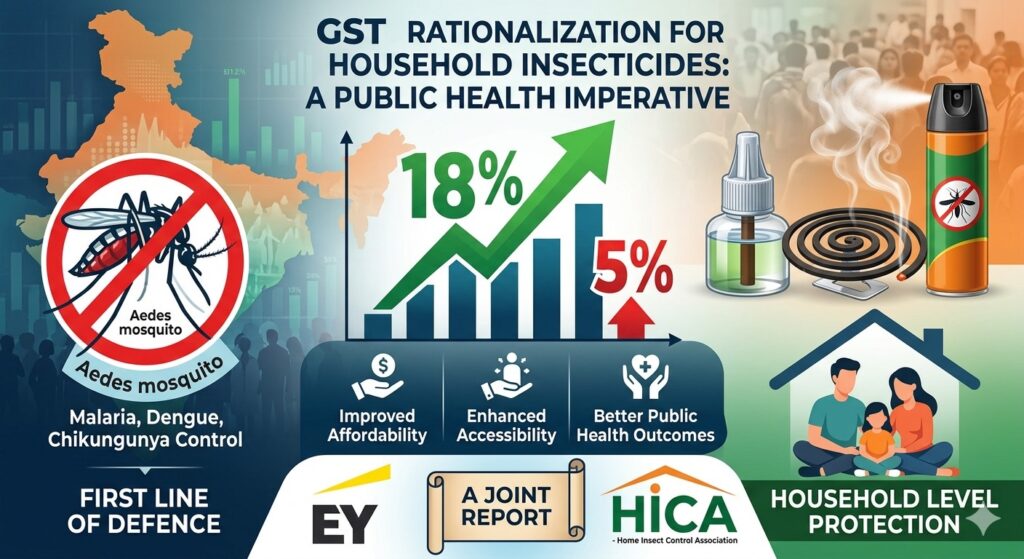
Mumbai: A joint report by EY and Home Insect Control Association (HICA) has recommended reducing the Goods and Services Tax (GST) on household insecticides from 18% to 5%, citing the need to improve affordability, accessibility, and public health outcomes.
Titled “GST rationalization for household insecticides: A public health imperative,” the report highlights the critical role of products such as liquid vapourisers, coils, and aerosols in preventing vector-borne diseases like malaria, dengue, and chikungunya. These products act as a first line of defence at the household level, particularly where large-scale interventions face practical limitations.
The report notes a significant urban-rural divide in usage. While urban penetration of household insecticides stands between 92% and 99%, rural adoption remains lower at 64% to 73%, largely due to affordability constraints. This gap disproportionately impacts low-income households, which are often more vulnerable to mosquito-borne diseases.
Jayant Deshpande, Secretary and Director of HICA, emphasized that high taxation makes essential preventive products less accessible while allowing unregulated players to thrive. He noted that lowering GST could level the playing field, improve consumer safety, and potentially increase government revenues through higher consumption.
The report also flags structural issues within the GST framework, where regulated insecticides face higher tax rates compared to substandard alternatives that are often misclassified under lower slabs. This creates market distortions, encourages unsafe product usage, and leads to revenue leakage.
Bipin Sapra, Tax Partner at EY India, stated that reducing GST to 5% could significantly enhance access to safe and regulated products, especially in high-risk and rural regions. He added that while an inverted duty structure may pose some operational challenges, the public health benefits outweigh these concerns.
The report recommends not only GST rationalization but also a clear classification of household insecticides under the GST framework. Such measures, it argues, would improve affordability, discourage unsafe substitutes, promote formalization of the sector, and strengthen India’s disease prevention ecosystem.
From a policy perspective, improving last-mile access to these products could complement national disease control programmes by reinforcing community-level prevention, particularly in endemic regions.
About EY
EY is a global professional services organization operating across assurance, consulting, tax, and strategy, with a presence in over 150 countries.
About HICA
The Home Insect Control Association, established in 1995, represents India’s domestic insecticide sector and works to promote safe usage and awareness of home insect control solutions.