Govt says revised CBG pricing will have negligible impact on CNG and PNG consumers
The government has clarified that higher CBG procurement prices under the GOBARdhan Scheme will be partly offset by ₹10 per kg support and spread across a gas pool 2.5 to
Under the existing system, the price paid to CBG producers is linked to 85% of the retail selling price of CNG. Based on the latest revision, this translates into approximately ₹1,478 per MMBtu.

NEW DELHI: The Union government has rejected concerns that the revised pricing of Compressed Biogas (CBG) under the GOBARdhan Scheme would place a significant additional burden on CNG and household PNG consumers, saying the impact on individual consumers is expected to be negligible.
In a clarification issued on Saturday, the government said the higher price announced for CBG is primarily intended to provide producers with a stable and viable procurement price, while a government-funded affordability support mechanism and a larger domestic gas pool will limit the impact on consumers.
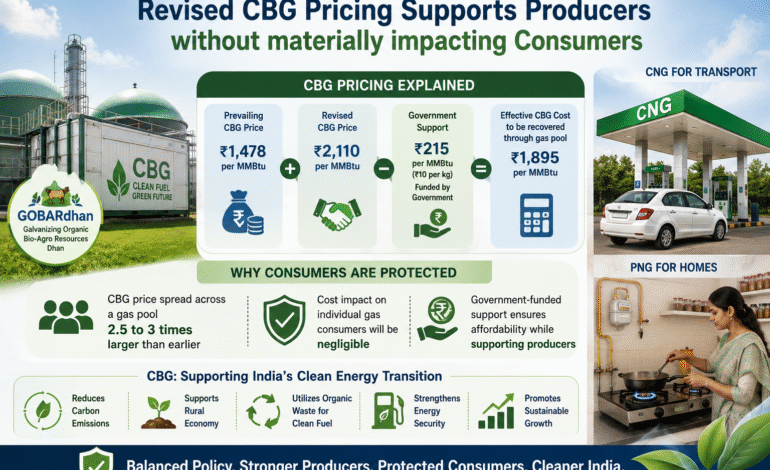
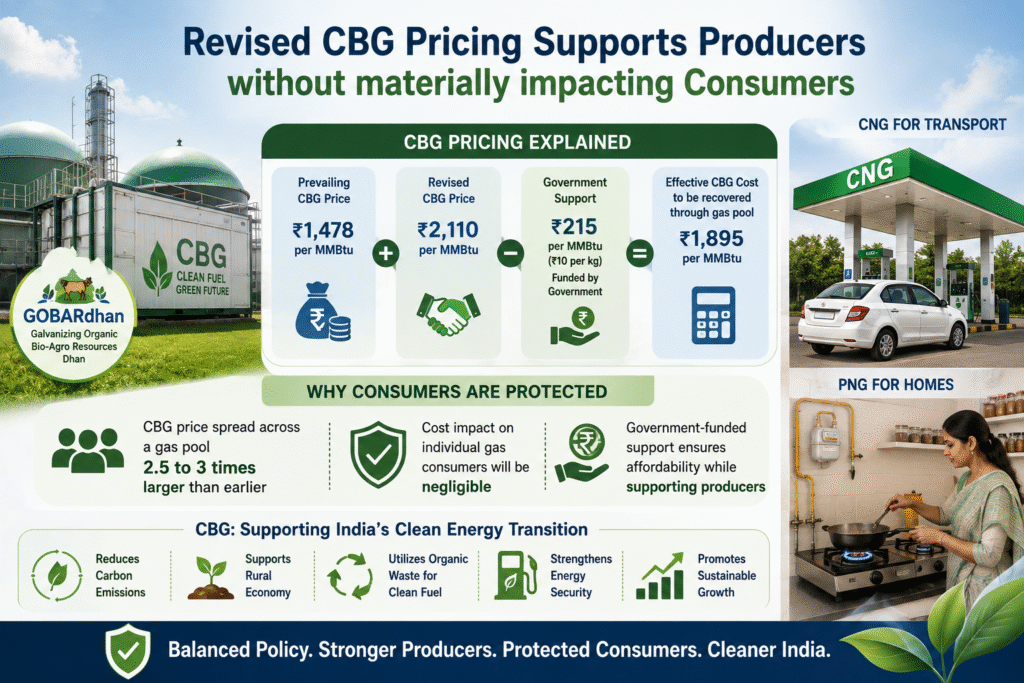
Under the existing system, the price paid to CBG producers is linked to 85% of the retail selling price of CNG. Based on the latest revision, this translates into approximately ₹1,478 per MMBtu.
Under the revised GOBARdhan framework, the procurement price for CBG has been fixed at ₹2,110 per MMBtu, representing an increase of about 43% over the prevailing price.
The government, however, stressed that ₹2,110 per MMBtu is the procurement price paid to CBG producers and is not the price directly paid by CNG or household PNG consumers.
A government-funded affordability support of ₹10 per kg of CBG will also be provided. For CBG containing 95% methane, this support is equivalent to approximately ₹215 per MMBtu.
After accounting for this support, the effective CBG cost to be recovered through the gas system would be approximately ₹1,895 per MMBtu, compared with the prevailing price of ₹1,478 per MMBtu.
This translates into an effective increase of approximately 28%, substantially lower than the headline 43% increase in the procurement price.
The government said another important factor is the manner in which CBG costs are pooled before reaching consumers.
CBG is not sold to City Gas Distribution entities at its procurement price. Instead, it is pooled with other domestically produced natural gas, with the cost distributed across the applicable domestic gas pool.
Under the earlier framework, the cost of CBG was spread across a relatively limited quantity of Administered Price Mechanism gas allocated to the CNG transport and domestic PNG segments.
Under the revised framework, the government said the net cost of CBG will be distributed across a domestic gas base approximately 2.5 to 3 times larger than the earlier base.
The wider pooling mechanism is expected to dilute the impact of the higher CBG procurement price across a substantially larger volume of domestic gas.
As a result, the government said, the increase in CBG procurement costs should not translate into a significant increase in the price paid by individual CNG and household PNG consumers.
The revised framework has been designed to balance producer viability with consumer affordability, according to the government.
For CBG producers, the higher and more stable procurement price is intended to support the sustainable operation of plants and encourage the development of the CBG ecosystem.
For consumers, the government-funded ₹10 per kg affordability support and the expansion of the gas pooling base are intended to prevent the higher procurement price from being passed through as a material increase in retail gas prices.
The clarification comes in response to concerns raised in a recent newspaper article that the revised CBG pricing could significantly increase costs for CNG and household PNG consumers.
The government said that conclusion was based on assumptions that did not account for the affordability support and the substantially wider gas pool under the revised framework.
The pricing changes are part of the government’s broader effort to support the development of compressed biogas as a renewable fuel while maintaining affordability for consumers of domestically supplied gas.